
Trader Joe DEX: A Guide to Trading & Yield Farming
Explore the Trader Joe DEX with our in-depth guide. Learn about JOE tokenomics, Liquidity Book, fees, and how to find profitable trades on Avalanche & Arbitrum.
You’re probably looking at trader joe dex for one of three reasons. You want lower slippage on active trades. You want to farm without spraying capital across dead ranges. Or you want a cleaner way to watch what skilled on-chain traders are doing instead of guessing from social posts.
That’s the right lens.
Trader Joe matters because its design is built around where trades happen, not around leaving your liquidity smeared across irrelevant prices. For traders, that can mean tighter execution. For LPs, that can mean more fees from the same capital if the range selection is right. For stakers, it creates a more direct tie between protocol usage and rewards than the usual token incentive loop.
It’s not a magic machine. If you place liquidity in the wrong bins, chase noisy wallets, or ignore interface risk, you can still lose money efficiently. But if you understand the mechanics, Trader Joe gives you better tools than many general-purpose DEXs.
Your In-Depth Guide to the Trader Joe DEX
Most DEX users learn the same lesson the expensive way. A trade looks fine in the quote box, then execution lands worse than expected because liquidity is too thin or too broadly distributed.
Trader Joe was built to reduce that problem on chains like Avalanche and Arbitrum by making liquidity more concentrated and more usable. The platform’s core edge is the Liquidity Book, which groups liquidity into discrete bins rather than using the older full-range AMM design.
That sounds technical. In practice, it changes how you trade and how you provide liquidity.
If you’re swapping, the main question is simple. Can the pool absorb your order cleanly without forcing you through a lot of shallow liquidity? Trader Joe’s structure is designed to help with that. If you’re LPing, the question changes. Can you place capital where volume is likely to hit instead of funding a huge empty curve? That’s where Trader Joe becomes interesting.
A second layer is the token model. JOE isn’t just a governance badge. On the platform’s current design, 100% of Liquidity Book trading fees in USDC go to veJOE stakers, which gives the staking side a direct connection to trading activity rather than a purely inflationary reward loop. That’s one of the few parts of DeFi tokenomics that deserves close attention.
Then there’s the practical edge most articles skip. Trader Joe is fully on-chain. That means traders can study liquidity placement, swap timing, and staking behavior by wallet. The opportunity isn’t only understanding the DEX. It’s learning who uses it well.
Practical rule: Don’t treat Trader Joe like “just another swap venue.” Treat it like a market structure with visible participant behavior.
That distinction matters. On trader joe dex, the edge usually comes from execution quality, range selection, and wallet analysis, not from blindly farming the loudest pool.
What Makes the Trader Joe Liquidity Book Unique
A good way to think about AMM design is this. Traditional liquidity can feel like a wide, shallow river. There’s water everywhere, but not much depth where you need it. Trader Joe’s Liquidity Book is closer to a canal. Narrower. Deeper. More usable where traffic moves.
That difference starts with bins.
Bins instead of broad liquidity spread
Trader Joe’s Liquidity Book AMM organizes liquidity into discrete bins rather than a continuous curve. That structure lets LPs concentrate capital in specific price zones, and it enables zero price-impact trades when an order stays within a single bin’s liquidity depth. For mid-sized trades, the model can reduce slippage by up to 10x compared with some competitors, and stablecoin LPs have shown 15% to 25% higher effective APRs from auto-compounding fees and better capital efficiency, according to QuickNode’s overview of Trader Joe’s Liquidity Book.
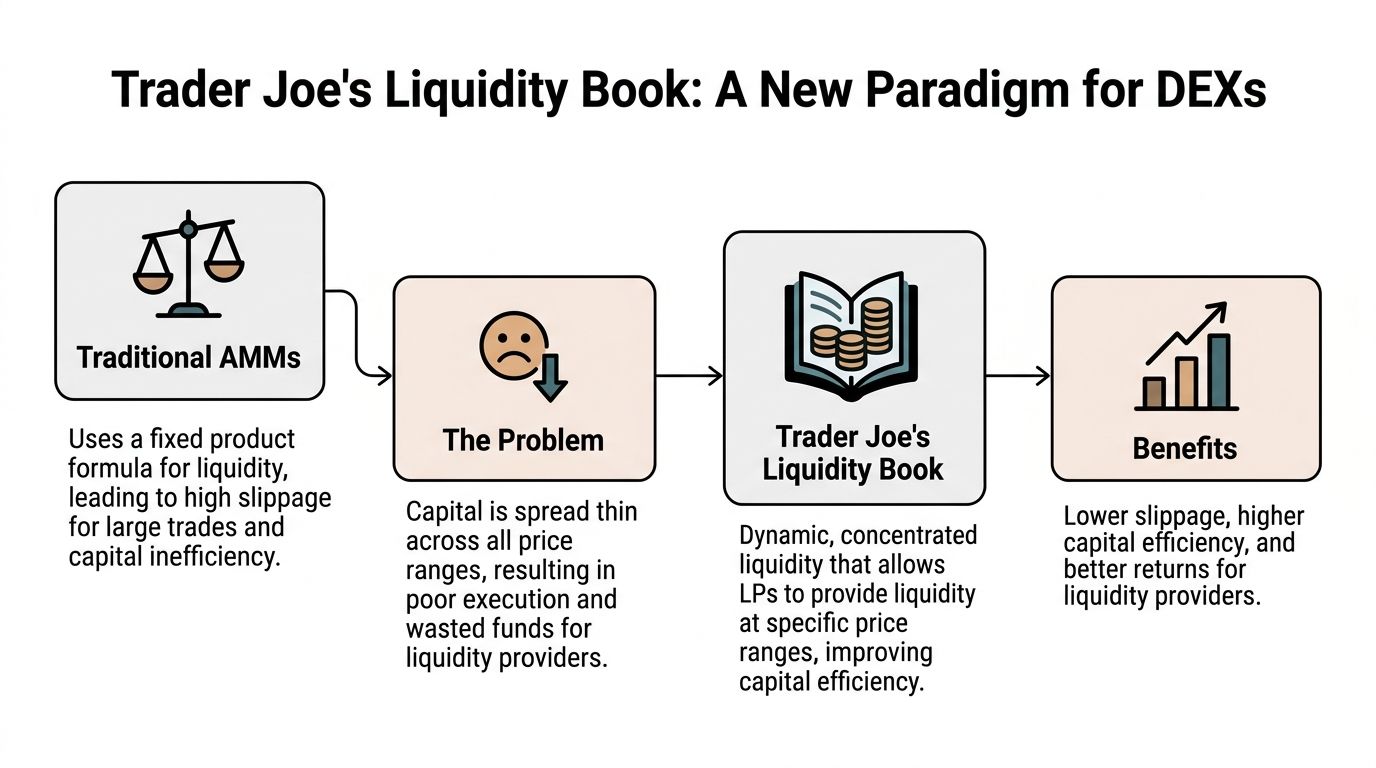
If you’ve used concentrated liquidity elsewhere, that still doesn’t mean Trader Joe behaves the same way. The bin model changes how you think about positioning. You’re not only selecting exposure. You’re choosing where execution quality is likely to be strongest.
For a useful primer on the mechanics behind liquidity pools in general, this guide on crypto liquidity pools is a solid companion.
Why traders care about the structure
For swappers, the immediate benefit is cleaner execution when liquidity is stacked near the active price.
That matters most in these situations:
- Active volatile pairs: You want the order to hit dense local liquidity, not thin reserves across a huge curve.
- Mid-sized directional trades: Sloppy pool design often manifests as avoidable slippage.
- Fast-moving conditions: Concentrated local depth can hold up better than broad passive liquidity.
The mistake is assuming every Trader Joe pool is automatically efficient. It isn’t. The architecture is strong, but pool quality still depends on where LPs choose to sit.
Why LPs care even more
The Liquidity Book gives LPs far more control than passive full-range provision.
That control cuts both ways.
What works
- Placing bins around actual traded zones: If price spends time there, fee capture improves.
- Using asymmetric shapes when you have a directional view: This suits traders who don’t want neutral exposure.
- Revisiting positions after large market moves: Bin placement gets stale fast in trend markets.
What doesn’t
- Setting and forgetting narrow bins in a volatile pair
- Copying ranges without understanding the pair’s behavior
- Providing concentrated liquidity during event risk if you can’t monitor it
Liquidity Book rewards active judgment. It doesn’t reward laziness with better branding.
A lot of LPs underestimate that. Trader Joe makes capital more efficient, but efficiency only helps if the capital is placed intelligently.
The mental model that actually helps
Use this checklist before entering a pool:
| Question | Why it matters |
|---|---|
| Is this pair mean-reverting or trending? | Mean-reverting pairs suit tighter placements better |
| Where is volume likely to cluster? | Fees come from activity, not from elegant theory |
| Can I monitor the position? | Narrow concentration needs more attention |
| Am I LPing or expressing a market view? | On Trader Joe, those can overlap more than people admit |
Start tracking smart money today
Join thousands of traders using WalletFinder.ai to find profitable wallets and copy their trades.
Start Free Trial →

