
Staking vs Yield Farming: The Ultimate Guide
Staking vs yield farming explained. This guide compares risks, returns, and mechanics to help you choose the right DeFi strategy for your crypto portfolio.
When you're figuring out where to put your crypto to work, the staking vs yield farming debate is one of the first you'll encounter. Here’s the simplest way to think about it: staking is like earning interest in a high-yield savings account—it's generally stable, predictable, and lower-risk. Yield farming is like active, high-risk, high-reward investing. You're chasing much bigger returns, but that comes with a lot more complexity and danger.
Understanding the Two Paths to Crypto Earnings
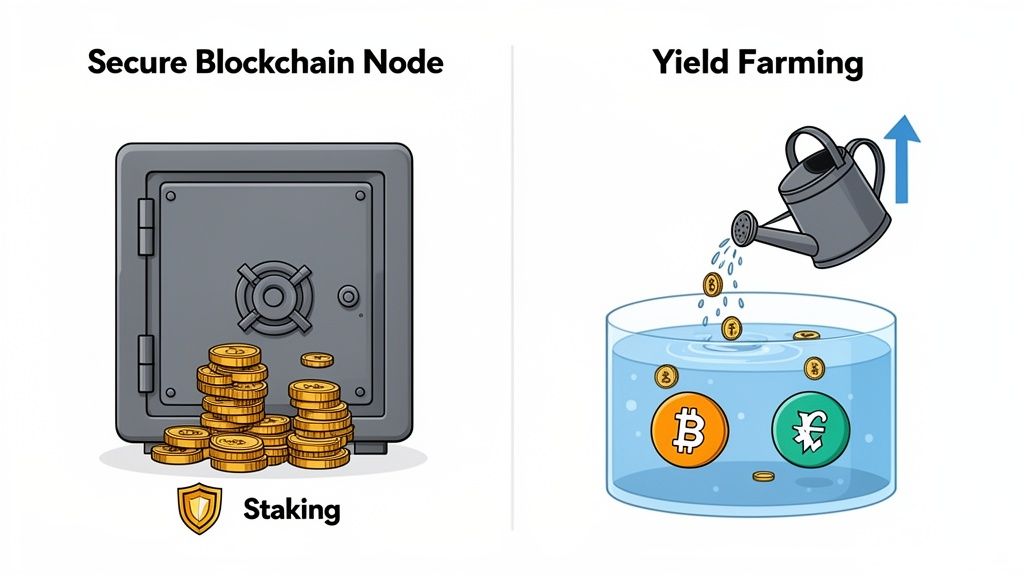
While both staking and yield farming let you generate passive income from your crypto, they come from completely different worlds and are built for different types of investors. Getting a handle on their origins helps explain why their risk and reward profiles are so distinct.
The Foundation of Staking
Staking is the engine that powers Proof-of-Stake (PoS) blockchains like Ethereum, Solana, and Cardano. When you "stake," you're locking up a network's native token to help secure the entire blockchain.
Your locked coins are used by validators to confirm transactions and add new blocks to the chain. The network thanks you for this service by rewarding you with more of that same token. It’s a straightforward deal, perfect for long-term believers in a project who want a low-maintenance way to grow their holdings.
The Rise of Yield Farming
Yield farming exploded onto the scene during the legendary "DeFi Summer" of 2020. This strategy isn't about securing a network; it's all about providing liquidity to decentralized applications (dApps), especially decentralized exchanges (DEXs).
You deposit a pair of tokens into a liquidity pool, which allows other people to trade between those two assets. In return, you get a cut of the trading fees and, often, bonus reward tokens from the protocol itself. This is a much more hands-on process that brings with it way more complexity, risk, and—if you play your cards right—potential reward.
For years, staking has been the reliable choice for steady returns. Ethereum staking, for example, typically offers a predictable 2.02% to 3.5% APY, and Solana stakers can expect somewhere between 5.1% and 9.39%.
Yield farming is a different beast entirely. It drew in hordes of "farmers" with APYs that could shoot past 100%, sometimes even hitting 250% in popular pools. If you're curious about what drives these numbers, you can find a detailed guide on these return differences and the factors behind them.
Quick Comparison: Staking vs Yield Farming
To give you a clearer picture, here's a high-level breakdown of how these two strategies stack up against each other.
Start tracking smart money today
Join thousands of traders using WalletFinder.ai to find profitable wallets and copy their trades.
Start Free Trial →

