
Yield Farming Crypto: A Complete Guide
Discover the secrets of yield farming crypto. This guide breaks down strategies, risks, and how to find profitable wallets to copy for higher returns.
Imagine your crypto isn't just sitting idle in a wallet. What if it could be out there working for you, earning a salary just like an employee? That’s the entire idea behind yield farming crypto. It's a way to put your digital assets to work to generate even more crypto.
You’re essentially lending or staking your funds in various decentralized finance (DeFi) protocols, and in return, you earn rewards.
What Is Yield Farming And How Does It Work
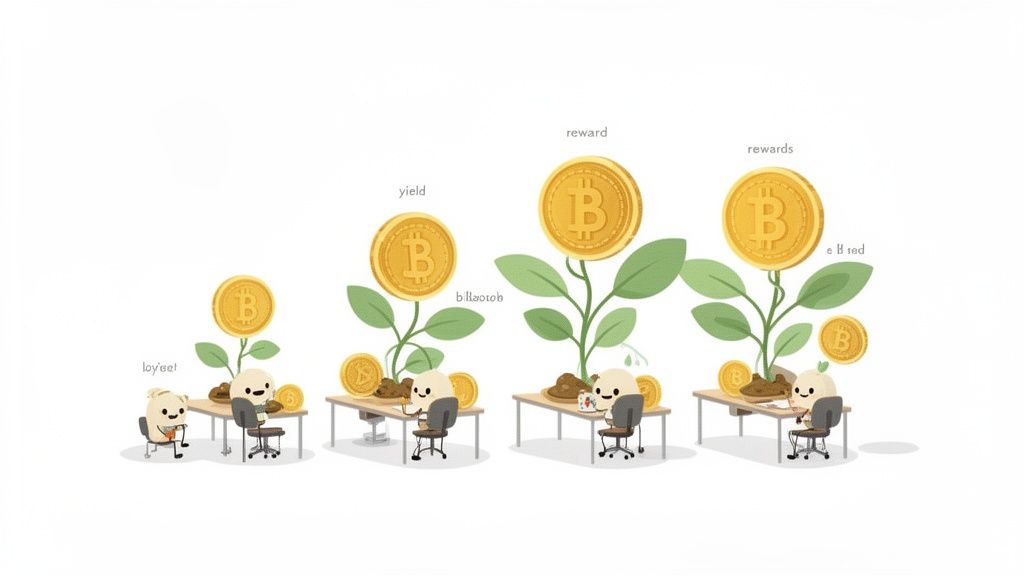
Yield farming is all about strategically putting your crypto to work to squeeze out the highest possible returns. Think of it like a high-yield savings account, but instead of dealing with a traditional bank, you're interacting with a financial system built entirely on the blockchain.
When you start yield farming, you take on the role of a liquidity provider. Your job is to supply your crypto assets to a DeFi protocol. These platforms require massive pools of assets, known as liquidity pools, to operate smoothly. If you want to dive deeper, you can learn all about how these pools power DeFi in our comprehensive guide.
The Core Mechanism
The whole process runs on smart contracts—basically, self-executing code on a blockchain that automatically manages all the funds. When you deposit your crypto, it gets pooled together with assets from thousands of other users. This collective pot of money is then used to enable activities like decentralized trading or lending money to borrowers.
So what's in it for you? For providing this crucial liquidity, the protocol rewards you. These rewards, or your "yield," typically come in a few different flavors:
- Trading Fees: You get a cut of the fees generated from trades happening within the pool.
- Interest: Borrowers pay interest on loans taken from the pool, and a portion of that goes to you.
- Token Rewards: Many protocols issue their own new tokens as an extra incentive for you to participate.
This reward system gives users a powerful reason to supply their capital, which in turn makes the entire DeFi ecosystem more liquid and efficient for everyone.
Yield farming isn't just a way to earn passive income. It's the engine that provides the liquidity needed for decentralized exchanges, lending platforms, and other DeFi apps to function.
The Birth of the Farming Frenzy
So, how did this all start? The concept of yield farming absolutely exploded back in the "DeFi Summer" of 2020. The catalyst was Compound Finance, a lending protocol that started giving out its COMP governance token to users. This one move shot the total value locked (TVL) in DeFi from around $1 billion to over $10 billion in a matter of months.
Early farmers who jumped in were reporting insane triple-digit APYs, sometimes over 100-300%, because they were earning COMP tokens on top of the regular interest for both lending and borrowing.
Yield Farming Core Components
To really get a grip on how yield farming works, it helps to break down the key players involved. Each piece has a specific job to do.
| Component | Role In The Ecosystem | Analogy |
|---|---|---|
| Liquidity Provider (You) | Lends or stakes crypto assets to a protocol. | You're the depositor at a high-yield savings account. |
| Liquidity Pool | A smart contract holding the collective funds. | This is the bank's vault where all the deposits are stored. |
| DeFi Protocol | The platform facilitating transactions (e.g., Aave). | This is the bank itself, setting the rules and interest rates. |
| Rewards (Yield) | Interest, fees, or new tokens paid to you. | These are the interest payments you earn from the bank. |
Start tracking smart money today
Join thousands of traders using WalletFinder.ai to find profitable wallets and copy their trades.
Start Free Trial →

