
CoinMarketCap Yield Farming: A Trader's Guide for 2026
Master CoinMarketCap yield farming. Our guide explains how to find, vet, and analyze pools, interpret APY/risk, and use on-chain tools to mirror top traders.
You’re probably doing the same thing most DeFi traders do when yield gets interesting again. You open CoinMarketCap, sort by eye-popping returns, click a few pools, and try to work out whether any of them are real opportunities or just temporary emissions wrapped in good marketing.
That instinct is fine. The mistake is stopping there.
coinmarketcap yield farming is useful, but only as a discovery layer. It helps you spot categories, tokens, and protocols worth investigating. It does not tell you whether a pool is durable, whether rewards can be dumped, whether smart money is already rotating out, or whether the token you’ll be paid in is collapsing.
The traders who survive in yield farming don’t chase the biggest number on a dashboard. They build a workflow. They use CoinMarketCap to scan, then they switch to protocol docs, block explorers, on-chain activity, and wallet tracking to confirm whether the setup is worth the risk.
What Is Yield Farming and Why Start with CoinMarketCap
Yield farming is the practice of putting crypto assets to work inside DeFi protocols so those assets generate returns. In plain terms, you’re renting out your crypto to a market structure that needs liquidity, lending capital, or both.
Sometimes you deposit a single asset into a lending market. Sometimes you provide a token pair into a DEX pool. In return, the protocol may pay you from trading fees, lending interest, token incentives, or a combination of all three. That’s the attractive part. The ugly part is that your return can change fast, and the headline rate rarely tells the full story.
For newer traders, CoinMarketCap is the obvious starting point because it gives you a familiar interface and broad market coverage. It’s the crypto equivalent of opening a map before you start driving. You can see projects, token categories, and farming-related assets without needing to jump immediately into five different DeFi dashboards.
Why traders begin there
CoinMarketCap is good at a few things:
- Fast discovery. You can identify yield farming tokens, related sectors, and protocols quickly.
- Common language. Most traders already understand market cap, price action, and token pages from using CMC elsewhere.
- Surface-level screening. It helps you build a shortlist before you spend time on deeper research.
That’s useful when the market gets noisy and you need a first filter.
What it isn’t good at is giving you a tradable edge on its own. It doesn’t replace reading reward mechanics, checking release pressure, reviewing contract behavior, or watching wallet flows. If you want a practical base before getting more advanced, this breakdown of yield farming crypto basics is a good companion to keep the terminology straight.
Practical rule: Use CoinMarketCap to find candidates, not to approve positions.
The right mindset
A lot of traders approach yield farming like a savings product. That’s the wrong frame. It behaves more like an active strategy with hidden variables. Your real return depends on entry timing, token volatility, liquidity conditions, and whether the incentives keep attracting sticky capital or just short-term mercenaries.
Start with CoinMarketCap because it’s accessible. Leave it quickly once a pool looks interesting. That’s where the actual work begins.
Navigating CoinMarketCap's Yield Farming Dashboard
CoinMarketCap became a major entry point for DeFi research because yield farming helped drive DeFi from $500 million to $10 billion in market capitalization in 2020, a 20x increase, during the period many traders call DeFi Summer, and Compound’s liquidity mining launch in June 2020 helped pull billions in value into DeFi platforms almost overnight, according to CoinMarketCap Academy’s overview of yield farming.
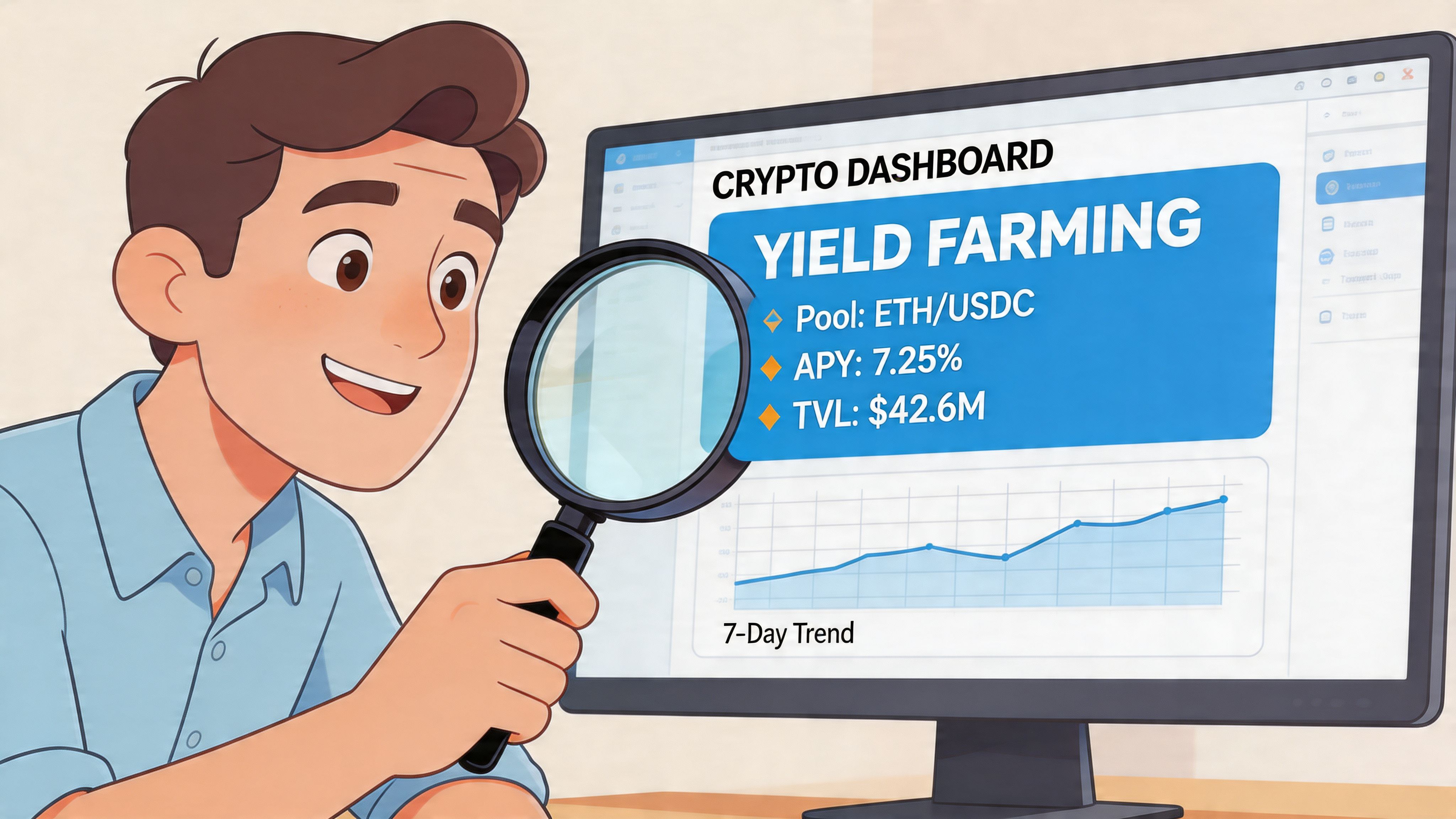
That history matters because it explains why dashboards built around farming data became so popular. Traders wanted one place to compare opportunities without opening every protocol manually. CMC filled that role for a broad audience.
What to look at first
When you land on a CoinMarketCap yield-related page, the first job is to separate discovery metrics from decision metrics.
Discovery metrics help you notice something. Decision metrics help you size a position. CMC gives you more of the first than the second.
Key dashboard elements usually include:
- Token or protocol identity. This tells you what ecosystem you’re looking at.
- Chain context. You need to know whether the opportunity lives on Ethereum or another network because execution costs, liquidity depth, and wallet behavior differ by chain.
- APY displays. These are the attention magnets, but they need interpretation.
- Market data. Price, category, and token page information can hint at how speculative the rewards are.
If you’re rusty on rate terminology, a quick refresher on what APY means in crypto helps because many traders still confuse nominal rewards with compounded outcomes.
How to read APY without getting trapped
An APY number on CMC is not a promise. It’s a snapshot generated from current inputs.
That means three things:
- It can compress quickly when more capital enters the pool.
- It can overstate reality if the reward token falls while you’re farming.
- It can hide execution friction such as slippage, gas, or poor exit liquidity.
A practical way to read APY is to ask what component is driving it. If the return is mostly from protocol emissions, you need to inspect the reward token before you inspect the pool. If the return is mostly from real fees, the setup may be sturdier, though never risk-free.
Here’s a simple lens:
| Dashboard item | What it tells you | What it doesn’t tell you |
|---|---|---|
| APY | Current quoted return profile | Whether rewards hold value |
| Chain | Where the strategy lives | Whether liquidity is deep enough to exit cleanly |
| Token page | Market context and category placement | Whether insiders or top wallets are rotating out |
| Price chart | Recent market behavior | Whether farming economics still make sense after incentives change |
Start tracking smart money today
Join thousands of traders using WalletFinder.ai to find profitable wallets and copy their trades.
Start Free Trial →

