
XBT Price USD: The Trader's Guide to Bitcoin & Alts
Unlock the real meaning of the XBT price USD. Learn the difference between Bitcoin's institutional ticker and a volatile altcoin, and how to profit from both.
Typing "xbt price usd" into a search bar usually leads to bad advice. Most pages assume XBT always means Bitcoin, or they treat every XBT quote as if it refers to the same instrument.
That assumption gets traders into trouble.
There are two very different things hiding behind the same three letters. One is XBT as Bitcoin’s institutional ticker, used on venues such as CME and Kraken. The other is a separate micro-cap altcoin called XBT that has traded at fractions of a cent and shown extreme instability. If you don't separate those two immediately, your pricing model, your risk model, and your execution plan are already wrong.
The practical edge is simple. Institutional desks care about XBT because that label shows up in derivatives, benchmarks, and professional market structure. Speculative on-chain traders care about the altcoin XBT because its price can move violently on thin liquidity and whale activity. Those are different games with different data sources, different liquidity assumptions, and different failure modes.
Most retail content blurs the distinction. A professional process can't. When I evaluate xbt price usd, I first ask one question: Are we talking about Bitcoin market structure, or a micro-cap token? That single filter prevents category errors that ruin otherwise solid analysis.
Introduction
The most popular advice around xbt price usd is to “just check the chart.” That works only if you already know which XBT you're looking at.
In practice, many traders don't.
A quote labeled XBT/USD can refer to Bitcoin under its ISO-style ticker, or it can refer to an unrelated low-cap altcoin. Those are not interchangeable symbols. One sits inside institutional price discovery and derivative hedging. The other behaves like a thinly traded speculative token where sentiment and wallet concentration can dominate price.
That distinction matters because your next action depends on it. If you think XBT means Bitcoin, you'll look at futures basis, exchange liquidity, and cross-venue execution. If you're looking at the altcoin, you should care more about holder concentration, wallet behavior, and whether liquidity can absorb your order at all.
Practical rule: Never trade a symbol before identifying the venue, the contract type, and the underlying asset.
The confusion gets worse because both interpretations can appear in the same search results. One result may discuss institutional Bitcoin pricing conventions. Another may show a micro-cap chart with sharp swings and speculative forecasts. Traders who don't notice the difference often compare prices that should never be compared.
Here's the useful framing:
- Institutional XBT is about Bitcoin pricing in a professional market context.
- Altcoin XBT is about speculative trading in a separate token.
- xbt price usd only becomes meaningful after you identify which market structure you're dealing with.
That’s where the edge starts. The traders who separate naming from market structure make better reads on flow, better decisions on venue selection, and fewer category mistakes when volatility spikes.
Why XBT Became Bitcoin's ISO Ticker and Why That Still Confuses Traders Today
The reason XBT exists as a label for Bitcoin has nothing to do with rebranding or marketing. It comes from a structural problem inside the ISO 4217 standard — the same international framework that gives us USD for the US dollar, EUR for the euro, and XAU for gold.
Under ISO 4217, currencies tied to a specific country start with that country's two-letter code. The British pound is GBP. The Japanese yen is JPY. Assets that are supra-national — meaning they belong to no single country — get a ticker that starts with X instead. Bitcoin fits that definition precisely. It has no issuing government, no central bank, and no national jurisdiction. So under the ISO framework, BTC was a non-starter. The B prefix is reserved for national currencies. The community had already claimed BTC organically, but BTC doesn't fit the standard. XBT does.
Why BTC couldn't just become the official standard
The reason the switch didn't happen cleanly is the same reason most standards battles drag on forever — incumbency. Bitcoin's community adopted BTC long before ISO compliance was a concern, and that abbreviation became embedded across thousands of exchanges, wallets, APIs, news sites, and trading interfaces. Switching a deeply embedded ticker requires coordinated effort across a decentralized system with no central authority to mandate anything. The result is a permanent split: BTC for the retail and community world, XBT for institutional systems, derivatives venues, financial reporting tools, and regulated environments where ISO compliance is a hard requirement.
What this means when you search "xbt price usd"
When someone types that into a search bar, they are almost certainly not thinking about ISO currency codes. They are trying to price an asset. The problem is that the search returns at least two completely different answers — sometimes on the same page. One set of results treats XBT as Bitcoin's institutional ticker and gives you data from CME, Kraken futures, or benchmark composites. Another set shows the altcoin XBIT, which trades on PumpSwap and KCEX at fractions of a cent and has a market cap measured in hundreds of thousands of dollars. Bitcoin Magazine and Paybis both note that Kraken runs a deliberate hybrid model: BTC for spot retail trading, XBT for futures, OTC desks, and API endpoints serving institutional clients. That split is deliberate and useful for Kraken's two very different user bases. For traders unfamiliar with it, the same split produces consistent confusion.
The single most valuable thing you can do before reading any xbt price usd quote is verify which asset and which venue the quote is coming from. Everything downstream of that check — fair value, position sizing, liquidity assumptions, risk controls — changes depending on the answer.
Decoding XBT Bitcoin Ticker vs A Separate Altcoin
Think of BTC and XBT as a common name and a formal name for Bitcoin. Retail exchanges commonly use BTC. Institutional and standardized contexts often use XBT.
According to PrimeXBT’s explanation of the XBT ticker, XBT serves as the ISO 4217 standardized ticker symbol for Bitcoin, and major venues including CME and Kraken use it. That matters because some of the most important institutional flows are quoted, hedged, and discussed through XBT conventions rather than BTC conventions.
The problem is that XBT is also the name of a separate altcoin on crypto data sites. Same letters, different asset.
Why traders get confused
Search behavior causes the mix-up. A trader sees “XBT,” assumes Bitcoin, then lands on an altcoin page. Or they see “XBT/USD” on a professional venue and assume it's some niche token when it refers to Bitcoin.
That confusion isn't harmless. It changes:
- What you think fair value means
- Which exchanges you monitor
- How much slippage you should expect
- Whether on-chain wallet analysis is relevant
- What kind of risk controls belong in the trade
For a good primer on how naming and quote conventions affect interpretation, this guide to crypto trading pairs is worth reviewing.
XBT Bitcoin versus XBT altcoin at a glance
AttributeXBT (Bitcoin's ISO Code)XBT (Altcoin)What it refers toBitcoin under a standardized tickerA separate micro-cap crypto assetPrimary contextInstitutional trading, derivatives, standardized market referencesSpeculative altcoin tradingTypical venuesCME, Kraken, other venues using XBT notationCrypto exchanges tracking the tokenCore driverBitcoin market structure, macro flow, derivatives positioningSentiment, liquidity, wallet concentrationRisk profileDeep global asset, but still volatileMuch higher trading risk due to thinner liquidityMain analytical lensSpot, futures, basis, benchmark pricingHolder behavior, order book fragility, on-chain flow
The decision rule that actually works
Before reading any xbt price usd quote, verify three things:
- Venue context
A CME-style or institutional context usually points to Bitcoin under XBT. - Instrument type
Spot Bitcoin, futures, ETPs, and an altcoin token can all appear under related naming. - Unit sanity check
If the displayed price looks like a micro-cap token, you are not looking at Bitcoin.
If your market data workflow doesn't force an asset identity check before price interpretation, it will eventually feed you a false signal.
That’s the core distinction. Once that’s clear, the rest of the analysis becomes much cleaner.
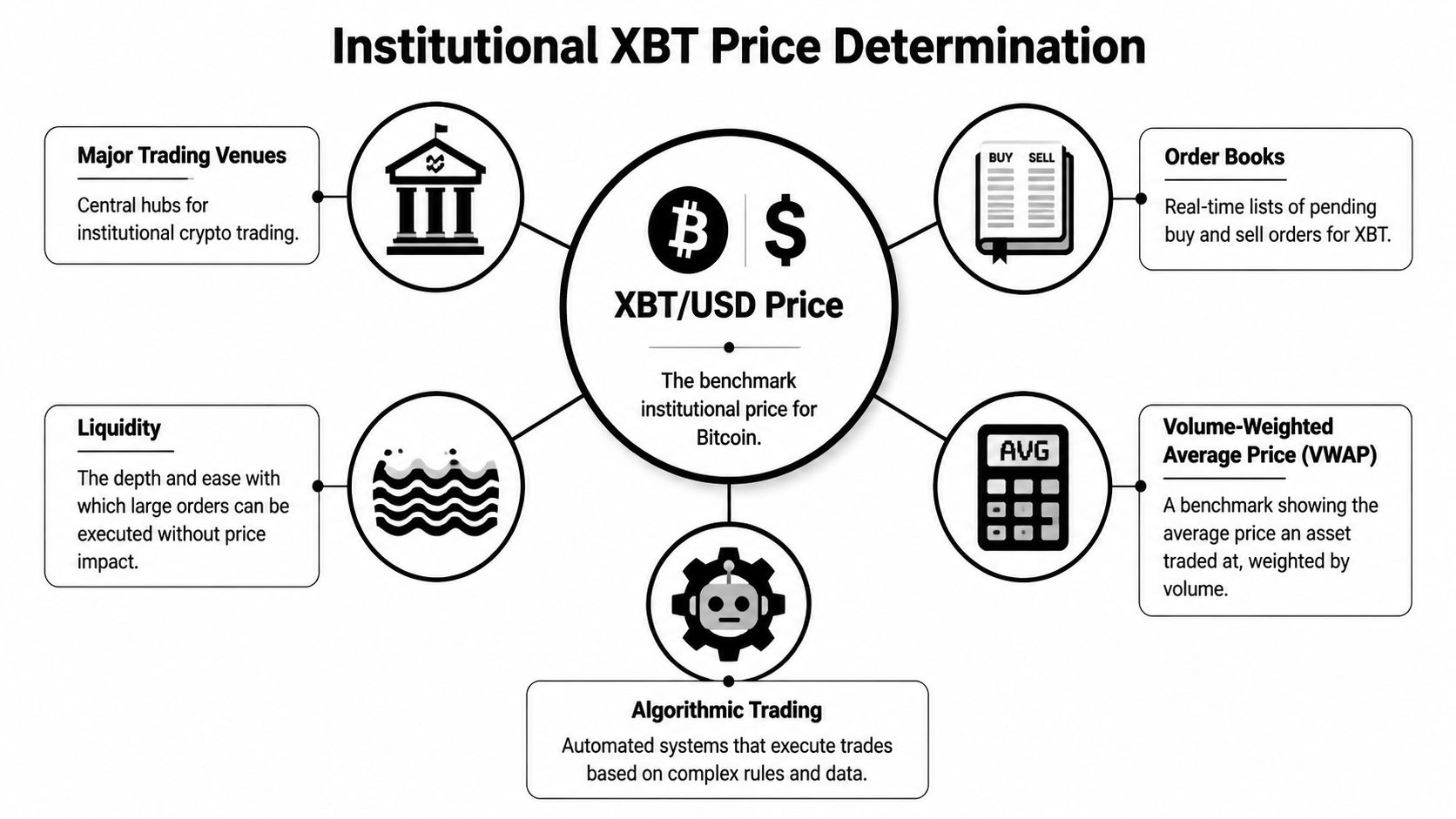
How the Institutional XBT Price USD Is Determined
Institutional XBT/USD is not a single number. It is a pricing stack.
A desk can be looking at spot on Kraken, CME Bitcoin futures quoted under XBT, or a benchmark built from several liquid venues. All three are valid references for Bitcoin, but they answer different trading questions. If you treat them as interchangeable, execution quality drops fast.
Start tracking smart money today
Join thousands of traders using WalletFinder.ai to find profitable wallets and copy their trades.
Start Free Trial →

