
Bitcoin Block Reward: A Trader's On-Chain Guide
Understand the Bitcoin block reward, halvings, and miner economics. Learn to track on-chain signals and trade miner activity for a strategic edge in 2026.
Bitcoin's block subsidy is down 93.75% from its original level after the April 20, 2024 halving, falling from 50 BTC at launch to 3.125 BTC today according to Lightspark's block reward overview. Traders who still treat the Bitcoin block reward as background trivia are missing one of the cleanest structural signals in crypto.
The reason is simple. The block reward isn't just a protocol detail. It changes miner cash flow, shifts the mix between fixed issuance and variable fee income, affects when miners are more likely to hold or sell, and shapes how on-chain analysts should read wallet flows around stress, congestion, and cycle transitions.
For DeFi analysts and copy traders, this matters even if you never touch mining stocks or operate hardware. Miners are among the most structurally important natural sellers in Bitcoin. Their behavior creates recurring pressure points that often show up on-chain before they become obvious in price. If you can read reward composition, fee conditions, and miner wallet movements correctly, you're no longer reacting to headlines. You're reading the supply machine directly.
The topic's usefulness becomes apparent. Not “what is a block reward?” but “what does the current reward regime imply for miner behavior, risk, and trade timing?” That's the difference between textbook knowledge and a tradable framework.
Practical rule: When protocol-level issuance is predictable, edge comes from watching how market participants adapt to it, not from rediscovering the schedule itself.
Introduction From Concept to Actionable Edge
Most Bitcoin explainers stop at the definition. Miners validate blocks, receive newly issued BTC, and the reward halves on a schedule. All true, and not enough for trading.
The edge starts when you treat the Bitcoin block reward as a live economic input. A miner with a lower subsidy has less margin for error. If fees are quiet, treasury management matters more. If fees surge, miners can suddenly earn much more than the base subsidy from the same block. Those shifts influence wallet behavior, pool payouts, exchange deposits, and short-term sell pressure.
For on-chain traders, the useful question isn't whether the reward exists. It's how the current reward structure changes incentives right now. That's especially relevant after the latest halving because the fixed subsidy is smaller, while the fee component can vary sharply with block space demand.
Three practical consequences matter most:
- Miner selling becomes more sensitive to conditions. Lower fixed issuance means miner revenue has less cushion.
- Fee spikes become informational. A high-fee environment can temporarily offset subsidy compression.
- Wallet flow interpretation gets harder. Not every miner transfer means distress, but clusters of miner outflows during weak fee conditions deserve attention.
That's why serious analysts track miner behavior alongside price, open interest, and exchange flows. The block reward is one of the few parts of Bitcoin's economy that is fully programmatic. You know the schedule. You know the base issuance. The uncertainty sits in behavior around it, and that's where trades get shaped.
Bitcoin's Predictable Issuance and Halving Schedule
Roughly every 210,000 blocks, Bitcoin cuts new issuance in half. That single rule changes the daily inventory miners can bring to market and gives traders a supply calendar that few other assets offer.
New coins enter circulation through the coinbase transaction, which pays the miner who produces a valid block. The block subsidy started at 50 BTC in 2009 and steps lower on a fixed schedule written into the protocol. For trading, the practical takeaway is simple. Future base issuance is visible well before it arrives, so analysts can model the shift instead of reacting after the fact.
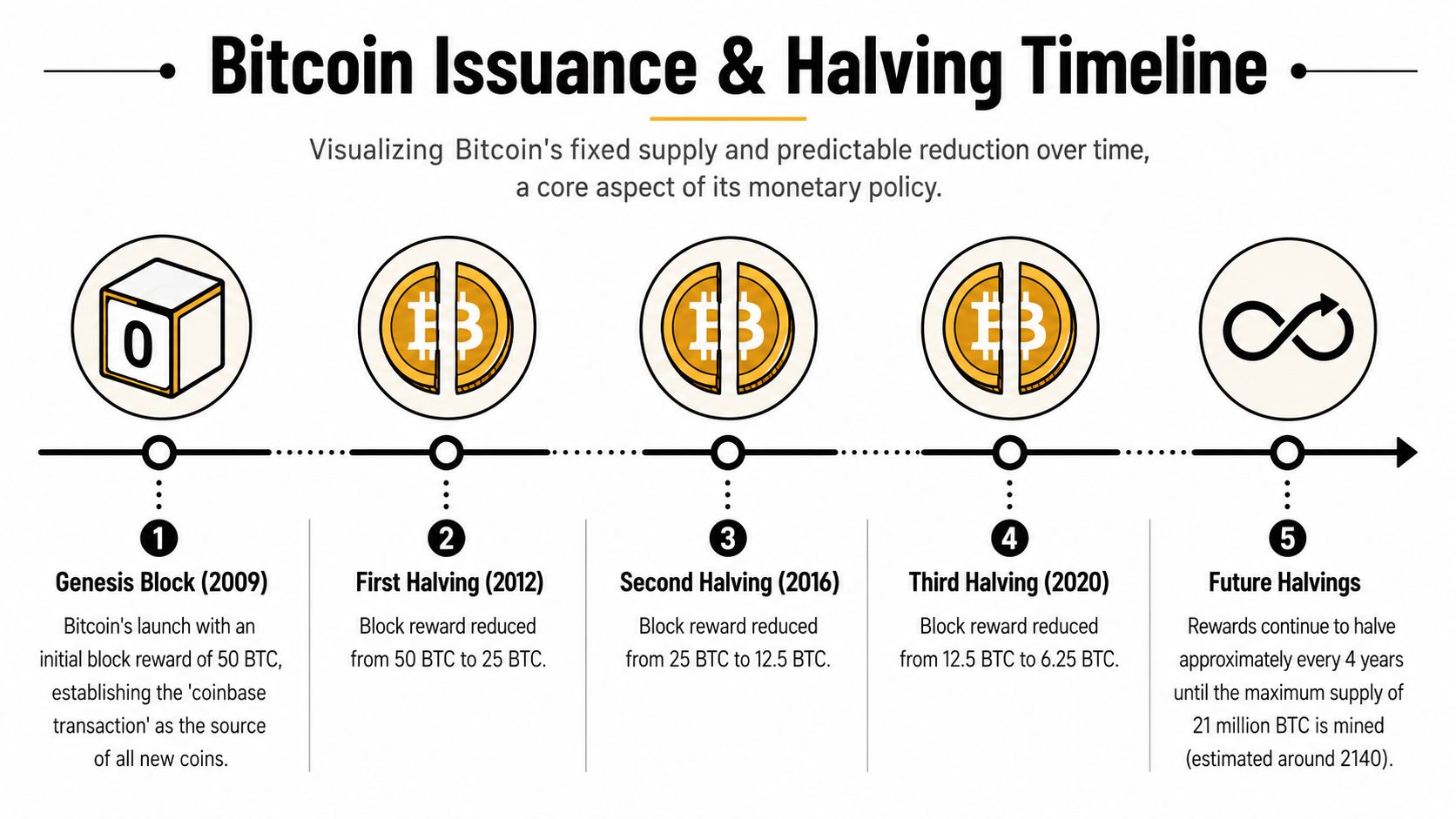
Why traders should care
Predictable issuance does not give a clean price forecast. It does give a clean change in sell-side flow. After each halving, miners receive fewer new BTC from subsidy alone, which means the natural source of fresh supply tightens.
That shift matters most when you connect protocol rules to wallet behavior. A miner running on thin margins after a halving has fewer easy choices. Treasury draws, hedging, payout timing, and exchange deposits start carrying more signal. For DeFi analysts and copy traders, that is the useful frame. The halving is a scheduled supply shock, and the edge comes from tracking how miners adjust around it.
Bitcoin also targets an average block time of about 10 minutes, which is what keeps issuance relatively stable over longer periods even as short-term block production varies. That consistency is why halving dates can be estimated closely enough for positioning months in advance.
History of Bitcoin halvings and block reward reductions
| Halving Event | Date (Approx.) | Block Height | New Block Reward (BTC) |
|---|---|---|---|
| Network launch | 2009 | N/A | 50 |
| First halving | November 2012 | 210,000 | 25 |
| Second halving | July 2016 | 420,000 | 12.5 |
| Third halving | May 2020 | 630,000 | 6.25 |
| Fourth halving | April 20, 2024 | 740,000 | 3.125 |
Start tracking smart money today
Join thousands of traders using WalletFinder.ai to find profitable wallets and copy their trades.
Start Free Trial →

