
Tik Tok Token: A Trader's Guide to Finding Real Alpha
A trader's guide to the "Tik Tok token" landscape. Learn to spot scams, perform on-chain due diligence, and use Wallet Finder.ai to track smart money moves.
A tik tok token starts the same way most bad trades start. You see a familiar brand name, a vertical chart, and a feed full of people acting like you’re already late.
That’s when traders make the expensive mistake. They assume the name means legitimacy, or at least enough attention to keep the move alive. In practice, a branded memecoin can be tradable for a short window and still be structurally awful.
The edge isn’t guessing whether hype will appear. Hype is the easy part. The edge is identifying what kind of “tik tok token” you’re looking at, then deciding whether the setup deserves capital at all.
The Tik Tok Token Pump Is It Real or a Trap
A trader sees “Tik Tok” in the pair name, opens the chart, and the candle already looks stretched. The room goes quiet for a second because everyone knows what happens next. Either you catch a fast momentum move, or you become exit liquidity for people who bought earlier and need your market order to get out.

The confusion is understandable. TikTok has a real economic engine behind its in-app virtual currency. According to Naavik’s analysis of TikTok’s in-app purchase economy, TikTok Coins powered a $6 billion+ economy in 2024. That kind of real consumer spending makes the brand irresistible to speculators and copycat token launches.
That’s why a branded token can feel more credible than it is. Traders see a familiar app, assume some relationship to the platform, and skip the basic checks they’d normally run on any new memecoin.
Why the name matters less than the structure
A token called TikTok Coin, Tik Tok Token, TIKTOK, or any variation of that theme can still be completely unofficial. The name tells you almost nothing about legal affiliation, contract safety, liquidity quality, or holder behavior. It only tells you the launch creator understands attention.
The right first move isn’t buying. It’s classification.
Ask these questions before you even consider an entry:
- What exactly is this asset? A memecoin, a social token, an app currency, or a developer credential.
- Where does it trade? If it’s on a decentralized exchange, contract risk and liquidity risk immediately matter.
- Who benefits from the brand confusion? Usually the earliest holders and deployer-connected wallets.
- What would invalidate the trade fast? Thin liquidity, holder concentration, or suspicious contract permissions.
Practical rule: If the ticker relies on a famous brand for attention, assume higher manipulation risk until the on-chain evidence proves otherwise.
A lot of traders don’t need more token ideas. They need a better pre-trade process. If you want to understand how hype can distort early price action, this breakdown of pump coin price behavior in speculative markets is a useful companion.
Decoding the Three Types of Tik Tok Tokens
Most search confusion comes from one phrase covering three completely different things. If you don’t separate them immediately, you can end up researching the wrong market, using the wrong tools, or worse, trading something you never intended to trade.
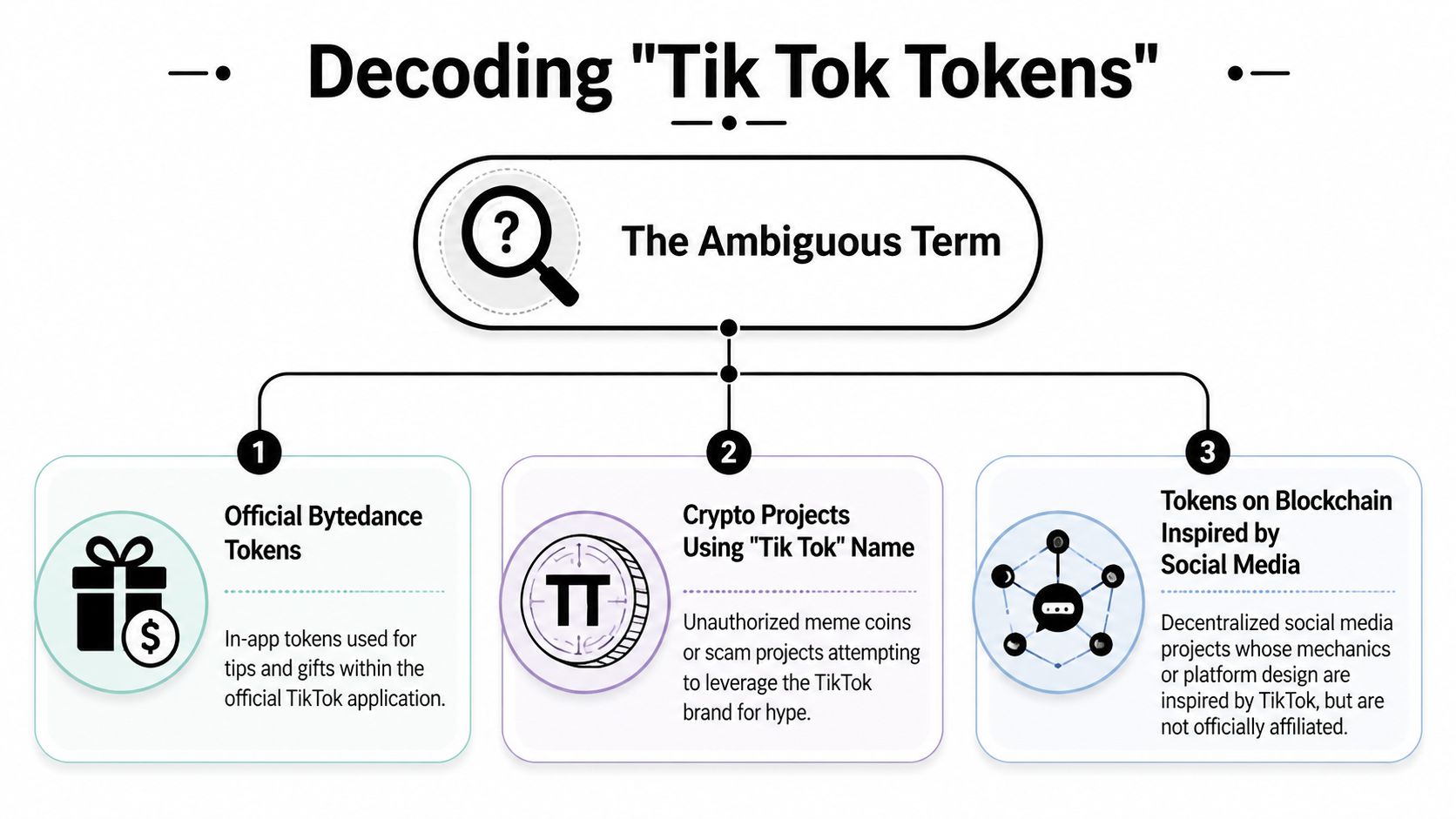
Official TikTok Coins
These are not crypto. TikTok Coins are the platform’s in-app virtual currency used for gifting during LIVE streams and similar in-app interactions. They function inside TikTok’s ecosystem, not on a decentralized exchange.
For a trader, the practical point is simple: you can’t treat TikTok Coins like a memecoin chart. They reflect a centralized platform economy, not an on-chain token market.
Unofficial crypto tokens using the TikTok name
This is the category most traders generally mean when they search tik tok token. These are unofficial blockchain assets that borrow the branding to pull attention, volume, and social speculation.
Some may be straightforward memecoins. Some may be short-lived pump vehicles. Some may be outright traps dressed up as “community” launches. They can still produce tradeable moves, but that doesn’t make them credible projects.
A few things distinguish this category fast:
- They trade on-chain. You’ll find a contract, a pool, and wallet flows.
- They depend on narrative velocity. Price often reacts more to social buzz than utility.
- They require hard due diligence. Contract review, liquidity review, and wallet review matter more than the logo.
Developer access tokens
Many newer users often misunderstand this concept. TikTok’s developer platform uses OAuth 2.0 access tokens for authentication and permissioning. These are technical credentials, not investments.
According to TikTok’s OAuth user access token management documentation, these access tokens manage permissions for apps to read user data and have no monetary value. They exist so developers can authenticate sessions and request approved scopes such as user info or public video access.
If a page talks about refresh tokens, scopes, or token storage, you’re probably reading developer documentation, not researching a trade.
A quick classification test
Use this whenever you encounter a new “Tik Tok token” mention:
| Type | Primary use | Tradable on DEX | What traders should do |
|---|---|---|---|
| TikTok Coins | In-app gifting and virtual spending | No | Don’t confuse platform currency with crypto exposure |
| Unofficial memecoin | Speculation and narrative trading | Yes | Run full on-chain due diligence before touching it |
| OAuth access token | App authentication and permissions | No | Ignore for trading purposes |
Start tracking smart money today
Join thousands of traders using WalletFinder.ai to find profitable wallets and copy their trades.
Start Free Trial →

