
Swarm Node AI: A Trader's Guide to Decentralized Alpha
Explore swarm node AI, the decentralized architecture for on-chain analysis. This guide covers use cases, costs, and integration with DeFi tools for traders.
Most traders don’t need more alerts. They need fewer false positives, faster context, and a way to spot intent before the move becomes obvious.
Swarm node ai becomes interesting here. Not because it’s magical, and not because every “AI agent” pitch in crypto deserves attention. It matters because on-chain trading has become too fragmented for one dashboard, one analyst, or one model to keep up with in real time.
A good trader already watches wallet flows, liquidity changes, token launches, bridge activity, and narrative rotation. The problem is coordination. One signal means nothing without the others. By the time you connect them manually, the trade is crowded.
Swarm systems try to solve that by turning research into a team sport. One agent watches new contracts. Another checks wallet relationships. Another scores behavior that looks like rotation, distribution, or insider accumulation. A fourth writes the summary and flags what deserves action. In theory, that’s the jump from reactive tracking to active discovery.
In practice, it’s powerful, expensive in the wrong setup, and still unreliable in places that matter most.
Beyond Alerts The Hunt for Predictive Alpha
You're already running the standard workflow. Telegram alerts. A few wallet watchlists. DEX activity on one screen, charting on another, and a notebook full of half-finished theses on why a wallet bought one low-cap token before the rest of the cluster moved.
That setup works until it doesn’t. The wall most traders hit isn’t lack of data. It’s lack of synthesis.

The trader who wins early usually isn’t reading more dashboards. They’re combining signals faster. They see a deployer wallet fund a fresh address. They notice related wallets touch the same ecosystem. They catch liquidity placement before the social posts start. Then they act while everyone else is still trying to check on-chain activity.
Where current tooling starts to fail
Classic analytics stacks are good at showing activity. They’re weaker at coordinating interpretation.
A single rules-based alert can tell you:
- A wallet bought a token
- Liquidity appeared on a pool
- A contract was deployed
- Funds bridged into a chain
It usually can’t tell you whether those events belong together, whether they fit a known wallet pattern, or whether the setup looks more like accumulation than noise.
That’s the promise behind swarm node ai. Instead of one model trying to do everything, you split the work across specialized agents. The result isn’t just another alert feed. It’s a research layer that can keep context alive across many moving parts.
Practical rule: If your workflow still depends on you manually cross-checking every alert against wallets, pools, and transaction history, you don’t have an intelligence system. You have an inbox.
Why Traders are Attracted
The attraction isn’t automation by itself. Plenty of automated systems just create automated garbage.
What matters is whether the swarm can produce a tradable output such as:
- a shortlist of wallets behaving like early winners in a new narrative
- a probability-ranked watchlist of fresh tokens worth manual review
- a live thesis update when a tracked cluster starts rotating sectors
- a cleaner distinction between random buys and coordinated positioning
That’s where swarm node ai starts to move from marketing phrase to useful trading primitive. But only if the architecture, costs, and failure modes are understood first.
What Is Swarm Node AI Explained
The cleanest way to understand swarm node ai is to stop thinking about one super-bot and start thinking about a colony.
A colony doesn’t have one worker doing everything. It has roles. One part scouts. Another transports. Another defends. The colony works because each unit handles a narrow job, then the combined behavior produces something bigger.
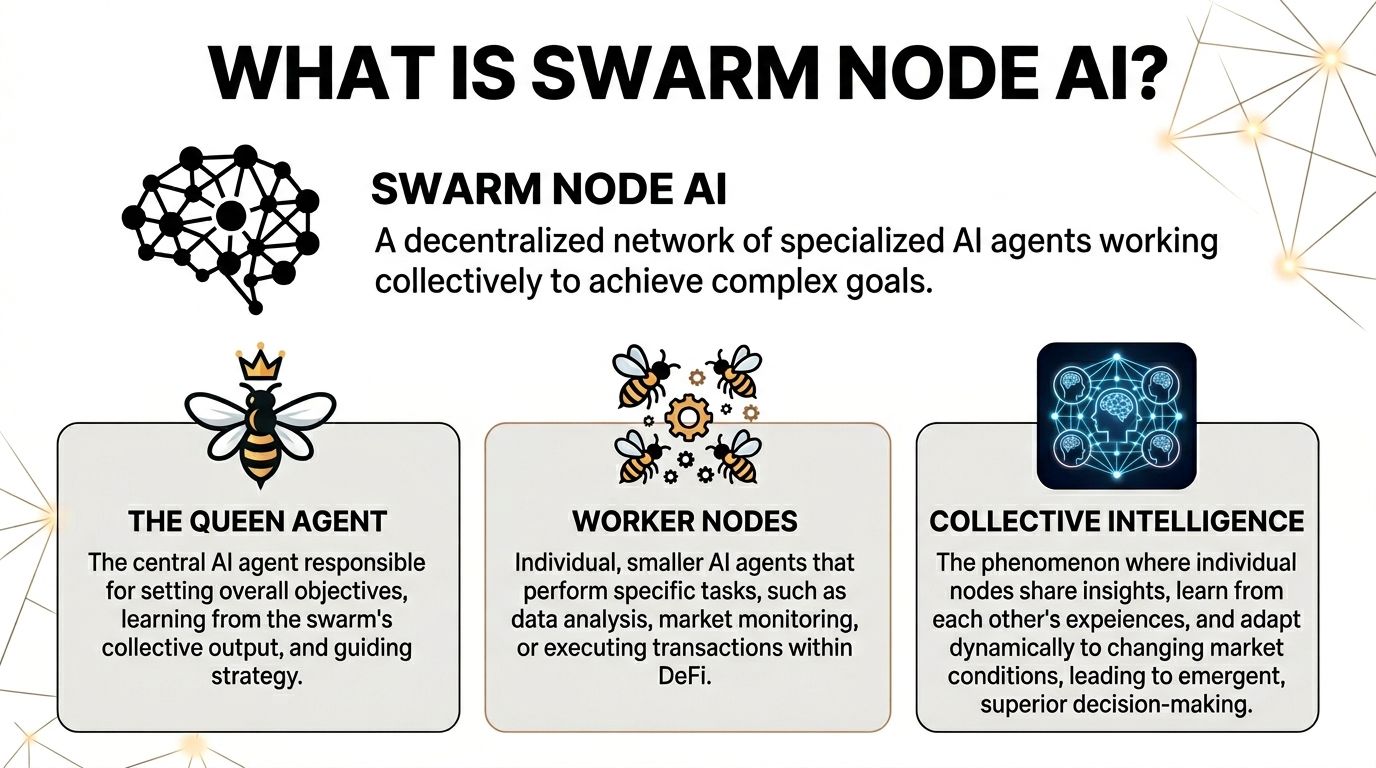
In trading terms, that colony model fits on-chain research well.
The colony analogy: A Useful Framework
Think of a swarm as three layers.
| Layer | What it does in plain English | DeFi example |
|---|---|---|
| Queen agent | Sets the objective and assigns tasks | “Find early signs of a token launch worth watching” |
| Worker agents | Handle narrow sub-tasks | One scans contracts, one checks wallet ties, one reviews liquidity behavior |
| Shared memory | Holds what the swarm learns | Wallet labels, suspicious addresses, prior token interactions, thesis notes |
Start tracking smart money today
Join thousands of traders using WalletFinder.ai to find profitable wallets and copy their trades.
Start Free Trial →

