
Staking in DeFi: An Ultimate Guide
Discover how staking in DeFi works, from basic concepts to advanced strategies. This guide covers rewards, risks, and how to find profitable opportunities.
Unpacking one of crypto's most popular passive income streams: DeFi staking. Think of it as a high-yield savings account for your digital assets. Instead of letting crypto sit idle in a wallet, you can lock it up to help secure a blockchain network. In return for this service, the network rewards you with more crypto. It’s a powerful concept for generating yield.
What Staking in DeFi Actually Means
At its core, staking in DeFi is your way to actively participate in a blockchain's operation. It's the engine behind the Proof-of-Stake (PoS) consensus mechanism.
PoS is a more energy-efficient and scalable alternative to the older Proof-of-Work (PoW) system used by networks like Bitcoin. PoW relies on intensive computing power (mining) to verify transactions. In a PoS system, anyone holding the network's native token can lock up a portion of their funds as a "stake." This acts as a security deposit, showing you’re committed to the network's integrity.
The Role of a Validator
When you stake your assets, you can act as a validator. Validators are the backbone of a PoS network, performing the essential tasks that keep it running smoothly and securely.
Their main responsibilities include:
- Proposing New Blocks: They gather recent transactions and organize them into new blocks to be added to the blockchain.
- Validating Transactions: They verify that all incoming transactions are legitimate and adhere to the network’s rules.
- Maintaining Network Security: Their staked crypto serves as collateral. If a validator acts dishonestly or fails to perform their duties, they can lose a portion of their staked funds—a penalty known as "slashing."
This system creates a strong financial incentive for all participants to act in the network's best interests. The more participants who stake, the more decentralized and secure the blockchain becomes, making it extremely difficult for malicious actors to compromise it.
When you stake, you're essentially voting for the network's security with your capital. Your locked assets act as a guarantee of good behavior, and for that, you earn a cut of the network's rewards.
Getting Started with Staking
Jumping into staking is more straightforward than it might seem. Here's a simple, actionable checklist to get started:
- Choose a PoS Blockchain: Research networks like Ethereum, Solana, or Cardano. Look at their staking rewards (APY), lock-up periods, and community strength.
- Acquire the Native Token: Purchase the cryptocurrency of your chosen network (e.g., ETH for Ethereum) from an exchange.
- Set Up a Compatible Wallet: Use a non-custodial wallet like MetaMask, Phantom, or Trust Wallet to hold your assets and interact with staking protocols.
- Select a Staking Method: Decide whether you want to delegate your stake, use a liquid staking platform, or run your own validator node.
- Stake Your Tokens: Follow the instructions on your chosen platform or wallet to lock up your assets and start earning rewards.
Different networks have varying entry requirements. To become a full validator on Ethereum, you need 32 ETH. However, many platforms allow you to join staking pools with much smaller amounts, making staking in DeFi accessible to nearly everyone.
Exploring Different Ways to Stake Your Crypto
DeFi staking is not a one-size-fits-all strategy. There are several ways to put your crypto to work, each tailored to different levels of technical expertise, investment size, and risk tolerance.
Running Your Own Validator Node
This is the most direct method, giving you full control and allowing you to earn 100% of the staking rewards directly from the network. However, it's not for beginners. This path requires significant technical knowledge, a dedicated computer with 24/7 uptime, and a substantial capital investment—like the 32 ETH required for an Ethereum validator.
Delegated Staking
A far more common approach is delegated staking. Here, you entrust your crypto to a professional validator who manages all the technical aspects for you. You earn rewards (minus a small service fee) without the hassle of maintaining a node. This is the ideal model for most users seeking a simple, hands-off way to stake.
The diagram below illustrates the basic flow of how you, the blockchain, and the rewards connect.
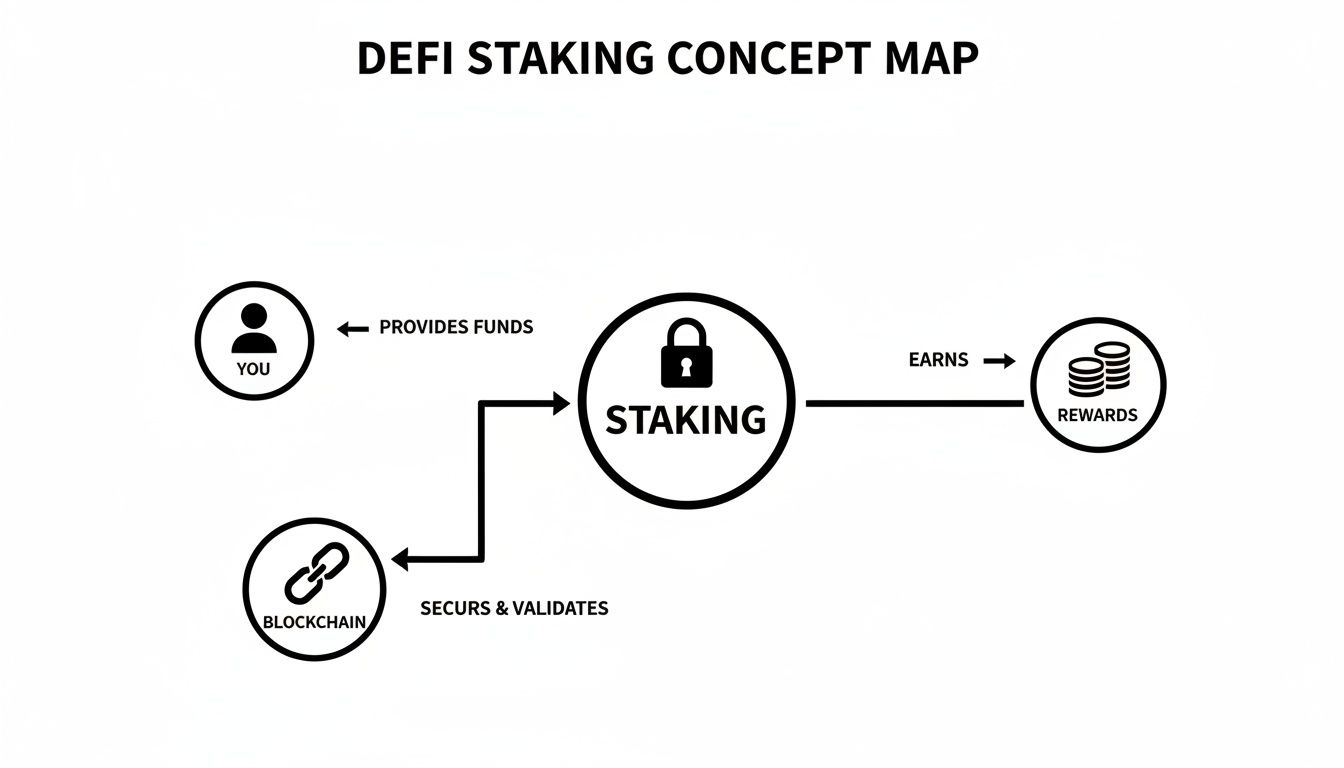
As you can see, your locked assets help secure the network. In return, the network generates rewards that are distributed back to you.
The Rise of Liquid Staking
While the previous two methods lock up your funds, liquid staking has revolutionized the game. With this model, you stake your assets and receive a "receipt" token in return, known as a Liquid Staking Token (LST). This LST represents your staked crypto and continues to earn rewards, but the key difference is that it's fully tradable and usable across the DeFi ecosystem.
With liquid staking, your capital is never truly locked. You can earn staking rewards and simultaneously use your LST as collateral for a loan, provide liquidity to a trading pool, or engage in other yield-generating strategies.
This capital efficiency has fueled explosive growth. The global liquid staking market is booming, particularly on blockchains like Ethereum, where its total value locked (TVL) has soared past $25 billion. Platforms like Lido Finance have become dominant players. For more insights on intelmarketresearch.com regarding this market's growth, you can find detailed analysis.
Comparison of DeFi Staking Models
To help you decide which path is right for you, here’s a breakdown of the key differences between these methods. Each approach has unique pros and cons.
Start tracking smart money today
Join thousands of traders using WalletFinder.ai to find profitable wallets and copy their trades.
Start Free Trial →

