
Stablecoin Interest Rates: Your Guide to Earning in 2026
Unlock the power of stablecoin interest rates. Learn how yields are generated, assess risks, and use Wallet Finder.ai to mirror top-performing DeFi wallets.
Your stablecoins might be doing nothing right now. They’re sitting in a wallet, parked on an exchange, or waiting for your next trade while the better wallets in the market are using the same assets as productive collateral, lending inventory, or low-volatility cash management.
That’s the appeal of stablecoin interest rates. You keep dollar exposure, avoid most of the price swings that come with directional crypto bets, and still put capital to work. For traders, that matters even more. Idle cash is drag. Productive cash gives you optionality.
The catch is simple. Not every yield is real, not every rate is worth the risk, and not every wallet earning stablecoin yield is running a strategy you should copy. The edge comes from knowing where the yield comes from, how to compare it on-chain, and which wallets are capturing it consistently without blowing up on hidden risks.
Why Stablecoin Yields Are Your DeFi Savings Account
If you trade actively, you already know the pattern. You trim a position, rotate into USDC or USDT, and tell yourself you’ll redeploy later. Then later becomes next week. Or next month. Meanwhile, that capital sits idle.
Stablecoin yield fixes that problem. It turns idle trading cash into a working balance while keeping your portfolio anchored in something designed to hold a dollar value. In practice, it’s the closest thing DeFi has to a savings layer for traders.
What makes stablecoin yield useful
The best use case isn’t complicated. Stablecoins give you a place to park funds between trades, after exits, or during uncertain market conditions. If you can earn on that balance without taking a full risk-on position, your capital stays useful even when you’re waiting.
That makes stablecoin strategies attractive for several groups:
- Active traders who need dry powder but don’t want zero return while they wait
- Treasury-style allocators who want lower-volatility parking for on-chain funds
- Copy traders who need a base layer strategy between higher-risk rotations
- Beginners who want DeFi exposure without immediately jumping into volatile assets
Practical rule: Treat stablecoin yield as cash management first, alpha second.
That mindset keeps you out of a lot of bad decisions. If you start chasing the biggest displayed APY without asking where it comes from, you usually end up taking liquidity, smart contract, or peg risk you didn’t intend to take.
What actually works
Simple, repeatable setups tend to last longer than flashy ones. For most traders, that means starting with lending markets, conservative liquidity routes, or yield-bearing structures backed by real-world assets rather than relying entirely on incentive-heavy farms.
What usually doesn’t work is treating a stablecoin position like a free lunch. Yield is compensation for some combination of liquidity demand, protocol risk, duration, or counterparty exposure. Your job is to decide whether the compensation is worth the trade-off.
That’s where on-chain analysis starts to matter. Once you can identify which wallets earn stablecoin yield consistently, how long they hold, and when they rotate out, stablecoin interest rates stop being background noise and become part of your trading framework.
Understanding the Mechanics of Stablecoin Yield
At the base level, stablecoin yield comes from one simple idea. Liquidity has a price. If someone wants to borrow stablecoins, they pay for access to that liquidity. If you supply the stablecoins, you earn part of that payment.
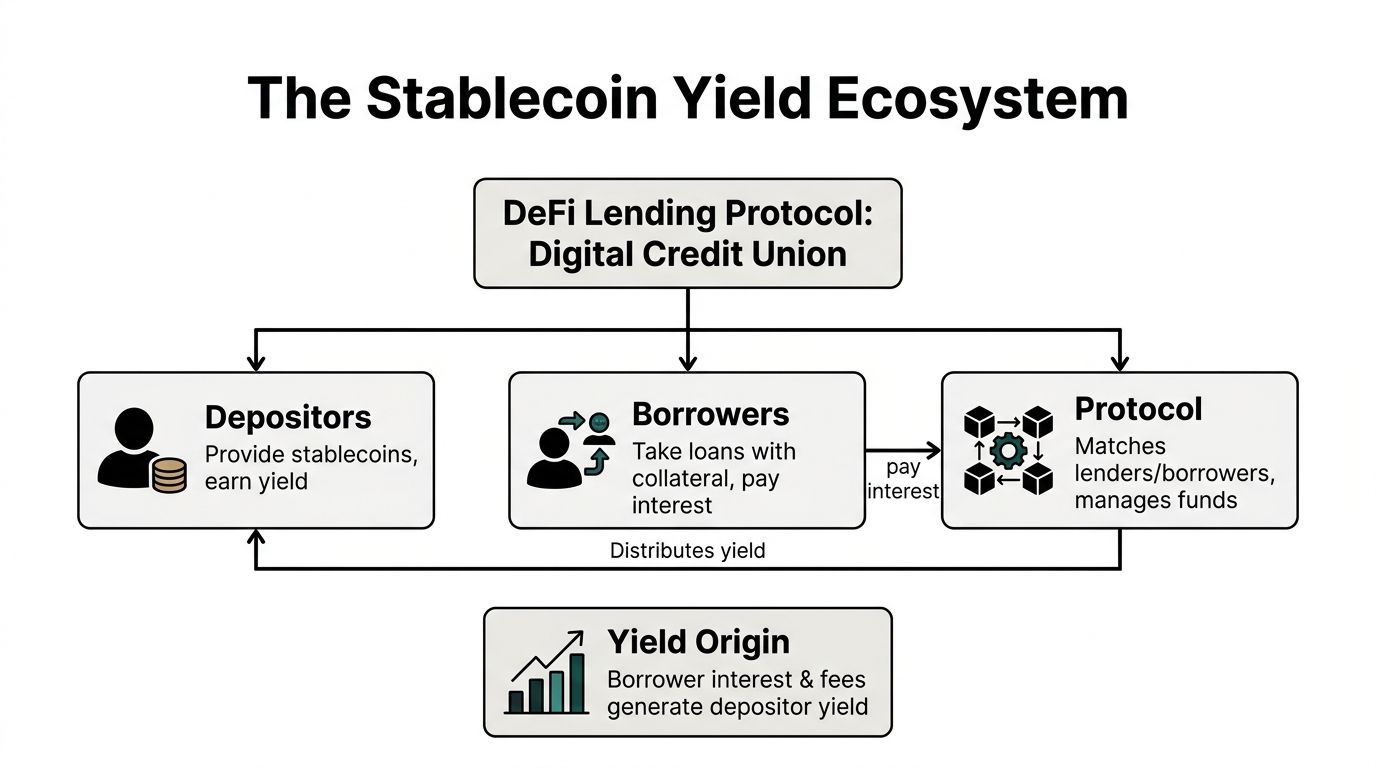
A lending protocol is the easiest mental model. Think of it as a digital credit union. Depositors supply USDC, USDT, or other stablecoins. Borrowers post collateral and take loans. The protocol handles matching, accounting, and distribution.
The basic cash flow
Here’s the flow most traders should understand before depositing anywhere:
- Suppliers deposit stablecoins into a protocol like Aave or a similar money market.
- Borrowers take those assets against collateral they’ve already posted.
- Borrowers pay interest and fees for that access.
- The protocol distributes yield back to suppliers after its own rules and fee structure.
That’s why rates move. If borrowing demand rises and available supply tightens, suppliers usually earn more. If everyone piles into the same pool and borrowing demand softens, rates compress.
Why rates aren’t just a DeFi side story
Stablecoin interest rates are tied more closely to traditional finance than many traders realize. A stablecoin rate analysis referenced by CoinInterestRate notes that a 2-standard deviation inflow into dollar-backed stablecoins lowers 3-month Treasury yields by 2-2.5 basis points within 10 days, and that outflows raise yields by two to three times more than inflows lower them.
That matters because it tells you stablecoin flows are not isolated crypto trivia. They can affect short-end dollar funding conditions. If you track flows well, you’re not just watching DeFi pools. You’re watching part of the plumbing connecting on-chain dollars to off-chain money markets.
Watch stablecoin flows like a macro trader watches funding. They often tell you more than the headline APY.
Two yield types traders confuse
A lot of confusion comes from lumping all stablecoin yield into one bucket. It helps to split the market into two broad categories:
Borrowing-demand yield
This is what you earn from lending markets and similar venues. The rate depends heavily on utilization and borrower demand.Reserve or asset-backed yield
This comes from structures that hold yield-generating reserves or real-world assets and pass some of that return through to holders.
That distinction matters because the first type can swing quickly with market conditions, while the second tends to be more benchmark-driven. If you don’t separate them, you’ll compare rates that look similar on the surface but behave very differently when conditions change.
Where to Find the Best Stablecoin Interest Rates
The fastest way to get lost in this market is to treat every stablecoin yield source as interchangeable. They aren’t. Some are simple and benchmark-like. Others look attractive until you account for liquidity risk, smart contract exposure, or the fact that the quoted APY depends on incentive emissions rather than durable cash flow.
A better approach is to think of the market as a menu. Each option serves a different job.
The main places yield comes from
Centralized platforms are the easiest entry point for many users. You deposit stablecoins, the platform handles the routing, and you receive a quoted yield if the product is available in your jurisdiction. The trade-off is obvious. You’re taking platform and custody risk.
DeFi lending protocols like Aave are the cleanest on-chain version of cash yield. You supply stablecoins into a lending market and earn from borrower demand. These setups are usually easier to monitor than complex farms because the source of return is straightforward.
AMM liquidity pools can pay more in the right environment, but they require more care. Yield may come from fees, incentives, or both. In stablecoin pairs, price volatility is lower than in directional token pairs, but pool design, liquidity fragmentation, and execution still matter.
RWA-backed yield-bearing stablecoins have become a serious category because they don’t rely entirely on volatile borrowing demand. A stablecoin yield explainer from CoinBrain notes that these mechanisms can offer predictable APYs of 4%-10%, and that in high-rate environments regulated issuers allocate reserves to T-bills yielding 4.5-5.2%, passing 80-90% of that as stablecoin APY after fees.
That last category is especially relevant if you want a lower-maintenance allocation. It behaves more like a tokenized cash product than a pure DeFi utilization trade.
Comparison of Stablecoin Yield Sources
| Yield Source | Typical APY Range (2026) | Primary Risks | Best For |
|---|---|---|---|
| CeFi stablecoin accounts | Qualitatively varies by platform | Counterparty risk, withdrawal restrictions, policy changes | Users who want convenience and simpler interfaces |
| DeFi lending protocols | Qualitatively tied to utilization and borrowing demand | Smart contract risk, rate volatility, chain-specific execution risk | Traders who want transparent on-chain cash management |
| Stablecoin AMM pools | Qualitatively varies with fees, incentives, and pool structure | Impermanent loss, smart contract risk, incentive decay | Users comfortable managing LP exposure |
| RWA-backed yield-bearing stablecoins | 4%-10% | Regulatory dependence, issuer structure, peg and redemption mechanics | Portfolio managers seeking lower-volatility anchors |
Start tracking smart money today
Join thousands of traders using WalletFinder.ai to find profitable wallets and copy their trades.
Start Free Trial →

