
Automated Trading Signals: Your 2026 Guide to DeFi Success
Learn how automated trading signals work, their quality, and use them for DeFi copy trading in 2026.
You open your terminal, Telegram, X feed, TradingView, and a DEX screener. Ten minutes later, you've seen twenty “can't miss” trades and learned nothing useful. That's where most traders are when they start looking at automated trading signals.
The appeal is obvious. Signals promise structure in a market that never stops moving. In crypto, especially DeFi, they also promise speed. But speed only helps if the signal is real, the execution is clean, and the edge survives contact with the market.
A lot of guides stop at signal generation. That's the easy part to talk about. The harder part is what happens after the alert fires: whether the trade fills near the intended price, whether too many others are chasing the same setup, and whether the model still works after conditions shift. That's the part that decides whether automated trading signals are useful or just another layer of noise.
Beyond the Hype of Automated Trading
Most traders confuse a signal with a bot. They're not the same thing.
The signal is the decision layer. It says buy, sell, reduce, or do nothing. The bot is the execution layer. It takes that instruction and routes the order. If the signal is weak, automating it just helps you lose money with more discipline.
That distinction matters because automated trading has become a serious market category, not a hobbyist side project. One industry projection puts the global automated algorithmic trading market at $53.8 billion by 2035 with a 10.6% CAGR according to EtnaSoft's market overview. That doesn't prove any specific signal is good. It does show that computer-generated entries and exits are now part of the mainstream trading stack.
What signals actually do
A useful signal cuts the decision down to a rule you can test. That rule might come from price structure, statistical patterns, order flow, or blockchain activity. In DeFi, the source often matters more than the syntax.
Three examples:
- Trend signal: A token breaks a defined level with enough confirmation to justify entry.
- Mean reversion signal: A sharp move stretches away from normal behavior and sets up a fade.
- On-chain signal: A wallet with a strong track record accumulates a token before broader attention arrives.
What usually goes wrong
Retail traders often buy signal feeds as if they're buying outcomes. They're not. They're buying a hypothesis about market behavior.
Practical rule: Treat every automated signal as a tradable claim that still needs validation under live conditions.
That means asking different questions than most marketing pages answer. Not “how many alerts do I get?” but “what kind of edge is this supposed to capture?” Not “can I connect it to a bot?” but “does the edge remain after fees, slippage, and latency?”
In volatile crypto markets, those questions aren't optional. They're the whole job.
The Signal Provider Landscape in 2026 — What's Available and What It Actually Costs
Your article teaches readers how to evaluate signals. Most arrive looking for a specific answer first: which providers are worth investigating before they build an evaluation framework. This section provides that map — not as an endorsement list, but as the landscape orientation that makes the rest of the article more actionable.
The signal provider market in 2026 runs across four distinct categories. Free Telegram groups with public track records represent the lowest-barrier entry point. Evening Trader has established a reputation as the most consistently cited free signal source, with verified win rates referenced in multiple independent reviews at 92%+ for simpler setups. The free tier provides enough signal exposure for a new trader to build a feel for signal quality without financial commitment. The limitation is frequency — free groups typically provide fewer signals per week than paid options, which means fewer opportunities to evaluate whether the provider's edge is genuine or regime-specific.
Paid Telegram and Discord groups occupy the middle tier. Learn2Trade has been consistently cited across NFTPlazas and Ventureburn's 2026 reviews for verified accuracy in the 79% range with affordable monthly pricing (approximately £39/month for the standard tier). CryptoSignals.org specializes in Bitcoin and major altcoin signals with detailed trade rationale rather than just entry/exit levels — which matters for traders who want to understand why a signal was generated, not just what it says. Wolf of Trading and Fed Russian Insiders are consistently mentioned in the premium Telegram category but at higher price points.
AI-powered automation platforms represent the third category. 3Commas is the most frequently cited in this space, combining a signal marketplace with bot infrastructure that can execute trades automatically when signals arrive. Signals Blue and Sublime Traders are cited as reliable providers of AI-generated signals that feed into automation pipelines. Dash 2 Trade blends automated market scanning with analyst review in a hybrid model that retains human oversight on algorithmically identified setups.
The premium end and what it implies
At the premium end, providers like Fat Pig Signals operate on lifetime pricing above $1,800 — a price point that implies either very high signal confidence or an effective marketing model for retail traders willing to pay for perceived exclusivity. The honest framing for premium pricing is that the lifetime cost is only justified if the win rate and average return per signal exceed what a lower-cost or free provider delivers by enough margin to recover the price differential. NFTEvening's May 2026 guide noted that top-performing bots and algorithmic traders achieve 10-30% annual returns in favorable markets — and that 60-70% of automated traders still lose money due to poor setup or unrealistic expectations. Premium price does not automatically correlate with premium signal quality, and no provider should be subscribed to without first verifying their publicly disclosed track record against independent sources rather than their own marketing materials.
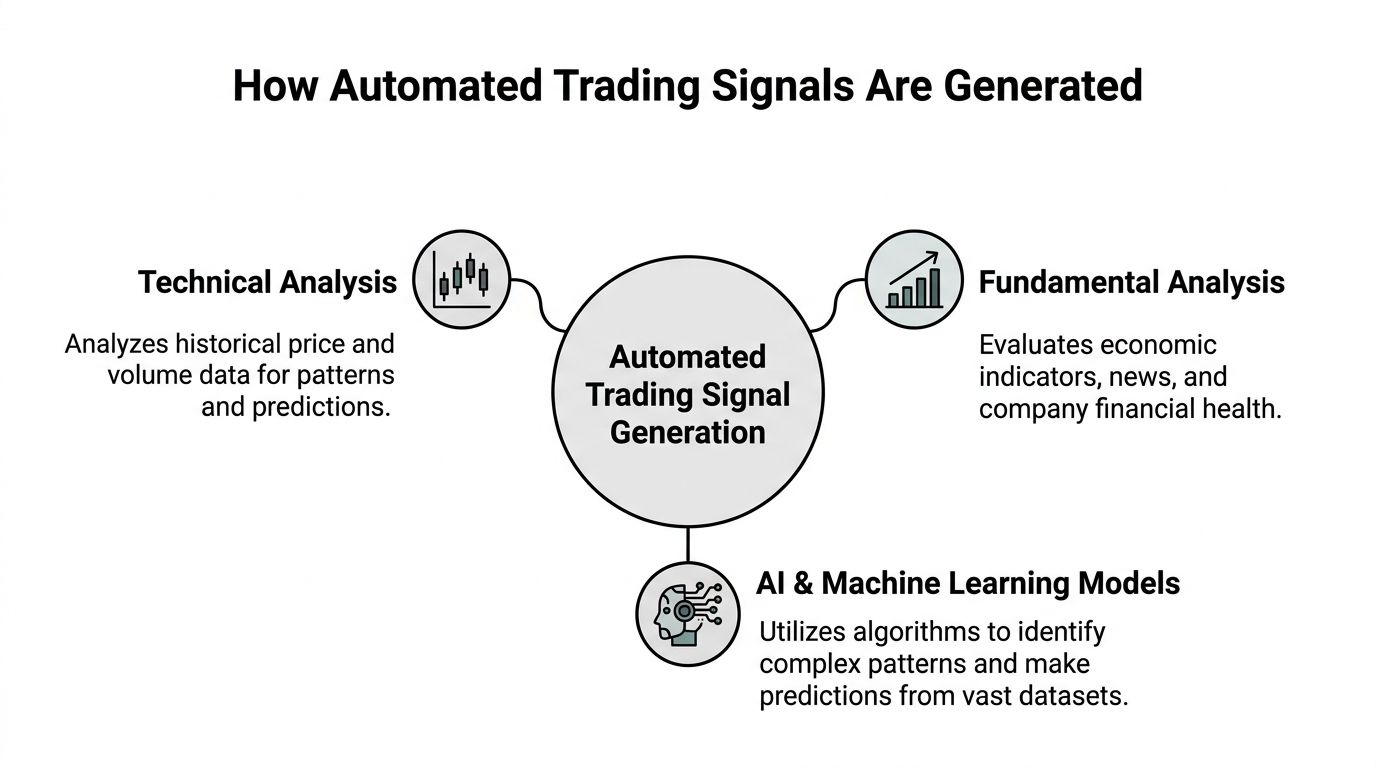
How Automated Trading Signals Are Generated
Most signal engines fall into a few broad families. You don't need to be a quant developer to understand them. You do need to know what each one is good at, and where each one tends to break.
Start tracking smart money today
Join thousands of traders using WalletFinder.ai to find profitable wallets and copy their trades.
Start Free Trial →

