
Robinhood Account Restricted? Your Fix-It Guide
Is your Robinhood account restricted? Learn the common reasons why, get an actionable plan to fix it, and restore your trading access fast.
Seeing the "Robinhood account restricted" message can freeze you in your tracks. It means your ability to trade, deposit, or withdraw funds is on a temporary hold. This can be due to a simple failed bank transfer, a trading violation, or a routine identity check. Pinpointing the why is your first step. After that, you can take targeted action by submitting the right documents or waiting out a required suspension to get your account back.
Why Robinhood Restricts Trading Accounts
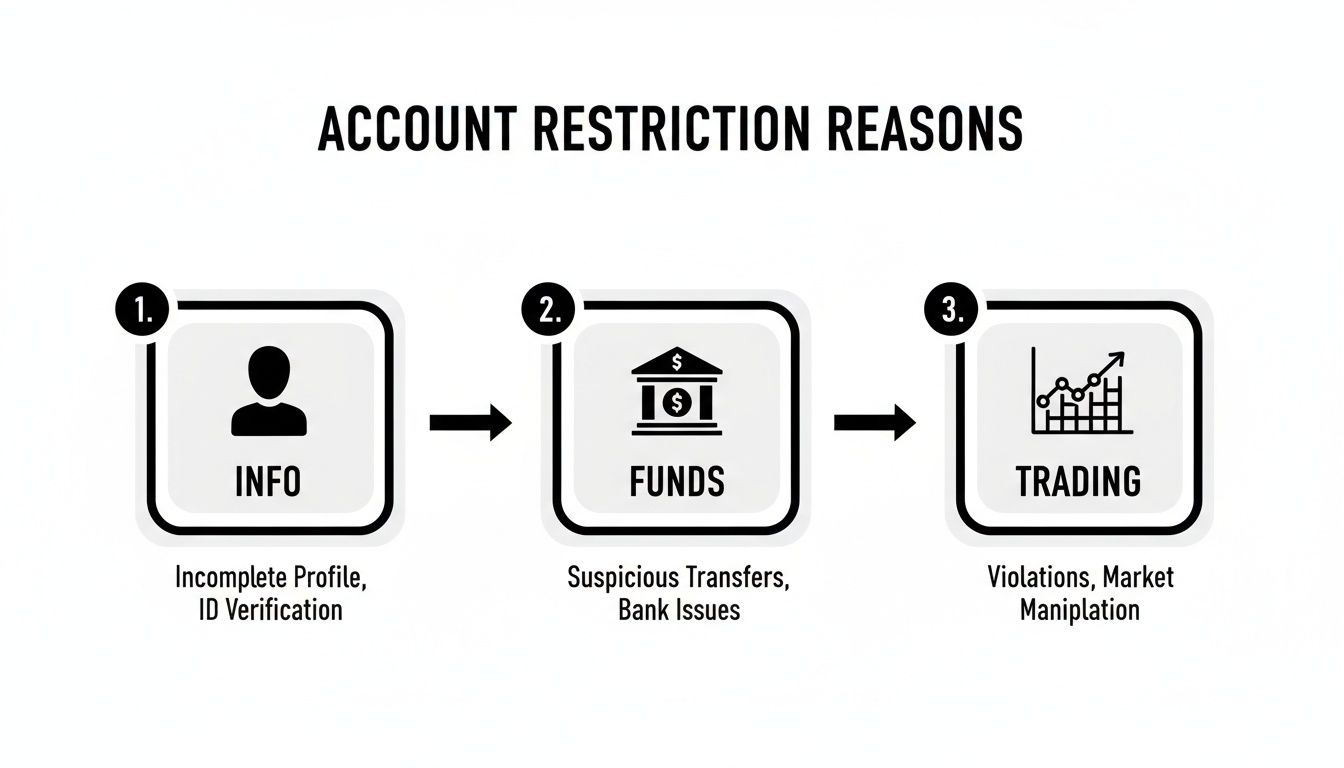
There’s nothing worse than seeing a market opportunity slip by because your account is suddenly frozen. It’s frustrating, and it cuts you off from managing your own portfolio. But these restrictions rarely happen out of the blue; they're almost always triggered by specific issues with your account, your funding, or your trading activity.
Getting to the bottom of it is key. If you can figure out the likely cause, you can get a head start on fixing it, often before you even need to talk to customer support.
Common Administrative and Funding Triggers
Most of the time, the culprit behind a Robinhood account restricted notice is a simple administrative hiccup or a funding issue. These are usually the easiest problems to fix, but they can definitely catch you by surprise.
- Failed Bank Transfers: This is a big one. You make a deposit, start using the instant buying power Robinhood gives you, and then the transfer from your bank bounces due to insufficient funds (NSF). This will lock your account instantly until you clear that negative balance.
- Outdated Personal Information: Brokers are required by law to keep customer info current. If you've moved or your name has changed and you haven't updated your profile, Robinhood might pause your account until you verify your new details.
- Suspected Unauthorized Activity: If the platform's security flags weird login attempts or transactions that don't match your usual patterns, they'll often put a temporary freeze on the account to protect you and your money.
Keep in mind, a restriction isn't an accusation. More often than not, it's a security measure or just a response to a simple mistake, like a typo in a bank account number.
The ACH Reversal Cascade: What Happens After a Failed Deposit
Most guides treat a failed bank transfer as a simple inconvenience, a deposit that bounces, a brief hold, and then normal service once you pay the balance. The actual downstream consequences of a reversed ACH on Robinhood are considerably more serious and affect your financial life well beyond your Robinhood account.
When a deposit reverses, Robinhood immediately suspends instant buying power on all future deposits. This means the next deposit you make, even if it goes through perfectly, will not be available for trading until the funds fully settle, which takes four to five business days. For a trader used to instant access to deposited capital, this operational restriction can last for months before Robinhood's system reinstates instant buying power, and the exact duration varies by account history.
The more significant consequence is what happens if you used that instant buying power to purchase securities before the reversal hit. You now have a debit balance: you hold securities that were purchased with funds that don't exist in your account. Robinhood will attempt to collect the owed amount from your linked bank account again. If that second collection attempt also fails, they may liquidate positions in your account to cover the debt without requiring your authorization to do so, a right granted to them explicitly in their customer agreement.
The financial reporting consequence is the least-discussed and most damaging part. Robinhood reports debit balances and failed payment activity to Early Warning Services (EWS) and ChexSystems, the two consumer reporting agencies that banks and brokerages use to screen new account applications. A negative EWS or ChexSystems report is not on your Equifax or Experian credit report, so your credit score is unaffected, but it can result in being declined for new bank accounts and brokerage accounts at other institutions for up to five years. Users who've had an unresolved Robinhood debit balance have reported being unable to open accounts at TD Ameritrade, Fidelity, and Charles Schwab due to the ChexSystems flag, even years after paying the original balance.
The resolution sequence when you have a debit balance matters enormously. Pay the negative balance directly through Robinhood's in-app payment option rather than waiting for them to initiate a new ACH pull. Once the balance is cleared, explicitly request from Robinhood support a letter confirming the account is paid and in good standing, then submit that letter to ChexSystems directly as a dispute to have the negative record updated. ChexSystems is required by the Fair Credit Reporting Act to investigate disputes within 30 days. Without this active dispute process, a paid debit balance may remain as a negative record on your ChexSystems file for the full five-year retention period even after the Robinhood account is fully resolved.
Trading Violations That Cause Restrictions
The more serious restrictions come from breaking specific trading rules set by financial regulators. These aren't about your personal details; they’re all about how you trade.
- Pattern Day Trader (PDT): If your account balance is under $25,000 and you make four or more "day trades" in a five-business-day window, you get flagged as a Pattern Day Trader. That triggers an automatic 90-day restriction on any further day trading.
- Good Faith Violations (GFV): This happens in cash accounts when you sell a stock you bought with funds that haven't settled yet. For example, you sell Stock A, immediately use that cash to buy Stock B, and then sell Stock B before the money from the Stock A sale has officially cleared (which takes two business days). Too many GFVs will get your trading restricted.
Sometimes, restrictions can stem from bigger issues on Robinhood's end. Between 2018 and 2022, for example, many users got locked out of their crypto accounts. The platform ended up in a $3.9 million settlement because it was preventing users from moving their crypto to their own personal wallets, trapping them in the Robinhood ecosystem. This was a massive headache for traders trying to get out of volatile coins like Dogecoin, which at one point made up over 60% of Robinhood’s Q2 2021 crypto trading volume. You can read more about the crypto company settlement on oag.ca.gov.
Your Immediate Plan to Restore Account Access
That "Robinhood account restricted" notification can definitely make your heart skip a beat. The first instinct for many is to panic, but trust me, a methodical approach will get you back in the game much faster than firing off a dozen frustrated emails.
Here is a step-by-step action plan:
- Check Your Notifications: Before anything else, check your email inbox (including spam) and the in-app messages from Robinhood. The platform almost always sends a notification explaining why the restriction was applied. This is your most important clue.
- Identify the Reason: The message will likely state the specific cause, such as a Pattern Day Trader (PDT) flag, a Good Faith Violation (GFV), a request for identity verification, or a reversed ACH transfer.
- Gather Your Documents: Based on the reason, get your required documents ready for a quick submission.
- Contact Support: Reach out with a clear, concise message that includes all relevant details.
Start tracking smart money today
Join thousands of traders using WalletFinder.ai to find profitable wallets and copy their trades.
Start Free Trial →

