
Wallet Reliability Ranking: A Trader's Guide
Understand what a wallet reliability ranking is and how to use it. Learn key metrics to find and copy the most consistent on-chain traders with confidence.
You're probably staring at a wallet leaderboard right now, trying to answer a simple question that never stays simple for long: who's worth copying?
One wallet shows a huge realized gain. Another has a clean win streak. A third caught a token before it exploded, and now it looks like a genius. Then you copy the next move, and suddenly the magic disappears. The wallet that looked elite was really just loud. One big trade made the profile sparkle, but the behavior underneath it wasn't stable.
That's the problem with reading on-chain performance the way most traders read it. They chase signal size instead of signal quality.
A reliability ranking fixes that. It gives you a way to separate traders who got paid once from traders who repeatedly make decisions you'd want to mirror. It's less about “who had the biggest win” and more about “who behaves in a way that keeps making sense across time, volatility, and different market conditions.”
If you already compare wallet results against a broader performance benchmark for trading evaluation, you're halfway there. The next step is asking whether that performance is repeatable enough to trust with your capital.
Beyond PnL The Copy Trader's Dilemma
A lot of copy traders learn the same lesson the expensive way.
You find a wallet that turned a small position into a massive gain on one meme coin or early rotation. The trade history looks sharp. The PnL column grabs your attention. You tell yourself that if this trader found one rocket, they'll find the next one too.
Then the next few trades look very different.
The entries come late. The sizing gets erratic. The wallet starts chasing thin liquidity, averaging down into weak names, or flipping too fast for your own execution to keep up. You copied the highlight reel, not the actual process.
Why PnL alone keeps fooling traders
PnL is useful, but it's incomplete. It tells you what happened, not how dependable the behavior is.
A wallet can post strong gains because of:
- One outsized winner that covers a lot of mediocre decisions
- A market regime tailwind where almost every momentum trade worked
- Risk concentration that looked smart only because the trade happened to resolve well
- Selective timing where the visible sample flatters the wallet more than the full history would
That's why two wallets with similar profit can be very different trading signals.
One trader may scale into setups in a consistent way, cut losers, and stay inside a recognizable playbook. Another may look profitable only because one position hit hard enough to erase a string of weak decisions.
Practical rule: If you can't explain how a wallet usually wins, you shouldn't assume it will keep winning.
What the dilemma looks like on-chain
Copy trading adds extra friction. You aren't just evaluating a strategy. You're evaluating whether you can follow it in real time.
A wallet might be profitable yet still be hard to copy because:
- It trades too fast for your alerts and execution.
- It sizes too aggressively for your risk tolerance.
- It changes style often so yesterday's logic doesn't help with tomorrow's trade.
- It relies on conditions you can't replicate, such as extremely early entries.
A reliability ranking helps because it shifts your attention from dramatic outcomes to repeatable habits. That gives you a cleaner answer to the question that matters: is this wallet likely to remain useful after I start following it?
What Is a Wallet Reliability Ranking
You pull up two wallets before a trade. Both show strong profit. One wallet has a jagged history with a few explosive wins. The other keeps producing decent entries, controlled losses, and a style that looks familiar week after week. If you are deciding what to copy with real money, those are not equal signals.
A wallet reliability ranking is a structured score that estimates how trustworthy a wallet's trading behavior is over time.
The key idea is simple. Raw profit tells you what happened. Reliability helps you judge whether that result came from a repeatable process you can use. For an on-chain trader, that difference matters because copied trades only pay if the wallet keeps behaving in a way you can recognize and act on.
Consider the difference between a casino hot streak and a card counter with a method. Both can leave the table up money. Only one gives you a reason to expect the next session will resemble the last. A reliability ranking tries to separate those two cases on-chain.
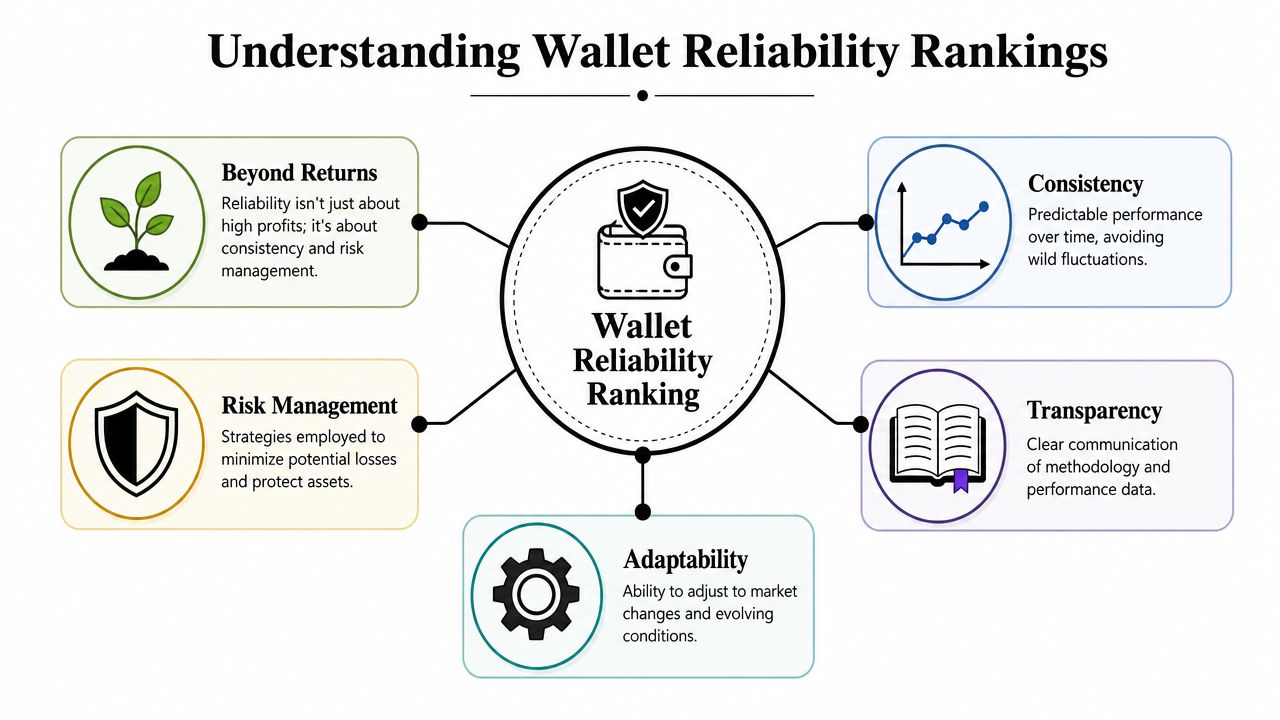
Reliability is really about signal quality
For traders, reliability is less about perfection and more about signal clarity.
If a wallet enters similar setups, manages risk in a recognizable way, and avoids wild swings in behavior, its history gives you a cleaner read on what to expect. If the wallet jumps between styles, depends on a few outlier wins, or hides long weak stretches behind one lucky run, the signal gets noisy. The ranking should reflect that difference.
That is why a useful ranking is not just a score on a leaderboard. It is a filter for trust. You are asking whether the wallet's past activity forms a pattern strong enough to support future decisions with capital at risk.
Why one metric is not enough
On-chain trading is a messy system. Entry timing, token selection, volatility, liquidity, hold time, sizing, and market regime all shape the final PnL. A single stat flattens that story too much.
A better framework combines several inputs, then asks a practical question: does this wallet produce a signal that survives contact with real execution?
Monte Carlo's explanation of data reliability is useful here because it treats reliability as a function of whether downstream users can trust the output, not whether one visible metric looks fine. Wallet rankings should work the same way. The score should reflect the chance that following this wallet leads to stable decision-making, not just impressive screenshots.
For a copy trader, that usually means evaluating questions like these:
- Does the wallet win in a repeatable way, or mostly through rare outliers?
- Are losing periods controlled, or do they erase weeks of gains?
- Does the strategy stay recognizable across different market conditions?
- Is there enough clean history to judge the wallet fairly?
If you want the supporting inputs behind those questions, this guide to key metrics for identifying profitable wallets gives useful context.
A working definition traders can use
A wallet reliability ranking is a multi-factor score that measures whether a wallet's behavior is consistent, interpretable, and practical enough to trust with real capital.
That definition matters because it connects statistics to trading action. You are not scoring a wallet for being interesting. You are scoring it for usefulness. A high-reliability wallet gives you a stronger base for copy trading, alerting, or using its activity as confirmation on your own setups.
In other words, reliability ranking turns raw wallet history into a decision tool. It helps you move from "this wallet made money" to "this wallet produces a signal I can trust."
The Core Metrics of a Reliable Trader
If reliability ranking is the finished product, these are the ingredients.
The important shift is this: don't read wallet stats as isolated badges. Read them as clues about a trader's operating style. A wallet with decent returns and controlled losses often tells a better story than one with explosive gains and chaotic behavior.
For a wider view of these inputs, this guide to key metrics for identifying profitable wallets is a useful companion.
The metrics that matter most
For physical systems, reliability frameworks often rely on failure and recovery measures such as mean time between failures and mean time to repair, because the most dependable assets are the ones that fail less often and recover faster, as outlined by the University of Tennessee's reliability metrics guidance. That's a strong analogy for trading. A reliable wallet isn't one that never takes a hit. It's one that limits damage and recovers in a disciplined way.
Here's a practical trader version of that logic.
| Metric | What It Measures | Why It Matters for Reliability |
|---|---|---|
| Win rate | How often trades close profitably | Helps reveal whether the wallet's edge shows up regularly, but it can mislead if winners are small and losers are large |
| PnL | Net trading outcome over the observed period | Shows whether the strategy actually made money, though it says little on its own about stability |
| Max drawdown | The deepest decline from a prior peak | Shows how painful the strategy can get while you're following it |
| Risk-adjusted return | Return quality relative to the volatility or downside taken | Separates disciplined profitability from reckless profitability |
| Trade frequency | How often the wallet enters and exits positions | Tells you whether the style matches your ability to execute and monitor |
| Position sizing consistency | Whether the wallet sizes trades in a stable, understandable way | Helps you detect discipline versus emotional or random sizing |
| Holding period behavior | How long positions are typically held | Distinguishes scalpers, swing traders, and conviction holders |
| Recovery pattern | How the wallet behaves after losses | Reveals whether bad periods are controlled or followed by revenge trading |
Start tracking smart money today
Join thousands of traders using WalletFinder.ai to find profitable wallets and copy their trades.
Start Free Trial →

