
Wallet Fees Explained: A Trader’s Guide to Cutting Costs
Don't let hidden wallet fees eat your profits. Our guide breaks down network, gas, and bridge fees and shows you how to minimize crypto transaction costs.
You close a trade green, check your wallet, and the result looks worse than the chart suggested. The swap worked. The thesis was right. But the net outcome got shaved by gas, approvals, a bridge hop, maybe a withdrawal, and sometimes a rushed fee preset that cost more than it needed to.
That gap is where a lot of copy traders leak PnL.
When people talk about alpha, they usually mean token selection, timing, or wallet discovery. In practice, wallet fees sit in the middle of all three. If you mirror an active wallet without understanding how it moves capital, what chain it prefers, and how often it pays to reposition, you can copy the idea and still miss the result.
Why Wallet Fees Erode Your Trading Profits
You mirror a wallet that called the move right. The token runs, the exit looks clean, and the lead trader books a solid gain. Your copy, however, lands much lower after approvals, gas spikes, a bridge transfer, and a sell executed with default settings. The trade idea was profitable. Your fee stack changed the result.
That gap matters because copy-trading PnL is path-dependent. The same wallet can produce very different net returns depending on your chain, position size, execution timing, and how often you need to move capital. Fees are not background noise. They are a direct input into breakeven.
In mainstream payments, those costs are often buried inside pricing. In crypto, they are exposed transaction by transaction. Finder's digital wallet statistics reported that digital wallets reached 4.3 billion global users in 2024, equal to 53% of the world's population, and accounted for 53% of global e-commerce transactions that year. On-chain, that cost transparency cuts both ways. You can see the leak, but you still have to control it.
Gross PnL is not real PnL
Wallet fees usually hit active traders before, during, and after the trade:
- Entry friction: approvals, swaps, and bridge transfers can all raise your cost basis before the position is live.
- Capital movement: sending funds between exchange accounts, wallets, and chains changes the true breakeven on the next trade.
- Exit drag: closing during congestion can strip a meaningful share of gains from an otherwise good trade.
Small positions feel this first. A $40 fee bill on a large swing trade may be noise. On a smaller copy trade, it can erase the edge entirely.
This gets sharper when you follow high-turnover wallets. A trader rotating size on a cheap chain can survive a style that would be untradeable for a follower using smaller clips, bridging in from another network, and paying priority fees on every action. Same entries. Different net outcome.
Hidden variable in copy trading
Many popular copy-trading dashboards rank wallets by realized returns, win rate, or recent momentum. Useful metrics, but incomplete. They do not show whether those returns came from disciplined execution or from a market strong enough to cover waste.
Fee efficiency is a real signal. A wallet that avoids unnecessary approvals, bridges less often, trades where blockspace is cheaper, and sizes positions so fees stay small relative to expected upside will hold onto more gross alpha. That matters even more in flat or choppy conditions, where the spread between gross and net performance decides whether a strategy still works.
This is also where on-chain analysis becomes practical, not academic. You can inspect a wallet's transaction history and ask better questions: How often does it bridge? Does it cluster trades to reduce overhead? Does it chase congested periods or wait for better execution windows? Does it route through expensive contract paths for marginal gains? Traders who manage these details tend to keep more of what they make, and they are usually better copy-trading candidates than a flashy wallet with weak fee discipline.
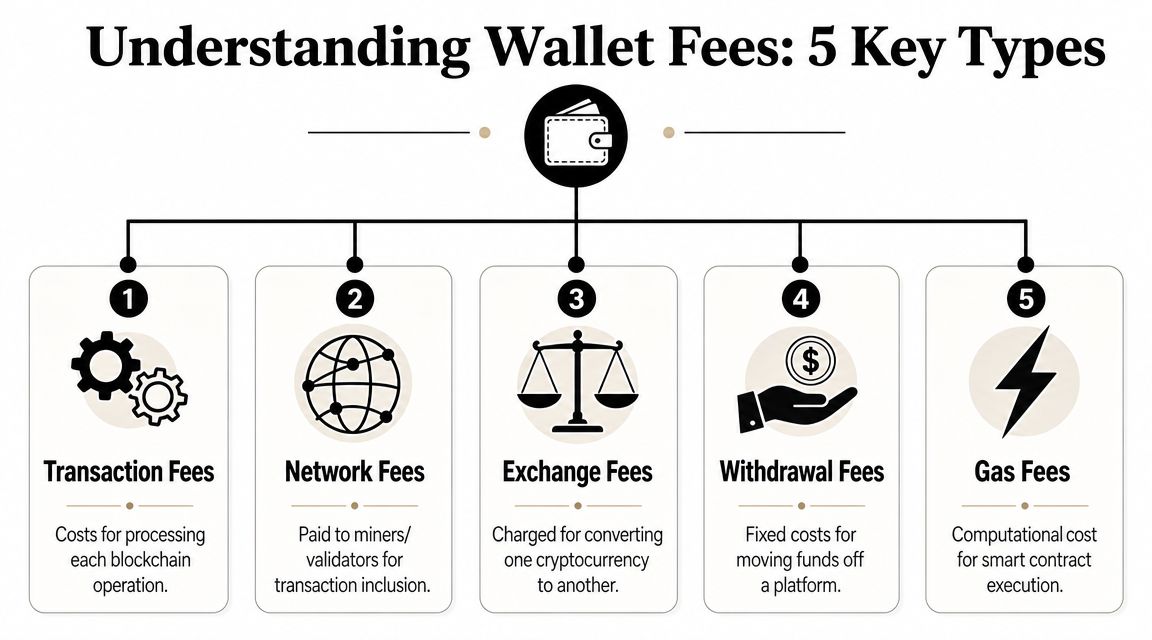
The Five Types of Wallet Fees You Must Know
If you can't label the fee, you can't control it. Most trading costs fall into five buckets.
Start tracking smart money today
Join thousands of traders using WalletFinder.ai to find profitable wallets and copy their trades.
Start Free Trial →

