
Realized Profit and Loss a DeFi Trader's Guide
Learn to calculate realized profit and loss on crypto trades. Our guide covers formulas, DeFi examples, tax rules, and how to track P&L effectively.
Your wallet says you're up. Your brain says you're winning. Then you try to answer a basic question, how much profit have you locked in, and things get fuzzy fast.
That confusion gets worse in DeFi. You buy on one chain, swap on another, bridge assets, provide liquidity, unwrap tokens, and check a dashboard that shows a nice green number. But green on a screen isn't the same as money you've captured. If you can't tell the difference, it's hard to judge your trading, manage risk, or prepare clean records later.
The Difference Between Paper Wealth and Real Profit
A lot of new traders treat portfolio value as if it were banked profit. That works right up until price reverses.
If a token you hold rises, your wallet balance may look stronger. But until you sell, swap, or otherwise dispose of that asset, that gain is still only a paper gain. It can expand, shrink, or disappear while you're still holding the position. What matters for your money is whether you've completed a transaction that locks in the result.
Why traders mix these up
Crypto interfaces often put everything in one place:
- Current wallet value shows what your holdings are worth at recent market prices.
- Position gain often looks like profit, even when nothing has been sold.
- Historical charts can make temporary gains feel permanent.
That presentation is useful for monitoring exposure, but it can blur a critical line. A wallet can look successful while the trader hasn't secured much profit.
Practical rule: If you still hold the asset, your result is exposed to the next price move.
This distinction matters beyond theory.
What this means for your money
Realized profit and loss helps you answer questions that portfolio value can't:
- Did this trade make money? A closed trade gives you a finished answer.
- Are you taking profits with discipline? Locked-in gains show execution, not just optimism.
- Can you compare one strategy to another? Closed results let you evaluate decisions on equal footing.
- What may need to be reported later? Completed transactions create records that matter operationally.
Picture yourself standing on a mountain of chips at a poker table. Until you cash out some of them, your session result is still in play. Crypto works the same way. Unrealized gains tell you what could be yours. Realized profit and loss tells you what became yours because you acted.
What Is Realized Profit and Loss
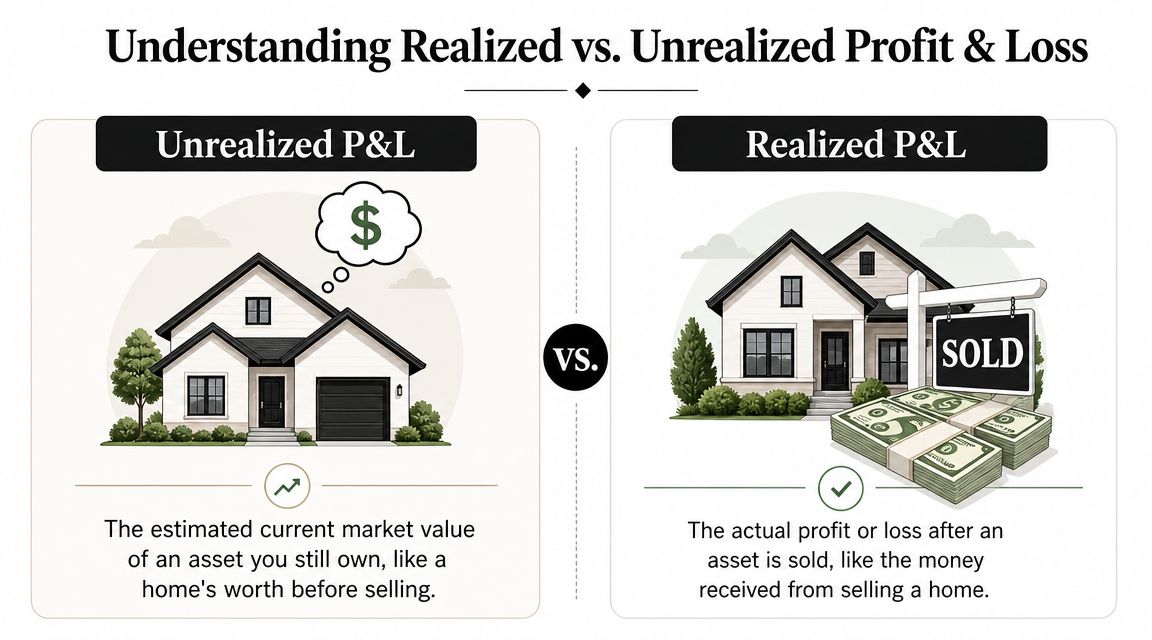
A simple analogy helps. Say your home's estimated market value goes up. You feel richer, and maybe you are on paper. But you don't know your actual profit until you sell and see what cash remains after the transaction is done.
That's the core idea behind realized profit and loss. It refers to the gain or loss that becomes real once a trade is completed. Unrealized profit and loss is the value change on an asset you still own.
The plain-English definition
When you buy a token and keep holding it, your gain or loss is still floating with the market. Once you sell that token, swap it away, or otherwise dispose of it, the trade is closed and the result becomes realized.
In on-chain analytics, realized profit is defined as the USD value of profits captured when coins are spent. Glassnode explains that the metric sums the USD difference between the spent-price and the created-price for all profitable spends, which turns blockchain activity into a measurable flow of seller conviction in its realized profit metric guide.
That on-chain definition sounds technical, but the intuition is simple. Blockchain data can tell when an asset moved and compare the value at entry and exit. If the later spend happened at a higher value than the earlier acquisition, profit was realized at that moment.
Realized versus unrealized at a glance
| Attribute | Realized P&L | Unrealized P&L |
|---|---|---|
| When it exists | After a completed sale, swap, or disposal | While you still hold the asset |
| Certainty | Locked in at the time of exit | Changes with market price |
| Usefulness | Evaluates finished trading decisions | Tracks current exposure |
| Emotional trap | Can show whether you actually took profit | Can tempt you to count gains too early |
| Recordkeeping burden | Needs clear entry, exit, and basis records | Needs current valuation, but no closed result yet |
Start tracking smart money today
Join thousands of traders using WalletFinder.ai to find profitable wallets and copy their trades.
Start Free Trial →

