
Choosing a Crypto Profit Loss App: A Trader's Guide
Find the best crypto profit loss app for DeFi. This guide covers PnL tracking, fees, taxes, and how to choose the right tool to maximize your trading returns.
You've got trades on Ethereum, Solana, and Base. Some are on a DEX, some on a CEX, some came from a wallet you were watching, and a few positions are half-investment, half-experiment. You know your balances. You don't know your actual performance.
That gap is expensive.
Most traders don't blow up because they lack charts. They lose edge because they can't answer basic questions fast enough. Which setups made money. Which wallets were worth copying. Whether fees turned a “green” strategy into a drag. Whether gains were realized or still sitting on open risk. A proper profit loss app fixes that. It turns raw transactions into something you can review, compare, and act on.
Why Manual PnL Tracking Is Costing You Money
The problem usually starts small. A spreadsheet feels fine when you've got one wallet, one exchange account, and a handful of spot trades. Then you add another chain. Then a perp account. Then a bot wallet. Then a few copied trades from wallets you found on-chain. At that point, your log stops being a trading tool and becomes a cleanup project.
I've seen the same pattern over and over. A trader thinks they're up because their current holdings are up. Then they check realized sales, bridge costs, gas, swap fees, and bad exits from earlier in the cycle. The picture changes fast. What looked like a strong month was often a few winners hiding a lot of sloppy execution.
Manual tracking fails in crypto for one reason. The transaction flow is too fast and too fragmented. Modern software has moved beyond static reporting because digital operations generate too much data for manual tracking to stay efficient. Finance software now emphasizes automated integration, line-item analysis, and in some cases real-time reporting instead of waiting for a static monthly review, as described in Domo's overview of profit and loss software.
Where spreadsheets break first
- Cross-chain confusion: You buy on one chain, transfer, LP somewhere else, then close on a different venue. Your spreadsheet rarely captures the full path cleanly.
- Fee blindness: Gas, swap fees, and bridge costs get ignored until tax season, which means your strategy review is wrong all year.
- No post-trade learning: If you can't tag and group past trades, you can't tell whether your edge came from timing, token selection, wallet selection, or luck.
Spreadsheets are fine for recordkeeping. They're weak for decision-making once your trading activity spreads across wallets, venues, and time periods.
If you're still piecing this together by hand, start with a clean framework for calculating crypto profits. The point isn't to build a prettier spreadsheet. It's to stop guessing what your trading is doing.
What Is a Crypto Profit Loss App
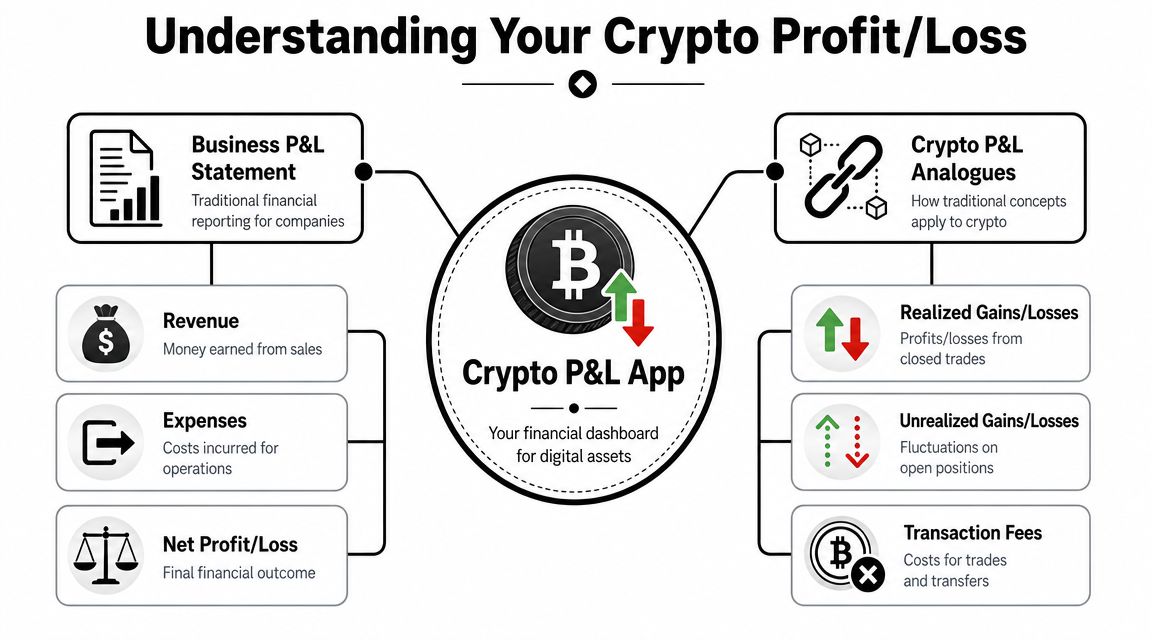
A crypto profit loss app is the trading version of a formal profit and loss statement. Traditional P&L reporting follows a simple structure. Revenue minus costs equals profit, then additional expenses and non-operating items lead to net income or loss over a reporting period. That accounting framework has been standardized for a long time, and modern software uses it to automate repeatable financial tracking, as explained in Workday's guide to profit and loss statements.
In crypto, the logic is the same. The inputs are just messier.
Start tracking smart money today
Join thousands of traders using WalletFinder.ai to find profitable wallets and copy their trades.
Start Free Trial →

