
Guide to Pump Coin Price Volatility
Decode the pump coin price phenomenon. Learn how to spot on-chain signals, manage risk, and track smart money wallets before the next major crypto move.
Ever witnessed a "pump coin price" event? It's a token's price suddenly spiking on hype, then crashing just as fast. Understanding this dynamic is your first step to navigating the wild world of crypto trading and protecting your capital.
What Is a Pump Coin Price Event?
A pump coin price event is a manufactured price surge. An obscure coin's chart suddenly goes vertical with no real news or fundamental reason. It's not organic growth; it's a coordinated effort to create a "get rich quick" illusion. These events are incredibly fast, often playing out over just a few hours.
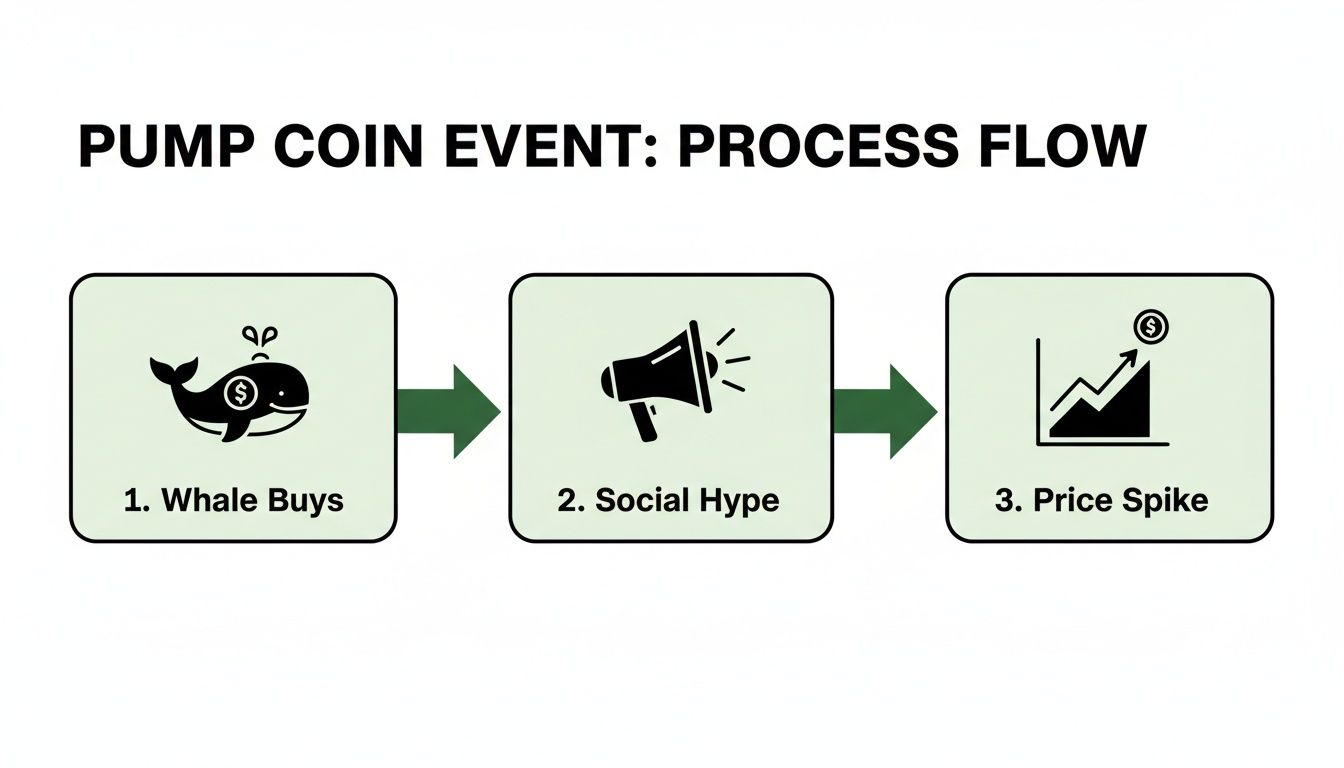
The orchestrators are typically a small group of insiders or influential traders. They quietly accumulate a large position in a low-volume coin. Then, they unleash a marketing blitz across social media and Telegram groups to trigger massive FOMO (Fear Of Missing Out), luring in retail buyers to artificially inflate the price.
The Four Types of Pump Events: Know What You're Trading
Not all pumps are created equal. Understanding which type you're facing changes everything about your entry, exit, and risk management strategy.
Type 1: The Organic Momentum Pump
This isn't a coordinated attack—it's genuine excitement that spirals out of control. A project announces a major partnership, a celebrity mentions the token, or a technical breakthrough happens. The price jumps legitimately, then FOMO takes over and pushes it into bubble territory.
How to spot it:
- News catalyst is real and verifiable
- Price climbs over days or weeks, not hours
- Trading volume increases gradually
- Multiple exchanges list the token
- Developer wallets aren't dumping
Trading approach:You can ride these longer. Set wider stop-losses (15-20%) and take profits in smaller increments. The crash comes eventually, but you have more warning signals.
Real example pattern:Token announces Coinbase listing → Price doubles over 3 days → FOMO kicks in → Price triples in next 2 days → Whale profit-taking begins → 40% correction over a week.
Type 2: The Coordinated Group Pump
A private Telegram or Discord group with 500-5,000 members agrees to buy a specific low-cap token at an exact time. They've done their homework: picked a coin with terrible liquidity and almost no attention.
How to spot it:
- Vertical price movement within 5-15 minute window
- Massive volume spike (500-2000% increase)
- Social media suddenly floods with the same hashtags
- New wallet addresses appear buying simultaneously
- All pumpers use similar talking points
Trading approach:Don't touch it. By the time you see the pump, the organizers are already selling. If you somehow catch it early (you won't), you have maybe 3-10 minutes before the dump starts.
Timing breakdown:
- Minute 0-2: Organizers buy
- Minute 3-7: Outside traders see movement, start buying
- Minute 8-12: Peak euphoria, everyone's buying
- Minute 13+: Organizers dump, price craters 60-80%
Type 3: The Bot-Driven Manipulation
Sophisticated trading bots create artificial price action to trigger stop-losses, liquidate shorts, or attract algorithmic trading systems. This is the most technical type and hardest to detect without proper tools.
How to spot it:
- Price moves in perfect geometric patterns
- Buy and sell walls appear and disappear instantly
- Order book shows suspicious symmetry
- Volume spikes at mathematically regular intervals
- Same wallet addresses trading back and forth
Trading approach:If you spot bot activity early, you can sometimes scalp small profits by riding their momentum. But set tight stops (5-7%) because bots can reverse direction instantly.
What the data shows:Bot-driven pumps typically last 2-6 hours and generate 40-120% gains before reversal. The key is recognizing the pattern within the first 30 minutes.
Type 4: The Insider Exchange Pump
Someone knows a token is about to get listed on a major exchange. They accumulate quietly for days or weeks, then the listing announcement triggers explosive growth.
How to spot it:
- Gradual accumulation phase (flat price, rising volume)
- Wallet addresses connected to exchange employees
- Unusual options activity if derivatives exist
- Price starts climbing 24-48 hours before announcement
- Massive gap up when news officially drops
Trading approach:The real profit happens in the accumulation phase, which you'll only catch with wallet tracking tools. Once the announcement hits, you're already late. Take quick profits (2-3x) and exit.
Typical timeline:
- Days 1-14: Silent accumulation
- Days 15-16: Price rises 30-50% on "no news"
- Day 17: Exchange announces listing
- Day 17-18: Price explodes 200-500%
- Day 19+: Profit-taking begins, settles 60% below peak
Why This Classification Matters
Each pump type requires different tools, different timing, and different risk tolerance. WalletFinder.ai helps you identify the type by showing you:
- Wallet accumulation patterns (Type 4)
- Coordinated buying clusters (Type 2)
- Gradual vs. instant volume changes (Type 1 vs. Type 2)
- Historical wallet behavior (separating bots from humans)
Trading a coordinated group pump the same way you'd trade organic momentum is how accounts get destroyed.
The Real Challenge for Traders
The challenge isn't just spotting a pump—it's distinguishing it from a coin gaining legitimate momentum. A solid project's price might climb after a major tech upgrade or partnership. A pump, however, is built on nothing but hot air.
FactorOrganic GrowthPump EventFoundationTechnology, adoption, utilityManufactured social media hypeCatalystProduct launch, partnershipCoordinated influencer shillingDurationSustained, gradual climbRapid spike followed by a crashGoalLong-term value creationQuick, profitable exit for insiders
Mistaking a pump for a genuine breakout is a surefire way to get wrecked. Just as the hype peaks, the organizers dump their holdings. The price collapses instantly, leaving late buyers with worthless bags. To avoid this, you must learn to analyze on-chain data and see what the smart money is really doing before the pump begins.
The Anatomy of a Crypto Pump
Every pump follows a predictable playbook. Learning to spot the four classic phases—Accumulation, Hype, Peak, and Dump—is like having a storm tracker for the market. By recognizing the early patterns, you can prepare before the chaos hits.
Start tracking smart money today
Join thousands of traders using WalletFinder.ai to find profitable wallets and copy their trades.
Start Free Trial →

