
Jesus Coin Price: A Trader's On-Chain Guide
Explore the current Jesus Coin price, history, and tokenomics. Learn to track smart money and decode on-chain signals for JESUS with our expert guide.
Jesus Coin nearly 5x'd from its launch price of $0.0000001 to an all-time high of $0.0000005796 in its early run, then gave back most of that move. That kind of path is common in memecoins, but it matters here because the chart alone does not tell you who drove the move, where liquidity resided, or which wallets exited before the collapse.
Jesus Coin trades like a flow asset. Price reacts to wallet concentration, fresh buyer velocity, and whether liquidity can absorb sells once attention fades. Traders who rely only on static price trackers usually arrive late.
The practical edge comes from on-chain reads. Track holder changes, watch for clustered buys from higher-signal wallets, and check whether smart money is adding into strength or distributing into retail momentum. Tools like Wallet Finder.ai help separate noise from real positioning, which matters more than headline price in a micro-cap meme trade.
Jesus Coin Price Now A Market Snapshot
The current jesus coin price sits in micro-cap territory. As of the latest market data, Jesus Coin trades at approximately $0.000000015 to $0.00000001613, with a market capitalization of $2.208M to $2.42M and a ranking around #1519 on major trackers, based on Kraken price data for Jesus Coin. That matters because micro-cap memecoins trade differently from larger names. Liquidity is thinner, price discovery is weaker, and a small number of active traders can move the chart.
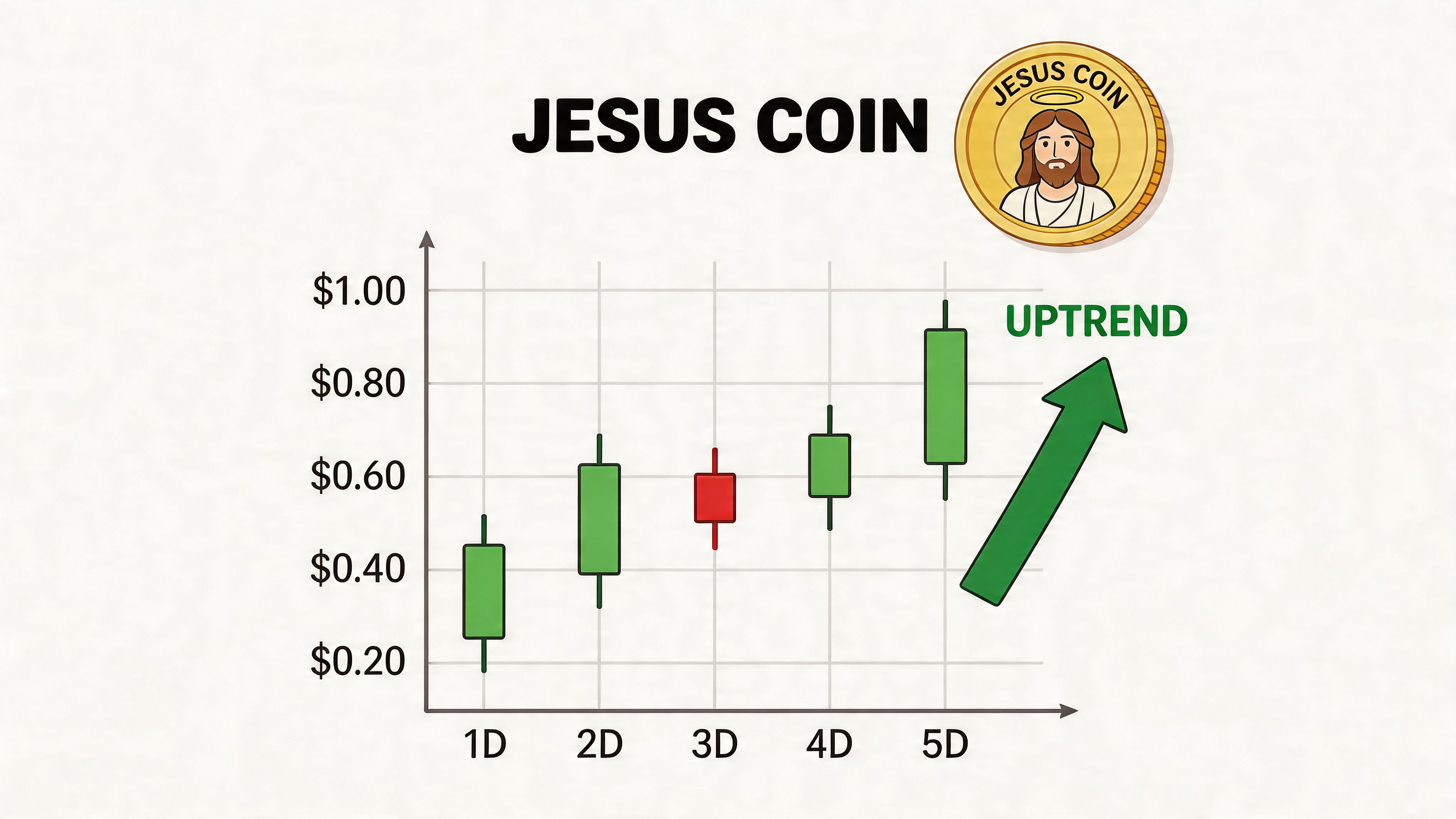
A few snapshot metrics stand out:
- Price range: The token is trading around the low $0.000000015 to $0.00000001613 area.
- Market scale: A market cap of $2.208M to $2.42M places it firmly in micro-cap territory.
- Supply profile: Circulating supply is 151.42T to 156.59T tokens, close to the reported total supply of 157T.
- Market presence: The token has 19.08K holders, which is enough to support ongoing trading interest, but not enough to remove concentration risk.
What this means for traders
At this size, the jesus coin price is less about broad market efficiency and more about who is active right now. A single motivated buyer, coordinated social attention, or a whale exit can distort short-term price action.
Practical rule: Treat JESUS like an execution-sensitive trade, not a passive investment.
The useful takeaway isn't whether the token looks cheap on a nominal per-token basis. That number is mostly irrelevant because supply is massive. What matters is whether liquidity can absorb your size, whether active wallets are accumulating, and whether the token still has enough attention to sustain follow-through after a move begins.
The Parabolic Rise and Fall of Jesus Coin
A move from roughly $0.0000001 to $0.0000005796 is a 4.796x run, not 4,796x. That correction matters because memecoin charts already distort perception. If the base math is wrong, the trade thesis usually is too.
JESUS still followed a familiar path. It launched into thin liquidity, caught a strong narrative bid, went near-vertical, and then spent months giving back most of that move. Traders see this pattern constantly in low-float meme names on Ethereum. The edge comes from spotting where the cycle is changing before the crowd does.
The early phase
The first leg in a token like JESUS rarely looks clean in real time. Volume is patchy, wallet concentration is high, and a small cluster of active buyers can force fast repricing. Price history alone does not tell you whether that move came from broad demand or a handful of wallets taking turns pushing the pair higher.
That is the practical difference between reading a chart and reading the chain.
Instead of anchoring on the launch price, track who accumulated before attention expanded. If a few early wallets built size and then stopped adding, the setup is different from one where new wallets kept entering during the climb. Traders who want context should understand what liquidity means in crypto before treating an early breakout as proof of durable demand.
The blow-off phase
Parabolic phases feel strongest right before they fail. On-chain, the signs are usually visible before the chart fully breaks. Early wallets start trimming into strength. New buyer quality gets worse. Trade count may stay active while conviction drops because smaller wallets are replacing larger ones.
That is usually the handoff from accumulation to distribution.
For JESUS, the important lesson is not that hype can send an illiquid token far above fair value. Traders already know that. The useful takeaway is that exit liquidity often arrives disguised as momentum. If smart money wallets are reducing exposure while social activity is accelerating, late longs are often funding those exits.
In memecoins, the best entries usually happen before the story spreads, and the best exits often happen while the story still sounds strong.
The long bleed
After the peak, these tokens often enter a slow decline that traps traders more effectively than a single crash. Sharp bounces create hope. Holder count may look stable enough to keep interest alive. But if the wallets that drove the first expansion are inactive or rotating elsewhere, price can grind lower for much longer than dip buyers expect.
Wallet-level analysis matters more than static price tracking. A chart can show drawdown. It cannot show whether experienced traders are re-entering, whether prior winners are distributing into every bounce, or whether fresh accumulation is happening at all. Tools like Wallet Finder.ai are more useful here than another price widget because they let you watch the wallets that drove the token during its strongest phase.
A practical lifecycle framework for JESUS looks like this:
- Stealth accumulation in thin liquidity
- Narrative breakout and fast repricing
- Vertical expansion driven by attention
- Distribution by early holders
- Extended bleed with intermittent relief rallies
Read JESUS through that sequence and the chart becomes easier to trade. The point is not to predict miracles. The point is to identify which wallets are buying, which wallets are selling, and whether the current move is real demand or recycled hype.
Analyzing Jesus Coin Tokenomics and Liquidity
Tokenomics won't tell you whether a memecoin will pump tomorrow. It will tell you how dangerous the trade becomes once volatility returns. For JESUS, liquidity is the first thing to respect.
Jesus Coin trades primarily on Uniswap V2 (Ethereum), where 94.01% of recent volume came through that venue, totaling $32,398 in 24 hours, paired with WETH at $0.000000074, according to CoinGecko's Jesus Coin market page. The key point is simple. Low liquidity amplifies whale impact.
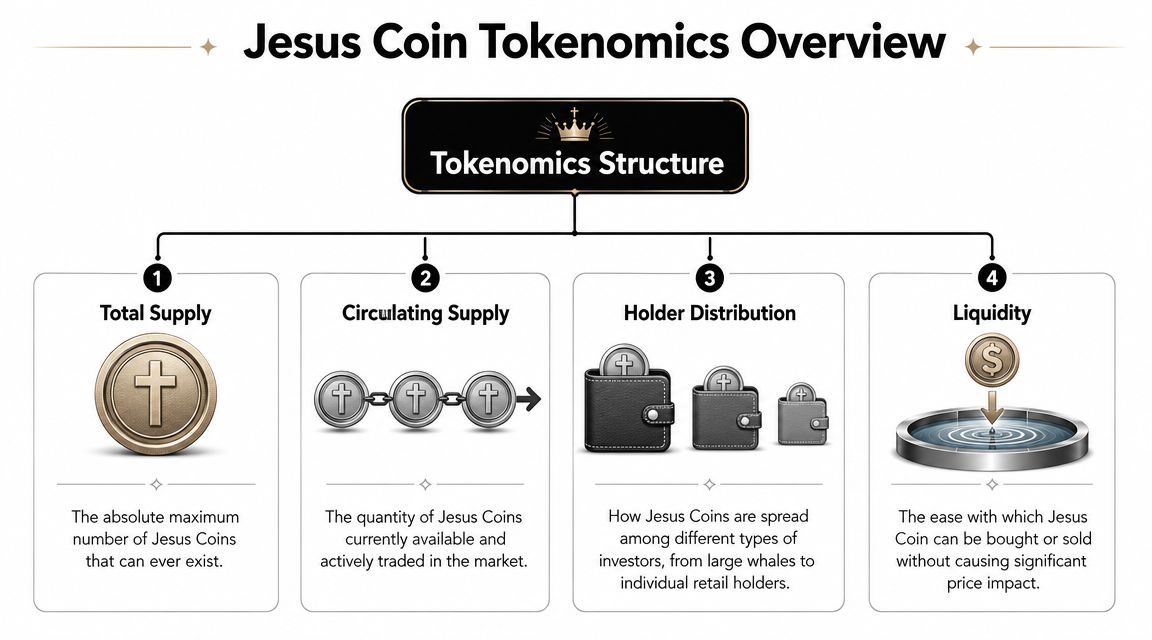
Jesus Coin tokenomics overview
| Metric | Value |
|---|---|
| Primary trading venue | Uniswap V2 (Ethereum) |
| Share of recent volume | 94.01% |
| Recent 24h volume | $32,398 |
| Main pair | WETH |
| Pair reference price | $0.000000074 |
| Circulating supply across sources | 151T to 160T |
| Approximate market cap across sources | Around $2.3M |
Start tracking smart money today
Join thousands of traders using WalletFinder.ai to find profitable wallets and copy their trades.
Start Free Trial →

