
A Guide to Using an Impermanent Loss Calculator
Master DeFi with our guide on using an impermanent loss calculator. Learn to calculate IL, understand the formula, and minimize your risk.
An impermanent loss calculator is a tool that shows you the dollar-value difference between holding assets in a DeFi liquidity pool versus just keeping them in your wallet. It’s built to show the opportunity cost you’re taking on in exchange for earning those juicy trading fees as a liquidity provider (LP).
Understanding Impermanent Loss and Why It Matters
Impermanent loss (IL) is one of the most talked-about concepts in decentralized finance, but it’s also one of the most misunderstood. It's not a direct loss of your tokens. Instead, think of it as a potential loss in value compared to just holding onto your assets—what the crypto world calls a "HODL" strategy.
When you deposit a pair of assets, like ETH and USDC, into an automated market maker (AMM), your funds are used to help other people trade. As the market prices of these tokens fluctuate, the AMM automatically rebalances the ratio of your assets in the pool. It's this constant rebalancing that causes impermanent loss.
How Price Changes Affect Your Holdings
Let's say the price of one of your assets skyrockets compared to the other. The pool sells off some of that high-performing asset for the less valuable one to keep things balanced. When you finally decide to pull your funds out, you’ll get back a different mix of tokens than you put in—less of the one that went up and more of the one that went down or stayed flat.
The name 'impermanent' is a bit of a trap. The loss is only theoretical while your funds are locked in the pool. The second you withdraw your liquidity at a different price ratio than when you deposited, that loss becomes very real and very permanent.
A visual impermanent loss calculator can really drive this point home.
As you can see from this chart, the bigger the price swing—up or down—the greater your potential impermanent loss.
A Real-World Scenario
To put this into perspective, imagine you're providing liquidity to an ETH/DAI pool. You deposit 1 ETH (worth $100) and 100 DAI, making your initial stake $200. Now, let's say ETH doubles in price to $200. Arbitrage traders will jump in to rebalance the pool.
If you were to withdraw at this point, your position would be worth less than if you had simply held your 1 ETH and 100 DAI from the start. This results in a 5.7% loss compared to just holding. It's a perfect example of how volatility can eat into your returns. You can check out more DeFi insights on impermanent loss to get a better handle on these market dynamics.
Figuring out this potential downside isn't just for kicks; it’s an absolute must for any serious LP. Without a solid grasp of IL, you can't know for sure if the trading fees and yield farming rewards you're collecting are actually putting you in the green.
How to Manually Calculate Impermanent Loss
While plugging numbers into an online impermanent loss calculator is definitely the fast lane, taking the time to understand the math behind it gives you a serious edge. Manually calculating impermanent loss pulls back the curtain on what’s actually happening to your assets in a liquidity pool. It’s the difference between being a passive user and an informed provider.
The formula might look a little intense at first glance, but it’s really just built on one simple idea that powers automated market makers (AMMs): the constant product formula. This is the mechanism that ensures the total value in a pool stays balanced, even as the ratio of the two tokens changes with every swap.
Let's break down the math for a standard 50/50 pool.
The Core Formula Explained
To figure out impermanent loss, we're simply comparing the value of your position inside the LP against what its value would have been if you'd just held those same assets in your wallet.
The most common formula to get the loss percentage is:
Impermanent Loss (%) = [ (2 * √(price_ratio)) / (1 + price_ratio) ] - 1
Here’s a breakdown of the key variables:
- price_ratio: This is the most important variable. It’s a simple measure of how much the price of one of your assets has changed relative to the other since you first deposited them. If the price of your ETH doubles against USDC, the price ratio is 2. If it gets cut in half, the ratio is 0.5.
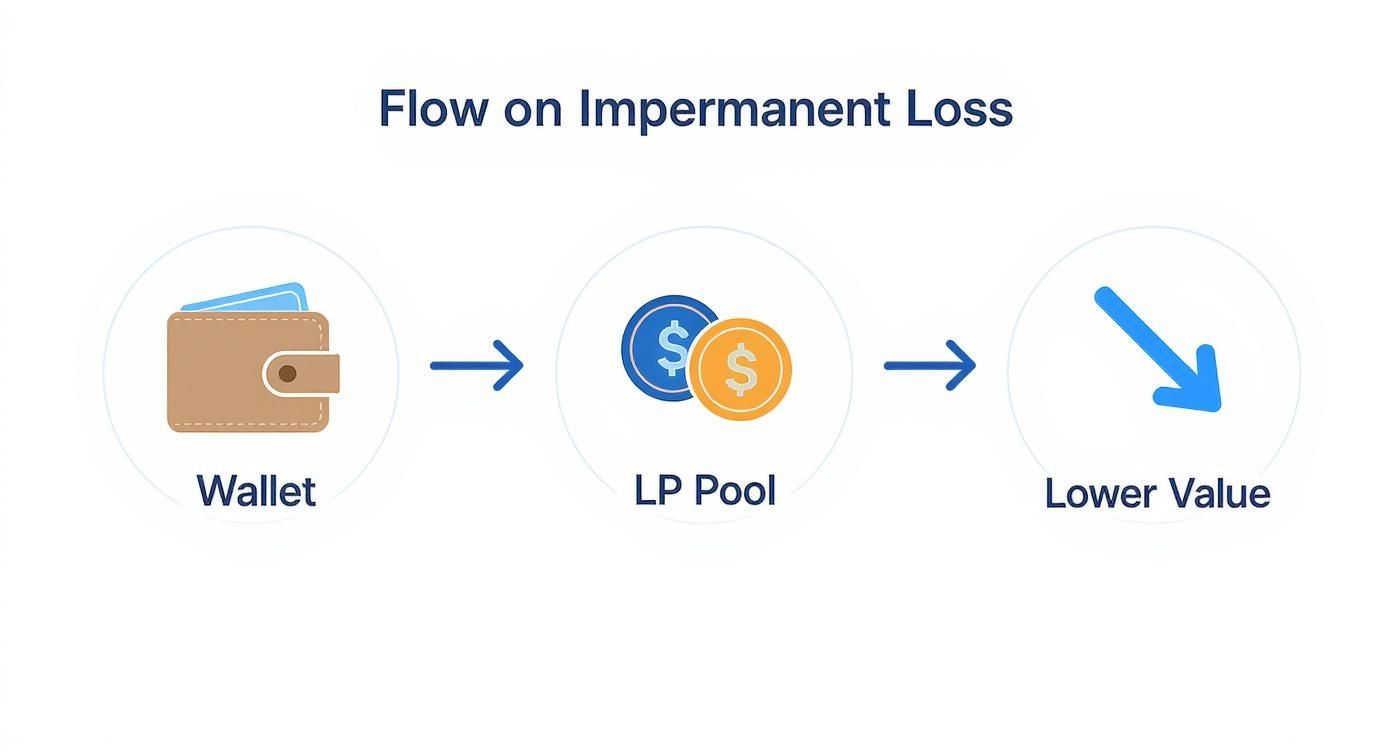
This visual gives a great overview of how providing liquidity can sometimes leave you with less than if you had just HODL'd.
Start tracking smart money today
Join thousands of traders using WalletFinder.ai to find profitable wallets and copy their trades.
Start Free Trial →

