
Avoid Coinbase Wallet Scams
Learn how to spot and avoid a Coinbase Wallet scam. Our 2026 guide covers phishing, fake support, and dApp scams to protect your crypto assets.
The most common Coinbase Wallet scams all boil down to one thing: tricking you into handing over your assets or your secret recovery phrase. It's a tough lesson to learn, but with Coinbase Wallet, you are in complete control of your security. This freedom is exactly what thieves bank on.
Understanding Your Risk with Coinbase Wallet
To keep your crypto safe, you first have to grasp the huge difference between using the Coinbase exchange (Coinbase.com) and the Coinbase Wallet app.
Think of Coinbase.com as your bank. The institution holds your funds, and they’re responsible for securing them behind the scenes. Coinbase Wallet, on the other hand, is like having physical cash in your own personal safe. You have total control, but you also have total responsibility for keeping it locked down. Scammers thrive on this distinction.
This shift from a custodial service (the exchange) to self-custody (the wallet) is where the real danger lies. Scammers know Coinbase can’t reverse a transaction or get your funds back from your personal wallet. Their entire strategy is to con you—the sole guardian of your crypto—into making a fatal mistake.
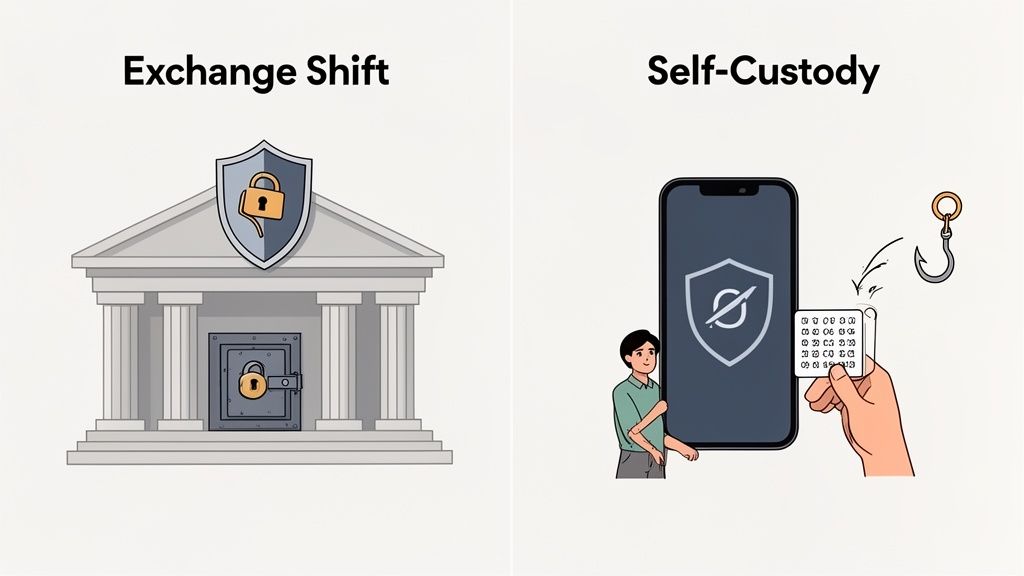
Custodial vs. Non-Custodial Security
Because the security models are worlds apart, so are the risks. On Coinbase.com, the company has massive, platform-wide security systems in place. With Coinbase Wallet, the security is all on you.
This means your biggest vulnerabilities aren't hackers breaking into Coinbase's servers, but rather:
- Social Engineering: Scammers manipulating you through DMs, emails, or fake support chats to get you to send them crypto or spill your secrets.
- Malicious Smart Contracts: Connecting your wallet to a shady decentralized app (dApp) that tricks you into signing a permission slip for them to drain your funds.
- Phishing: Landing on a fake website or clicking a link in an email that looks exactly like it's from Coinbase, designed to steal your recovery phrase.
Once your recovery phrase is compromised, it’s game over. An attacker gains irreversible control of your funds. Understanding this is the single most important step in protecting yourself. For a more detailed breakdown, check out our guide on how secure the Coinbase Wallet is.
Comparing Your Risk Profile
Let's put this side-by-side to make it crystal clear. This table contrasts where the security responsibilities and common threats lie for the exchange versus your personal wallet.
| Feature | Coinbase.com (Custodial Exchange) | Coinbase Wallet (Non-Custodial) |
|---|---|---|
| Who Holds the Keys? | Coinbase secures your private keys. | You hold your own private keys and recovery phrase. |
| Recovery Method | Password reset and identity verification. | Your 12-word recovery phrase is the ONLY way. |
| Primary Scam Vector | Account takeover through stolen passwords and SIM swaps. | Tricking you into signing malicious transactions or giving up your recovery phrase. |
| Fund Recovery | Possible in some cases, as Coinbase controls the accounts. | Impossible. Once funds are gone, they cannot be recovered by Coinbase. |
Start tracking smart money today
Join thousands of traders using WalletFinder.ai to find profitable wallets and copy their trades.
Start Free Trial →

