
Chainlink Staking Rewards: A Trader's Guide for 2026
Explore our guide on Chainlink staking rewards. Learn how they work, the real APR to expect, risks like slashing, and how to monitor staking activity on-chain.
Most advice on Chainlink staking gets one thing wrong. It treats the quoted reward rate like a deposit account yield. That's not how this works.
If you stake LINK because you saw a headline APY and assumed that's what will hit your wallet over the next few months, you're already using the wrong model. Chainlink staking rewards depend on mechanics that many guides skip: reward distribution design, lock behavior, ramp-up timing, cooldown constraints, and your own actions after staking.
For a trader, that gap matters more than the marketing line. Your realized return isn't just about the annualized number. It's about whether your LINK stays locked while price moves, whether you reset your own reward timing, and whether the position still makes sense against your alternative uses of capital. If you want a broader grounding in how staking rewards differ across networks, this guide to staking rewards by blockchain is a useful companion.
What Chainlink Staking Rewards Are Really Worth
Headline APR is the wrong number to anchor to if you trade around positions.
What matters is realized return over your actual holding period, after you account for reward vesting, cooldown friction, and the chance that you change the position before rewards fully mature. Chainlink's official Staking v0.2 overview explains the mechanics at a high level, and those mechanics are exactly why two wallets can face very different outcomes even if both entered at the same advertised rate. For a broader benchmark on how these trade-offs show up across networks, this guide to staking rewards by blockchain is a useful comparison.
The main gap is simple. Quoted APR assumes time and behavior you may not give the position.
Many YouTube explainers and staking roundup posts focus on the displayed annual rate because it is easy to compare across tokens. That shortcut breaks down with Chainlink staking. If you stake LINK, add more later, or start planning an exit before rewards have fully ramped, your wallet-level return can land well below the headline figure.
Why the advertised rate can overstate your P&L
A passive holder who plans to leave LINK staked through the full cycle can use the quoted rate as a rough baseline. An active trader cannot.
Your actual outcome depends on a few practical questions:
- How long will you keep the position live? Annualized yield means less if you may rotate out on the next major move.
- Will you top up the same staking address later? Chainlink documentation notes that wallet actions can affect how rewards accrue and when they become fully available.
- Can you tolerate the exit friction? Cooldown and unbonding mechanics matter if volatility spikes and you need capital elsewhere.
That last point is where a lot of P&L gets misread. A staking position is not only a yield line item. It is also a liquidity decision.
What the rewards are actually worth
Chainlink staking rewards are worth more to investors who already intended to hold LINK and can accept reduced flexibility. They are worth less to traders who value fast redeployment, trade around catalysts, or scale in and out frequently.
The clean way to judge the position is to compare expected realized staking return against the opportunity cost of having LINK tied up under Chainlink's staking rules. If the spread is small, the headline APR is mostly noise. If the spread is wide enough to cover liquidity risk and execution constraints, staking can make sense.
How Chainlink Staking Generates Rewards
Chainlink staking isn't just passive yield. It's economic backing for oracle performance.
The simplest analogy is a security deposit. Stakers lock LINK to help support honest, reliable oracle services. In return, they earn rewards through the staking system. That framing matters because it explains why rewards exist at all. You're not just collecting emissions in a vacuum. You're taking part in a security model.
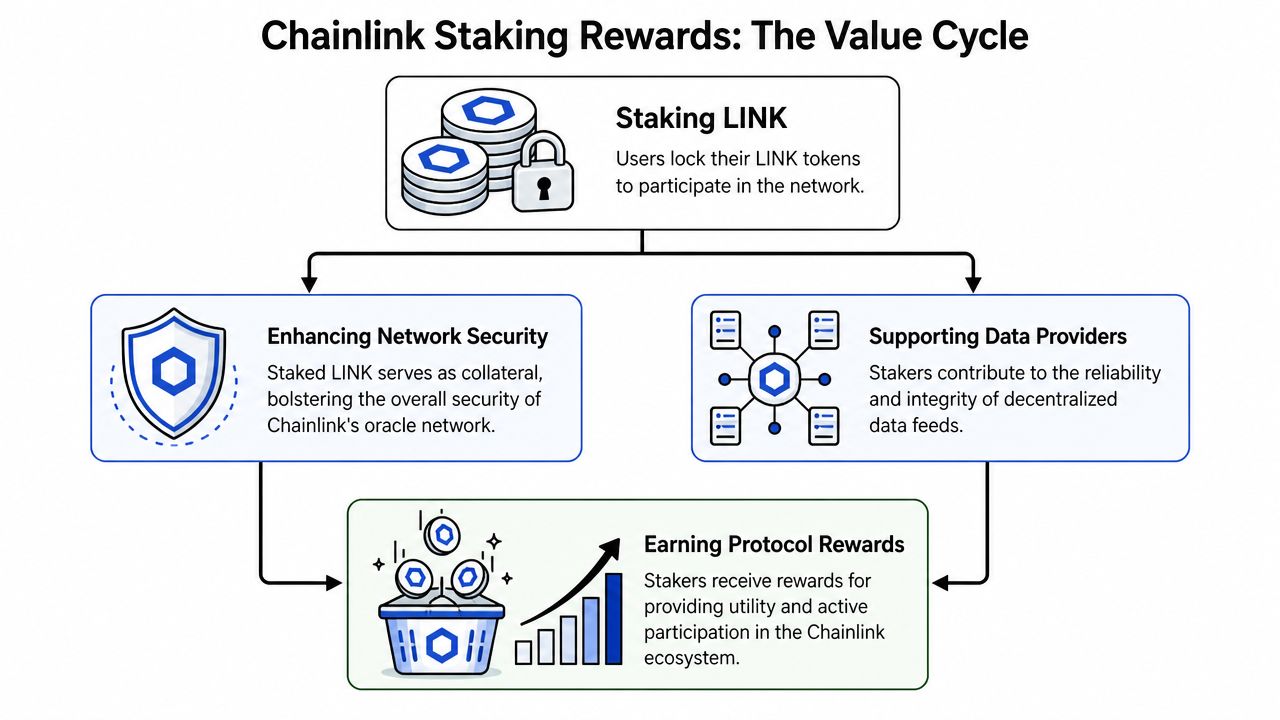
The basic value cycle
At a high level, the process looks like this:
- You lock LINK into the staking system.
- That stake strengthens network security by adding economic weight behind oracle reliability.
- The protocol distributes rewards to participants in line with staking mechanics.
This is why staking LINK should be judged differently from farming a transient incentive program. The position ties your capital to a network service role, not just to short-term token distribution.
Community stakers and node operators
Chainlink separates participation into distinct pools with different roles. The key distinction is between community stakers and node operator stakers.
Community stakers are the closer fit for most token holders. They stake LINK to participate in network security and receive staking rewards under the protocol's rules. Node operators play the operational role inside the oracle network and have a different reward profile.
That distinction matters because your reward stream isn't isolated from the broader staking structure. Community staking may look simple from the front end, but the system is built around role-based incentives underneath.
What experienced traders usually miss
A lot of market participants still evaluate chainlink staking rewards like this:
- quoted annualized rate
- expected token payout
- done
That shortcut misses the important part. Mechanics drive realized outcomes. The protocol design determines how rewards accrue, when they become economically meaningful, and what trade-offs you accept to earn them.
Treat Chainlink staking like a portfolio sleeve with its own liquidity terms, not like idle cash earning a fixed return.
What tends to work and what doesn't
Here's the practical split:
- Works well for conviction holders: If LINK is part of a longer-duration thesis and you don't expect to rotate fast, staking can align with that view.
- Works poorly for tactical traders: If you regularly move inventory around events, staking adds friction.
- Works best when monitored: Reward conditions and participation dynamics aren't static, so a one-time decision is rarely enough.
- Fails when treated as guaranteed yield: The protocol structure is more nuanced than that, and your own wallet behavior can change the payoff path.
How to Estimate Your Real Staking APR
The quoted APY is the least useful number in the model if you trade around it like cash yield. Real return depends on how long your LINK stays staked, whether rewards are still ramping, and whether your own wallet actions reset part of the reward path.
Chainlink documents the reward structure in practical terms on its staking concepts and FAQs page. For community stakers, the headline base rate is not the number to underwrite blindly because part of community rewards is redirected to node operator stakers, and some rewards mature over time instead of becoming fully usable from day one.
Start with the benchmark that matches your wallet
Use the effective community reward rate as your anchor, not the advertised top-line figure. Then adjust that number for your expected holding period.
That matters because annualized rates compress a lot of friction into one clean number. If you stake for a shorter window, add to the same address later, or start an exit process before rewards have fully matured, your realized APR will usually come in below the rate used in promos and dashboards.
If you want a quick refresher on how quoted annual rates can diverge from what you earn, this APR vs APY calculator guide helps frame the math.
What actually moves your realized return
| Component | What it means in practice | Impact on Your APR |
|---|---|---|
| Effective community rate | Community stakers do not keep the full headline reward stream. | Your real starting benchmark is lower than the advertised base rate. |
| Variable distribution | Rewards depend on protocol parameters and pool conditions, not a fixed personal payout. | Your return can drift from the number you first modeled. |
| Reward ramp-up | A portion of rewards matures over time instead of behaving like fully earned yield immediately. | Shorter staking periods tend to realize less than the annualized quote suggests. |
| Wallet top-ups | Adding LINK to an address that is already staking can affect the reward ramp for locked rewards. | Active position management can reduce near-term yield. |
| Exit timing | The moment you decide to unstake matters, not just the day you entered. | Poor timing can leave part of the expected annualized return unrealized. |
Start tracking smart money today
Join thousands of traders using WalletFinder.ai to find profitable wallets and copy their trades.
Start Free Trial →

