
Chain of Markets: A Trader's Guide to Cross-Chain Alpha
Explore the 'chain of markets' concept in DeFi. Learn to identify cross-chain cascades and use tools like Wallet Finder.ai to find actionable trading signals.
You spot a token ripping on one chain, pull up the chart, and feel that familiar frustration. By the time most traders react, the clean entry is gone, the first wallets are already rotating, and the next move is happening somewhere else.
That's the wrong way to read crypto.
A chain of markets is what you're trading. One venue moves first. Another reprices late. A bridge starts carrying inventory. A lending market gets tapped for collateral. A fresh liquidity pool absorbs the second wave. If you only watch the chart where the move began, you're staring at the first domino after it already fell.
Traditional retail learned this lesson long ago. Chain stores became a major retail force in the early 20th century, and by the 1920s they accounted for nearly half of all consumer sales in groceries, showing how standardized pricing and centralized purchasing could scale across local markets and turn fragmented commerce into concentrated networks, as summarized in EBSCO's history of chain stores. Markets behave the same way when infrastructure connects what used to be separate pockets of demand.
For traders, that changes the job. You're not just asking whether a token is bullish. You're asking where the move started, which linked market is slow to react, and what signal appears before capital spreads. That's where timing improves.
If you already use on-chain analysis workflows, the next step is widening the lens. Wallet behavior, bridge flows, liquidity migration, and repeated wallet cohorts often tell the story before headlines or social sentiment catch up.
Introduction Seeing the Full Picture
Most missed trades don't start with bad analysis. They start with a narrow frame.
A trader sees momentum on Solana, Ethereum, or Base and assumes the opportunity lives only there. Then the same narrative leaks into adjacent markets. Liquidity providers reposition. Copy traders chase the first visible wallets. Market makers adjust quotes where they expect inventory to arrive next. By the time the second chain lights up, the move looks sudden, but it usually wasn't.
The shift from reaction to sequence
The practical edge comes from thinking in sequence instead of event. A chain of markets is not one market with noise around it. It's a set of connected venues, assets, and participants that transmit pressure from one place to another.
That matters because price rarely moves alone. It moves with routing, positioning, and attention.
Practical rule: If a move can spread, the earliest clue usually won't appear on the destination chart. It will appear in the path capital takes to get there.
Three habits usually separate proactive traders from late traders:
- Track origin points: Don't begin with the most popular chart. Begin with the wallets, pools, or chains where the first concentrated buying appeared.
- Watch transfer infrastructure: Bridges, wrapped assets, and settlement rails often reveal intent before broad participation does.
- Map linked expressions: A theme can surface through spot buys, LP changes, collateral usage, and copycat wallet clusters before it becomes obvious in one headline token.
What traders miss when they isolate one chain
Single-chain analysis can still catch local setups. It struggles when a narrative migrates.
A meme rotation, an airdrop trade, or a tokenized asset theme often starts with a small group that acts early and moves capital quickly. If you only monitor one DEX, one screener, or one social feed, you see the market after propagation has begun. The better frame is to treat every move as part of a connected system with lead markets and lagging markets.
That's the lens for the rest of this piece. The goal isn't to define the term in abstract language. It's to trade the ripple before the crowd notices the wave.
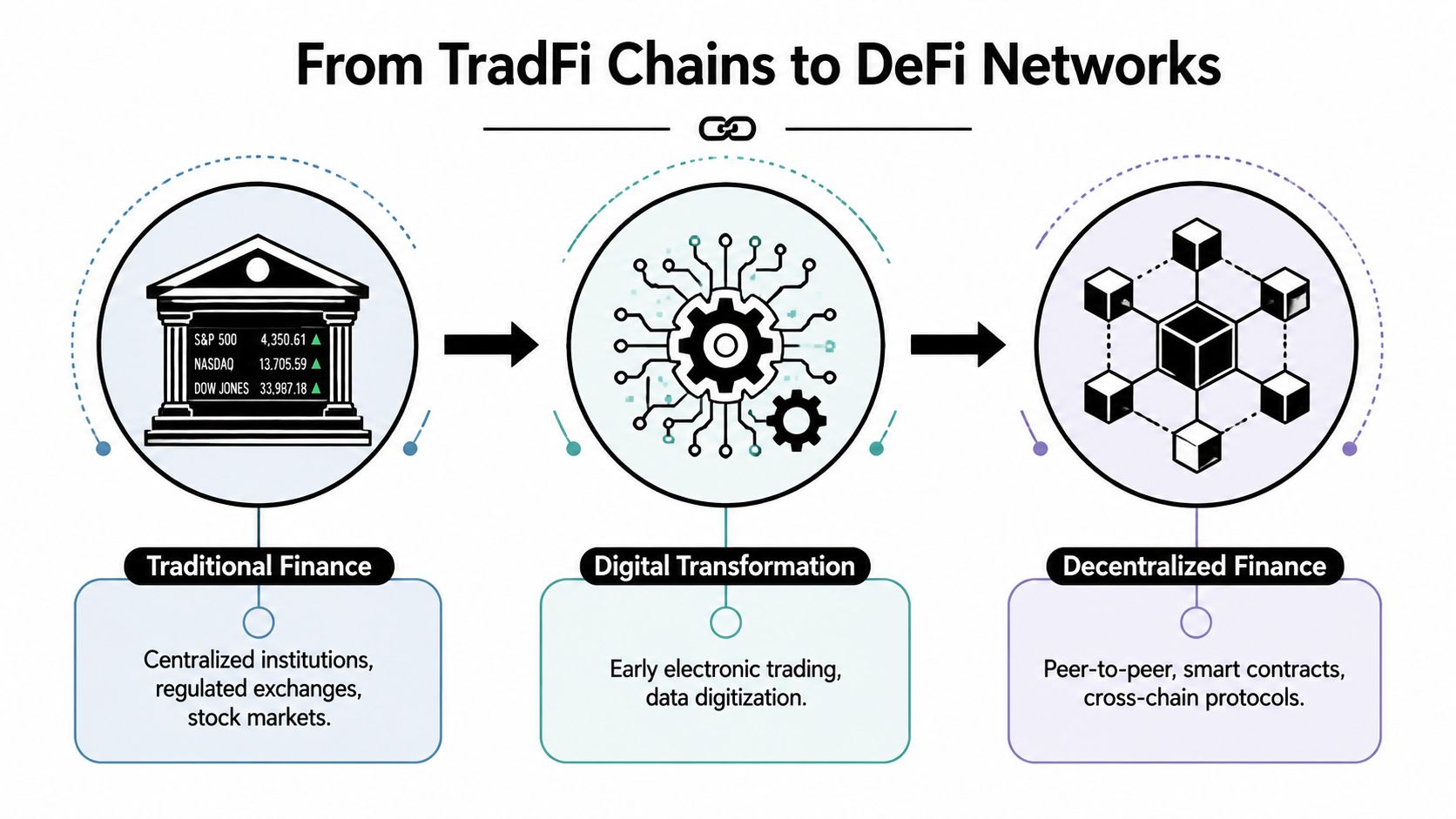
From TradFi Chains to DeFi Networks
A trader sees buying pressure hit a token on one chain, then assumes the move starts and ends on that chart. In practice, the first chart is often just the first visible stop. Capital can route through bridges, wrappers, lending markets, and perp venues before the broader market catches up.
Organized finance learned this lesson early. Once trading moved from scattered bilateral deals into formal exchanges, participants could track where price formed, where liquidity sat, and how orders traveled. The specific dates matter less than the market structure change itself. Standardized venues made capital flows easier to read, and readable flows are what make chain reactions tradable.
What TradFi got right
Traditional finance built a system of connected hubs. Exchanges handled price discovery. Brokers handled access. Clearing and settlement reduced confusion around who owed what and when.
Fragmentation still existed. It was just easier to map. Traders could identify the primary venue, judge where liquidity was thick or thin, and anticipate how a move in one instrument would affect another. That visibility is part of why cross-market trading became a discipline instead of guesswork.
Crypto is building a similar structure, but with open rails and faster feedback loops.
What a market means in DeFi
In DeFi, a market is not just a token pair on a DEX. It is the full set of venues where the same thesis can be expressed or hedged: spot pools, bridges, aggregators, perpetuals, lending protocols, wrapped assets, and the wallets moving between them.
That matters because one decision can echo through several layers at once. A wallet buys spot on the origin chain. Inventory gets bridged to a second chain. LPs rebalance after the price move. A related wallet cluster opens the same trade through perps or collateral elsewhere.
By the time the destination chart wakes up, the early actors may already be positioned.
The role of cross-chain rails
Cross-chain rails change execution, not just infrastructure. If capital cannot move efficiently, the same idea trades at different speeds across chains. If capital can move cleanly, lag closes faster and weak pricing gets arbitraged away.
For traders, the practical question is simple. Is this move trapped inside one ecosystem, or is it starting to spread?
| Market feature | What it means in practice |
|---|---|
| Liquidity silo | Price can break out on one chain while related venues stay slow |
| Shared settlement paths | Capital can shift to the venue with better depth, lower slippage, or cleaner exposure |
| Portable market data | Traders can act on activity from another chain before local charts fully reflect it |
| Flexible routing | The best expression of a theme may appear on a different chain than where it started |
Start tracking smart money today
Join thousands of traders using WalletFinder.ai to find profitable wallets and copy their trades.
Start Free Trial →

