
What Does Slippage Mean in Crypto? A Trader's Guide
Learn what does slippage mean in crypto, from the math and causes to actionable strategies using slippage tolerance and tools to protect your trades.
You line up a trade, the chart looks clean, the wallet you're watching just bought, and the quoted output seems good enough. Then the transaction lands and you get fewer tokens than expected, or you pay more than the screen showed a moment earlier. That gap is often where a decent trade turns into a mediocre one.
That hidden cost is slippage. In crypto, it shows up everywhere, but it hits hardest where many traders spend their time: fast-moving DEXs, copy trading setups, and low-liquidity memecoin markets. If you're chasing momentum on Solana, buying new launches on Base, or trying to mirror a smart wallet entry on Ethereum, slippage is part of your P&L whether you track it or not.
The practical problem isn't just that slippage exists. It's that many traders treat it like a technical setting instead of a trading cost. That's a mistake. Slippage changes your average entry, your average exit, and your ability to reproduce another trader's performance. A wallet can buy well and still be impossible to copy profitably if your execution is consistently worse.
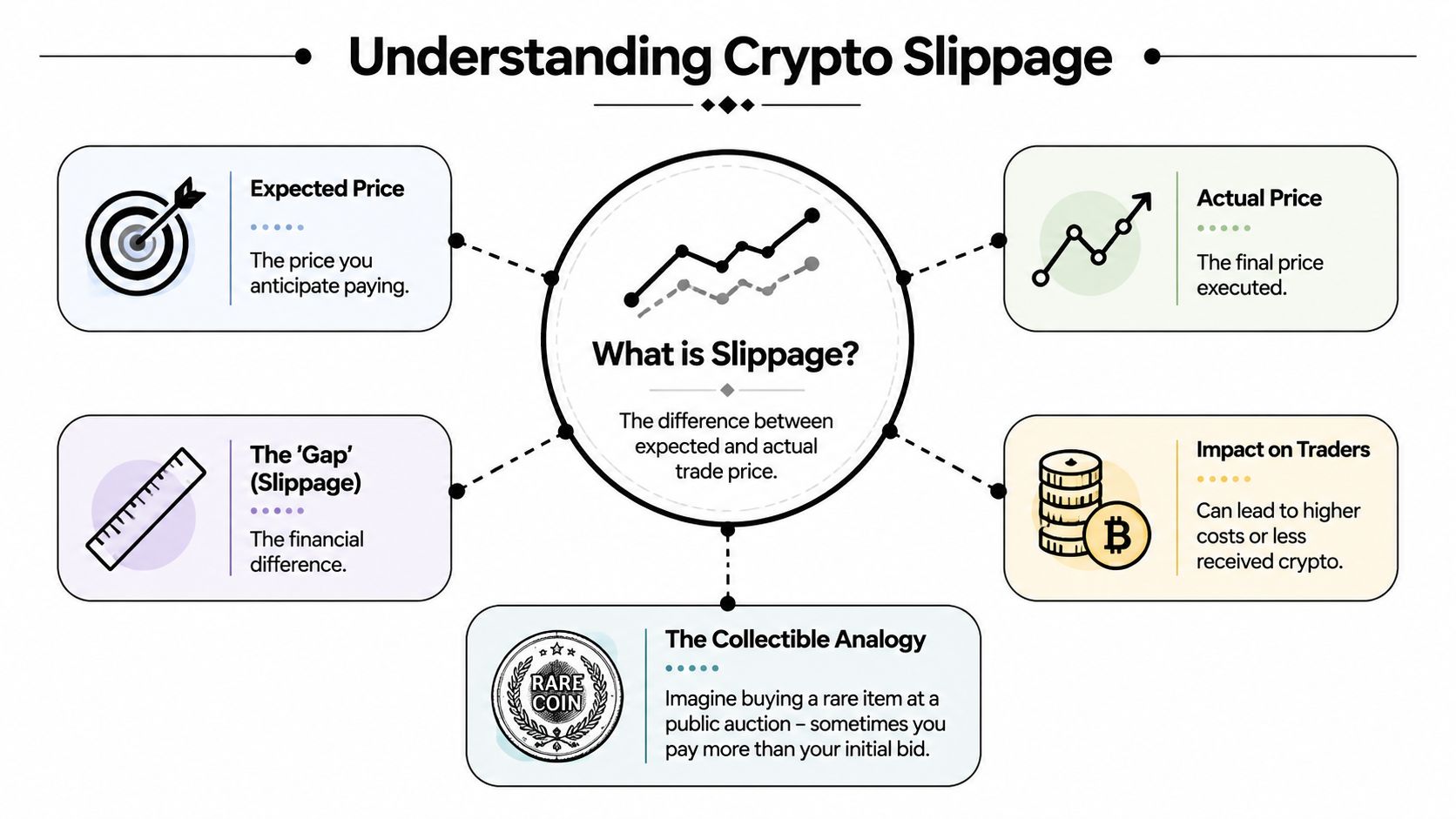
For less experienced traders, the most useful way to think about slippage is simple: it's the difference between the trade you planned and the trade you got. The rest of the details matter, but that framing keeps you focused on what counts. Execution quality.
MEV and Sandwich Attacks — When Slippage Is Not Market Movement but Manufactured Theft
Your article correctly explains slippage as the gap between expected and executed price caused by volatility, low liquidity, and order size. There is a fourth cause that is not a market condition but a deliberate extraction mechanism — and it accounts for a significant portion of the slippage that DEX traders experience on Ethereum specifically. Understanding it changes how you set slippage tolerance from a passive preference into an active defense decision.
MEV stands for Maximal Extractable Value. It refers to the profit that bots and block producers can capture by reordering transactions within a block before they confirm. The most common and directly harmful version for retail traders is the sandwich attack. The mechanics are precise and repeatable. A bot monitors the public mempool — the queue of pending transactions waiting to be included in a block — for large DEX swaps. When it identifies a swap large enough to move a pool's price, it submits its own buy transaction with a higher gas fee to jump ahead in the queue. The bot's buy executes first, pushing the price up. The original trader's swap then executes at the now-worsened price. The bot immediately sells into the trader's transaction, capturing the price impact as profit. The trader receives fewer tokens than they should have, and the deficit is not random market movement — it is the exact amount the bot extracted.
The detail that connects this directly to slippage tolerance settings is critical: your slippage tolerance is the ceiling on how much a sandwich bot can extract from you and still have your transaction succeed. Arch's April 2026 analysis states this plainly — if you set 3% slippage tolerance, a sophisticated bot can push your execution price to within 2.9% of your expected price and your transaction will still confirm. You have, in effect, pre-authorized up to 3% extraction. A tighter tolerance shrinks the bot's profit window and makes your transaction less attractive to sandwich. A tolerance below what the pool's natural volatility requires will cause your transaction to fail — so the calibration is not zero, but it should be as tight as the market allows rather than as wide as you feel comfortable accepting.
The practical defenses available in 2026
Flashbots Protect on Ethereum routes your transaction directly to block builders without passing through the public mempool, eliminating the window in which bots can see and front-run your order. Jito on Solana provides equivalent protection for Solana-based trades. CoW Swap uses a batch auction model that eliminates the sequential transaction ordering that sandwich attacks depend on. DEX aggregators like 1inch and Paraswap route through private order flow paths when available, reducing but not eliminating MEV exposure depending on the specific path.
The practical rule for managing this is layered. Set slippage as tight as the pool's natural spread allows. For established tokens with real liquidity, 0.5% is a reasonable floor. For volatile or new tokens where 1% to 3% may be necessary to avoid failed transactions, use a private RPC or MEV-protected routing service to reduce the extraction risk that comes with wider tolerance. These two defenses — tight tolerance and private routing — work together rather than as substitutes. The wallet scanner protection guide covers the full threat landscape including honeypot contracts and approval scams that compound the execution risks your slippage settings alone cannot address.
Introduction The Hidden Cost in Your Crypto Trades
A lot of traders first learn what does slippage mean in crypto after a frustrating swap. You expect one amount, approve the transaction, and receive less. Nothing looks obviously broken. The route worked, the tokens arrived, and the wallet updated. But your trade cost more than you thought.
That's slippage in its most practical form. It's not a fee line item in the same way a platform fee or gas fee is. It's a change in execution. That makes it easier to ignore and harder to manage unless you know exactly what to look for.
For DeFi traders, especially copy traders and memecoin hunters, slippage can impact the economics of an otherwise good idea:
- A copied entry arrives late: the wallet you follow bought early, but your fill lands after the pool has already moved.
- A small-cap token punishes size: what looked like a manageable order turns into a worse average price because the pool can't absorb it cleanly.
- A fast market breaks assumptions: by the time your transaction confirms, the quote is stale.
Practical rule: If you don't account for slippage before you trade, you're letting the market choose part of your risk for you.
The fix isn't to avoid DEXs or stop trading volatile assets. It's to understand when slippage is acceptable, when it's a warning sign, and when it completely changes the trade. Good traders don't just find opportunities. They judge whether those opportunities can be executed at a price that leaves room for profit.
Understanding Crypto Slippage Fundamentally
Slippage is the gap between the price on your screen and the price you get when the trade executes. For a trader, that gap is part of the trade cost. For a copy trader chasing a wallet entry or a memecoin hunter hitting a fast-moving pool, it can decide whether the setup still has positive expectancy.
Start tracking smart money today
Join thousands of traders using WalletFinder.ai to find profitable wallets and copy their trades.
Start Free Trial →

