
What Does Dex Do? A Clear & Actionable Explainer
Discover what does dex do: learn how decentralized exchanges work, core functions like swapping and liquidity, and the key risks to know.
At its core, a decentralized exchange (DEX) is a peer-to-peer marketplace where you trade crypto directly from your own wallet. No middlemen, no company accounts, no handing over your funds.
Think of it like a digital farmers' market. You show up with your own cash (your crypto wallet) and deal directly with the vendors (automated smart contracts), keeping complete control over your funds the entire time. This setup opens the door to permissionless trading for anyone with a wallet and an internet connection.
How a DEX Changes the Trading Game
To really get what makes a DEX tick, it’s useful to stack it up against a centralized exchange (CEX) like Coinbase or Binance. On a CEX, you deposit your funds into an account the company controls. They’re the custodian, holding your crypto and matching buyers with sellers behind the curtain. You’re trusting them to keep your assets safe and execute trades fairly.
A DEX flips that model on its head. Instead of depositing anything, you just connect your personal crypto wallet to the platform. You never give up control of your private keys, which means you always control your assets. This principle of self-custody is the single biggest difference and a huge draw for traders.
And it's not a niche concept anymore. DEXs now process an average daily trading volume of $4.93 billion. Some projections even suggest the total yearly volume could hit $3.48 trillion.
This peer-to-peer magic is powered by two main technologies:
- Automated Market Makers (AMMs): These use community-funded pools of tokens (liquidity pools) to create instant liquidity for traders. This is the most common model.
- Order Books: These work more like traditional stock exchanges, matching individual buy and sell orders directly. This model is faster but less common.
We'll break down these "engines" in more detail later. For now, the key takeaway is that DEXs use on-chain smart contracts to automate trading, cutting out the need for a central company to run the show. For a deeper dive, check out our complete guide on decentralized crypto exchanges.
DEX vs. CEX: A Quick Comparison
To make the distinction crystal clear, it helps to see the practical differences side-by-side. The table below breaks down how trading on a DEX compares to a CEX.
The most fundamental difference between a DEX and a CEX is who holds your funds. On a DEX, your assets stay in your personal wallet throughout the entire trade — you never hand them over. On a CEX, the exchange takes custody, meaning you are trusting a company to keep your crypto safe and return it when you ask.
Privacy follows the same logic. DEXs require nothing but a wallet address to trade, with no identity verification of any kind. CEXs operate under KYC and AML requirements, meaning you submit personal identification before you can access the platform.
Token access is where DEXs have a structural advantage for active traders. Anyone can deploy a liquidity pool on a DEX, so new and early-stage tokens appear there long before a centralized exchange considers listing them. CEXs run a selective approval process, which filters out most low-cap and newly launched projects.
The risk profiles point in different directions. DEX users face smart contract vulnerabilities, the consequences of losing their own private keys, and impermanent loss if they provide liquidity. CEX users face exchange hacks, the possibility of fund freezes, and the counterparty risk of company insolvency — as multiple high-profile collapses have demonstrated.
In terms of best fit, DEXs suit traders who want early token access, yield opportunities, or financial privacy. CEXs are the better starting point for anyone who needs to move fiat into crypto, wants a guided user experience, or values having customer support available when something goes wrong.
Ultimately, the choice between a DEX and a CEX comes down to what you value most as a trader: the control and privacy of a DEX, or the convenience and user experience of a CEX.
The Two Engines That Power a DEX
To really get what a DEX does, you have to look under the hood at the two main "engines" that make trades happen. These systems are what set the prices, match up buyers and sellers, and ultimately define your entire trading experience. While they both get you to the same place—swapping assets without a middleman—they go about it in completely different ways.
Most modern DEXs run on an Automated Market Maker (AMM) system. Don't think of an AMM as a traditional marketplace with buyers and sellers haggling over prices. Instead, picture an automated robot banker that's always ready to trade with you, 24/7. This "robot" doesn't need to find another person to take the other side of your trade; it just uses a giant pool of tokens to fill your order instantly.
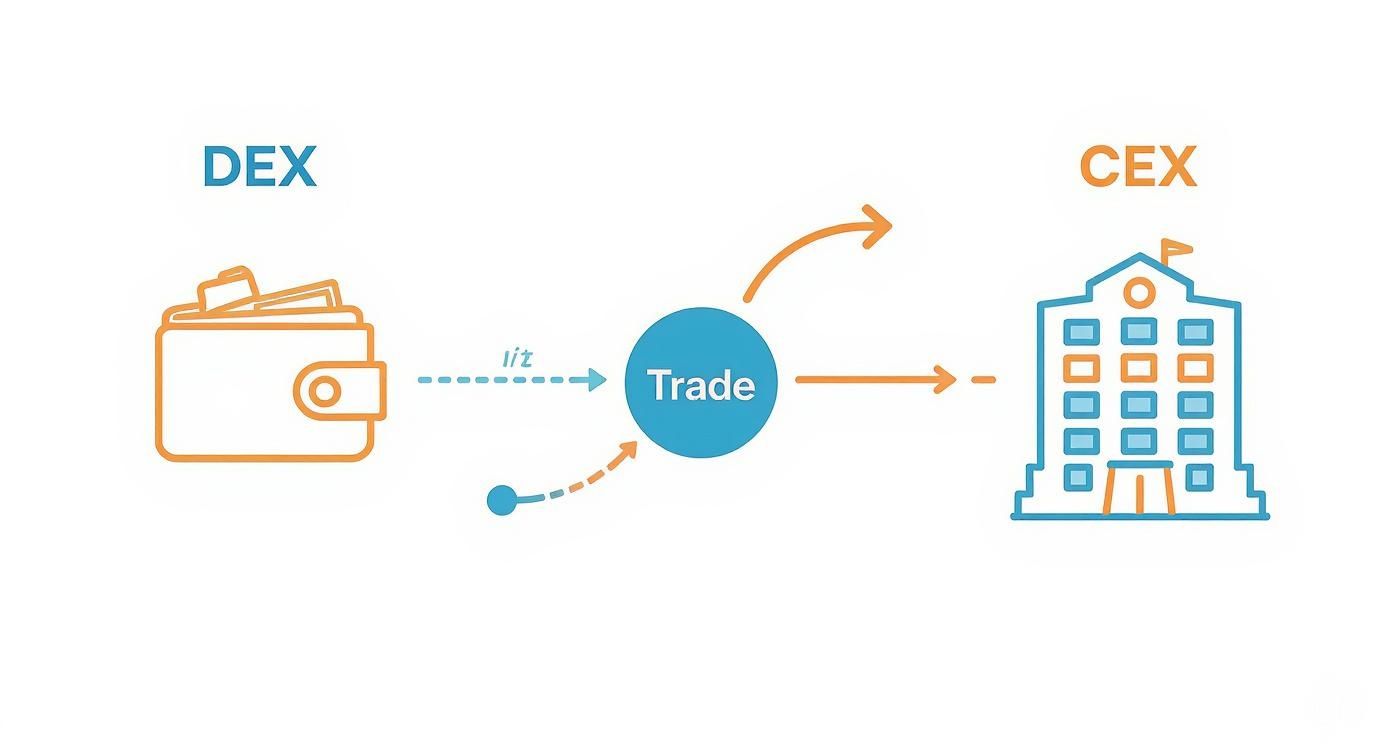
This infographic gives you a quick visual breakdown of the difference between a DEX, where you trade directly from your wallet with these automated systems, and a CEX, which holds your funds to manage its own book of trades.
Start tracking smart money today
Join thousands of traders using WalletFinder.ai to find profitable wallets and copy their trades.
Start Free Trial →

