
Wallet Protection From Scanning: A Guide
Discover essential wallet protection from scanning. Our guide offers practical tips on RFID shielding and crypto security to keep your financial assets safe.
Effective wallet protection from scanning isn't about paranoia—it's about being prepared. The idea is to use RFID-blocking technology, like specially designed wallets or simple card sleeves, to create a protective shield around your credit cards and passports. This barrier stops criminals from using portable scanners to wirelessly lift your personal and financial info right out of your pocket.
The Unseen Risks in Your Pocket
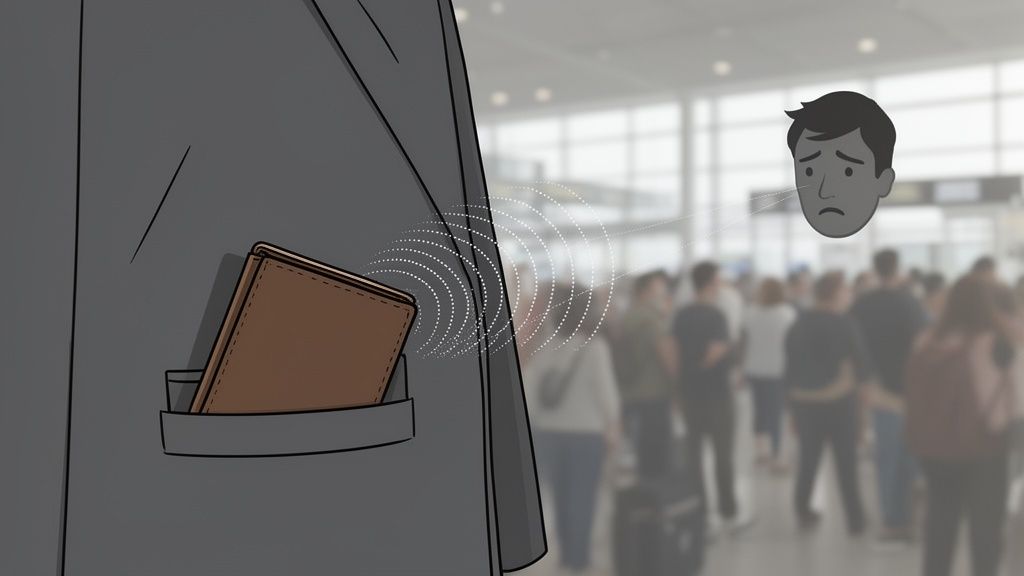
The "tap-to-pay" feature we all love for its convenience has a hidden dark side: digital pickpocketing. The very cards that make checkout a breeze are constantly broadcasting signals that can be snatched out of the air. This isn't some complex, Hollywood-style heist; it's a silent and invisible threat that can happen anywhere, anytime.
Think about the last time you were in a crowded airport terminal or waiting in line for coffee. Someone standing nearby could be holding a small, cheap scanner. By just walking past you, they can try to skim the data from the RFID and NFC cards in your wallet. You wouldn't feel a thing.
How Digital Skimming Actually Works
This type of theft, often called RFID skimming or electronic pickpocketing, works by exploiting the radio waves your contactless cards emit. While they're only designed to be read from a few inches away for a legitimate payment, criminals can use powerful boosters to read card data from several feet away.
With a simple scan, a thief can capture:
- Your Full Name: The name printed on the card.
- Card Number: The full 16-digit number.
- Expiration Date: The month and year the card expires.
With just these three pieces of information, a thief has everything they need to start making fraudulent online purchases or even create a cloned card. The whole process takes seconds, and you might not have a clue until you spot strange charges on your statement days later.
For a deeper look into identifying these kinds of threats, you can check out our detailed checklist for assessing wallet risks.
The really scary part isn't the technology itself, but how easy it is to get. Basic RFID readers can be bought online for less than $100, making this a low-cost, high-reward crime for anyone looking to make a quick buck.
Just understanding this vulnerability is the first step toward real wallet protection from scanning. It’s not about ditching your cards; it’s about taking control. Once you accept that your cards are always "on," you can take simple but powerful steps to decide who gets to listen in.
So, What Exactly Are RFID and NFC Threats?
To really bulletproof your wallet, you have to get inside the head of a digital pickpocket and understand their playbook. The magic behind "tap-to-pay" convenience relies on two key pieces of tech: Radio-Frequency Identification (RFID) and Near Field Communication (NFC). These are the very same technologies that open the door for bad actors.
People throw these terms around interchangeably, but the differences are what matter when it comes to keeping your money safe.
Think of RFID as the broader, simpler technology. It's mostly a one-way street where a passive tag—like in a building access card or a passport—broadcasts its info to any reader that wakes it up. It’s like a tiny radio station that just blurts out its ID to anyone listening.
NFC, on the other hand, is a smarter, two-way version of RFID. It’s designed for a much shorter range, usually just a few inches. This close-range handshake is what allows for secure, interactive stuff, like when you tap your phone or credit card to buy a coffee.
How Scammers Turn Convenience Against You
The real threat boils down to one thing: unauthorized scanning. Your contactless cards are packed with tiny chips and antennas that are built to respond to radio waves from a reader. In a perfect world, that only happens at a checkout terminal. But a thief with a portable, high-powered scanner can create that same energy field from a distance.
Sure, NFC is supposed to work only when things are cozy and close. But criminals don't play by the rules. They use booster antennas to stretch that range from a few inches to several feet.
This lets them pull off a "skimming" attack in any crowded space—a busy subway car, a packed concert, you name it. They just have to walk by you. Their scanner, hidden in a bag, wakes up your cards and snatches your name, card number, and expiration date. You won't feel a thing.
The weak link here isn't a flaw in your card's chip. It's the unshielded signal. Your card is designed to be helpful and respond to any valid reader, but it has no way of knowing if that reader is a legit payment terminal or a scammer's tool in a backpack.
This is where wallet protection from scanning comes in. The goal is simple: block those radio waves completely and create a silent bubble around your cards.
RFID vs NFC: What's In Your Wallet?
Knowing what's in your wallet helps you figure out your biggest risks. Both RFID and NFC use radio waves, but their different ranges and data capabilities mean they have different vulnerabilities. Most of your tap-to-pay credit cards will be NFC, while things like work ID badges or older transit passes might be RFID.
Here’s a quick breakdown to help you see what’s what.
Start tracking smart money today
Join thousands of traders using WalletFinder.ai to find profitable wallets and copy their trades.
Start Free Trial →

