
Finding the True Market Price in DeFi
Learn to find the true market price in DeFi. This guide uncovers how liquidity, slippage, and on-chain data reveal what crypto assets are actually worth.
When you see a token's price on an app, what are you really seeing? In the chaotic world of DeFi, that number is never a single, fixed truth. The true market price is a consensus—an ever-shifting average of an asset's worth across dozens of exchanges at any given second.
It’s the price you’d actually get if you tried to execute a trade right now, with all the market’s volatility and liquidity quirks baked in. It's almost always different from the last price someone else paid.
What Is the True Market Price in Crypto
Imagine a massive farmers' market with dozens of stalls selling the exact same apples. One sign reads $1.00 per pound, another says $1.05, and a small cart in the corner has them for $0.95. So, what's the "true" price?
It’s not just one of those numbers. The real price depends on how many apples you want to buy and how many each vendor has. You can’t just clear out the cheapest stall without the price jumping up. The true cost is a blend of all available prices, weighted by the supply at each stall.
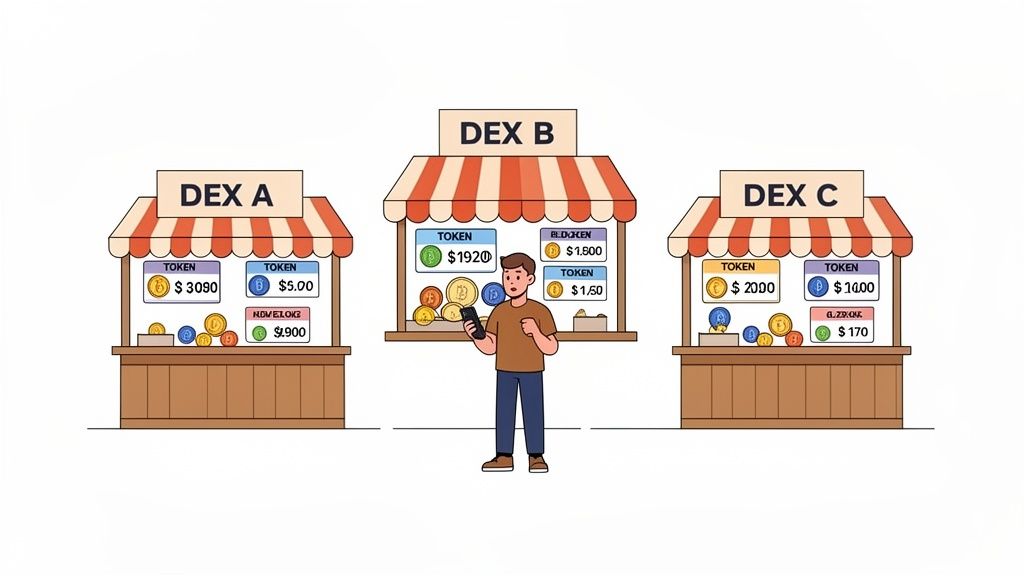
This is precisely what happens in Decentralized Finance (DeFi). A token's price on Uniswap will almost certainly be a fraction of a cent different from its price on SushiSwap. These aren't mistakes; they are the natural outcome of each platform operating as its own micro-economy with unique supply and demand dynamics. Understanding this is your first step to becoming a smarter trader.
The Illusion of a Single Price
The "last traded price" you see on an aggregator is just a snapshot of a past event—a single trade that's already over. The price you can actually execute at is constantly being pulled and pushed by forces that most traditional finance traders never deal with so directly.
A few key factors are always stirring the pot:
- Liquidity Depth: How much of an asset is available to trade without causing a massive price swing. A "shallow" pool means a single large order can send the price into a nosedive or to the moon.
- Order Book Dynamics: On exchanges that use them, the balance of buy and sell orders is everything. A tidal wave of sell orders will drown the price.
- AMM Mechanics: Most decentralized exchanges (DEXs) run on Automated Market Makers (AMMs), which use mathematical formulas—not order books—to set prices based on the ratio of two tokens in a liquidity pool.
The big takeaway is that every DEX is its own micro-economy. The true market price isn’t a number beamed down from a central authority. It’s a messy, decentralized consensus you can only find by comparing these little economies in real time.
DeFi Price Metrics at a Glance
So, how do you find the true market price? You start by understanding the different ways a "price" can be reported. Each metric gives you a piece of the puzzle, but none shows you the whole picture on its own.
Here's a quick rundown of common price metrics and why you can't trust any single one completely.
| Price Metric | What It Represents | Key Limitation |
|---|---|---|
| Last Trade Price | The price at which the most recent transaction occurred. | A single tiny or massive trade can skew this number, making it irrelevant to the current market. |
| Mid-Price | The average between the highest bid (buy) and lowest ask (sell) price. | A theoretical midpoint. You often can't actually trade at this price, especially when things get volatile. |
| AMM Implied Price | The price calculated by an AMM's formula based on its pool ratio. | Doesn't account for the price impact (slippage) your own trade will create. The final price you get will be worse. |
| Oracle Price | A price feed from an external source used by lending protocols. | Oracles are often slow to update. They lag behind real-time market action, making them useless for fast trading. |
Start tracking smart money today
Join thousands of traders using WalletFinder.ai to find profitable wallets and copy their trades.
Start Free Trial →

