
Mastering Stop Loss Crypto: Protect Your Investments in 2026
Master stop loss crypto in 2026 to safeguard your trades. This guide covers essential order types, common pitfalls, and advanced strategies for volatile
You bought a coin with a clean breakout, decent volume, and a story everyone on X seemed to agree on. For a while, it worked. Then the market turned while you were away from the screen. By the time you checked again, the green trade had become a red one, and the hardest part wasn't the loss. It was knowing you had time to prevent it.
That's where stop loss crypto trading stops feeling like theory and starts feeling necessary. A stop loss isn't there to make you look smart. It's there to keep one bad decision, or one bad hour, from damaging your account far more than it should.
Good traders don't always avoid losses. They avoid uncontrolled losses. That difference is most of the game.
The Trade You Wish You Could Take Back
Most newer traders remember one position more clearly than all the winners.
It's usually the one that was up nicely, then round-tripped because there was no exit plan. An altcoin breaks out, momentum builds, the candles look strong, and selling feels premature. You tell yourself you'll close it manually if price weakens. Then a sharp market-wide flush hits, liquidity disappears, and the chart falls much faster than your decision-making does.
That kind of trade leaves a mark because it exposes two things at once. First, crypto can move violently even when your original idea wasn't crazy. Second, hesitation gets expensive.
A stop loss solves a very specific problem. It handles the decision you're worst at making in real time: accepting that the trade is invalid before the loss gets emotionally hard to take.
What usually goes wrong
- You confuse unrealized profit with safety: A trade being up earlier doesn't protect it now.
- You wait for a bounce that never comes: Crypto often gives one weak bounce, then another leg down.
- You move the line in your head: Without a preset order, the exit keeps drifting lower.
- You size too large: When the position is uncomfortable, you stop acting rationally.
Losses hurt less when they're planned. Unplanned losses damage both capital and judgment.
The traders who stay around long enough to improve usually learn one habit early. They define the risk before they enter, not after the chart turns ugly.
That doesn't mean every stop will save you perfectly. It won't. Slippage is real, fast markets are messy, and low-liquidity coins can behave badly. But having a stop is still better than negotiating with yourself while a candle is collapsing.
If you've ever watched a good trade become a painful lesson, you already understand why this matters. The stop loss isn't the advanced part of trading. It's the adult part.
What Is a Crypto Stop Loss Anyway
A crypto stop loss is a conditional exit order. When price hits your trigger, the exchange activates the order automatically. On many venues, that order typically converts into a market order, which means it's built to prioritize execution certainty over exact fill price, and it can be used for both longs and shorts, as explained in Kraken's stop-loss order guide.
Consider a fire escape in a building. You don't install it because you expect disaster every day. You install it because when things go wrong, speed matters more than elegance.
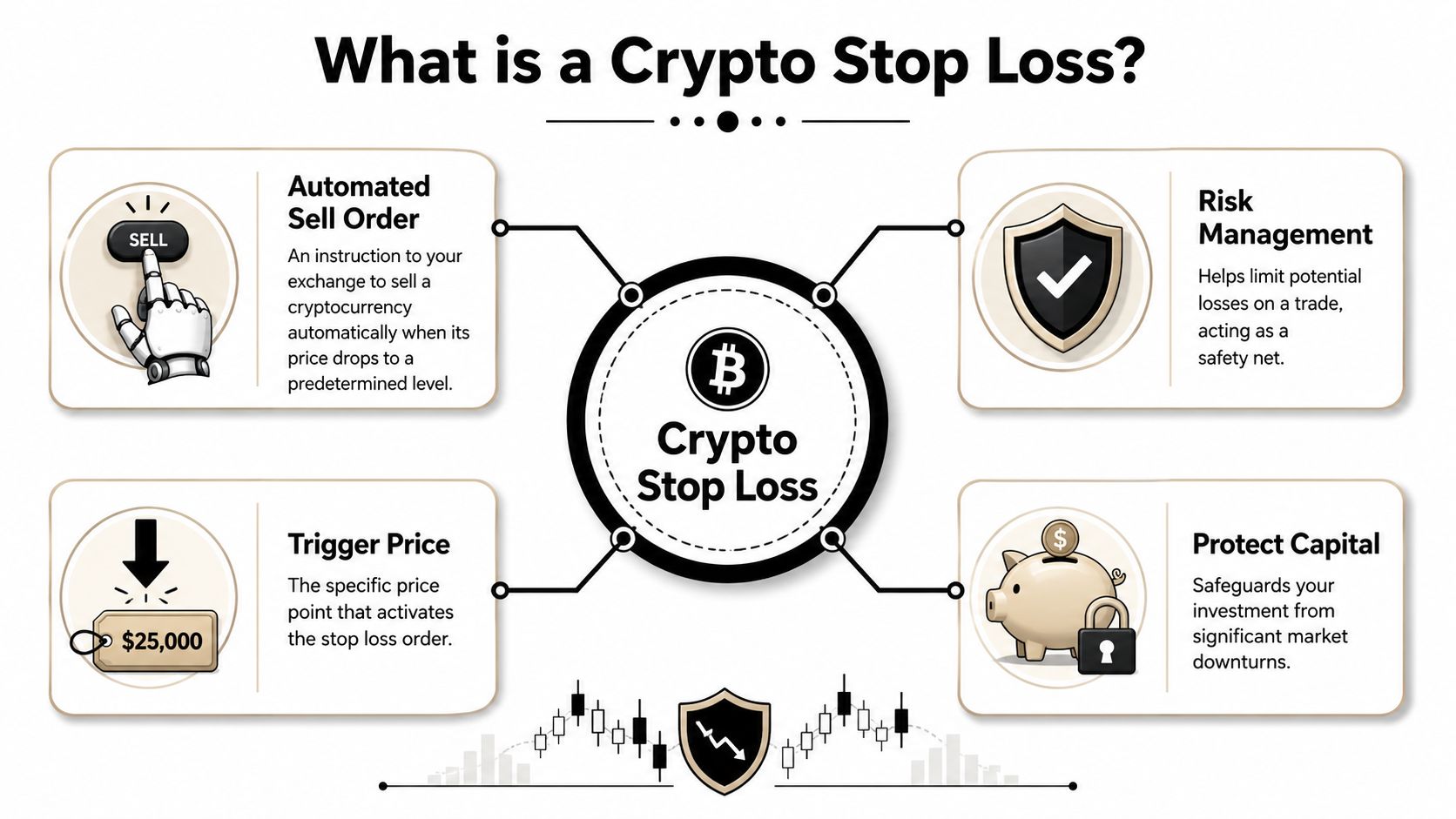
What a stop loss does for you
A stop loss does not predict the market. It does something more practical. It draws a line where your trade thesis is no longer valid.
That matters in crypto because volatility punishes indecision. If you trade manually without a predefined exit, you're forcing yourself to make a calm decision during the least calm part of the trade.
Here's the simplest way to frame it:
- Entry answers opportunity: Why buy here?
- Target answers reward: Where do you expect the move to go?
- Stop answers invalidation: At what point are you wrong?
If you can't answer the third question before entry, you don't really have a trade plan. You have a hope plan.
Trigger price versus fill price
Beginners often get confused. Your stop price is the trigger, not a promise.
If the market reaches that level, the exchange tries to get you out. In calm conditions, the fill may be close. In chaotic conditions, the fill may be worse. That's normal behavior for a tool designed to get you out first and optimize later.
Practical rule: Treat a stop loss as a damage-control tool, not a precision instrument.
If you want to get more comfortable with order mechanics before using stops, it helps to review how crypto limit orders work in practice. Limit logic and stop logic solve different problems, and mixing them up causes a lot of avoidable mistakes.
Why newer traders resist using one
Usually for emotional reasons, not technical ones.
- They don't want to be “wrong” quickly
- They've been wicked out before
- They think manual exits give more control
- They want to leave room for the trade to work
That last point sounds reasonable, and sometimes it is. But “giving it room” only makes sense if the room is defined in advance. Otherwise the trade just keeps borrowing more of your capital and attention.
A stop loss is not bearish. It's disciplined. In crypto, that distinction matters.
Choosing Your Shield Stop Loss vs Stop Limit vs Trailing Stop
Once you accept that you need an exit plan, the next question is which tool fits the job. Many traders make the first serious mistake at this point. They choose an order type because it sounds safer, not because it matches the market they're trading.
On major exchanges, stop-loss and stop-limit orders are standard risk controls. A stop-loss becomes a market order when triggered, which prioritizes execution. A stop-limit adds a second price condition and may not fill if the market moves too fast. Exchange education also repeats a broader portfolio rule: don't risk more than 2% of total capital per trade, as outlined in Crypto.com's guide to stop-loss and take-profit levels.
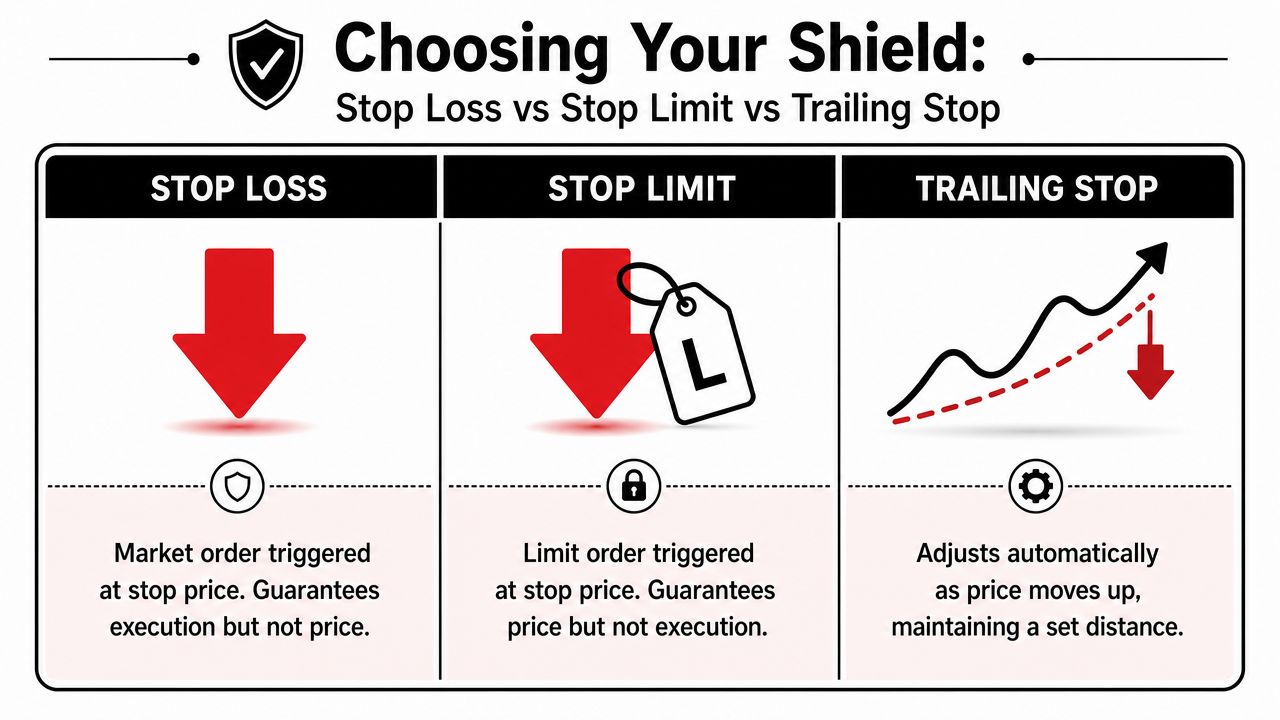
The three tools that matter most
A plain stop loss is the blunt instrument. It's there to get you out.
A stop limit adds control over price, but that control comes at a cost. In a fast drop, your order can trigger and still sit there unfilled while price keeps moving away.
A trailing stop is different. It follows price as the market moves in your favor, then triggers if price reverses by your chosen distance. Traders like it because it can protect gains without constant manual updates. The catch is simple: in choppy crypto markets, a trailing stop can get shaken out repeatedly.
Stop order type comparison
| Order Type | How It Works | Best For | Key Risk |
|---|---|---|---|
| Stop Loss | Triggers an exit order when price hits your stop level, with execution prioritized over exact price | Fast markets, high-conviction risk control, traders who care more about getting out than perfect precision | Slippage |
| Stop Limit | Triggers a limit order after the stop is reached | More controlled conditions where price discipline matters and liquidity is decent | No fill during sharp moves |
| Trailing Stop | Moves with price as the trade goes your way, then exits on reversal | Trend trades where you want to lock in gains without setting a static exit | Noise can trigger premature exits |
Start tracking smart money today
Join thousands of traders using WalletFinder.ai to find profitable wallets and copy their trades.
Start Free Trial →

