
Unlock DeFi's Future with Smart Wallet Crypto
Unlock DeFi's full potential. Explore smart wallet crypto & account abstraction for safer, automated copy trading. Elevate your strategy.
Most copy traders know the feeling. You catch a wallet alert, the setup still looks good, and then the old wallet flow slows you down.
First you approve. Then you swap. Then you sign another step because the route changed. Gas spikes, the token moves, and now you're deciding whether to chase or pass. One clumsy click can also expose more risk than the trade was worth.
That friction is why smart wallet crypto matters. For active DeFi traders, a wallet isn't just storage anymore. It's part execution engine, part risk control, part recovery system. Used well, it turns a wallet from a passive key holder into trading infrastructure.
The Trader's Dilemma with Traditional Wallets
A traditional wallet works fine until speed and precision start to matter. If you're copying wallets on Ethereum, Solana, or Base, delays compound fast. By the time a standard wallet user handles approvals, checks gas, and confirms every action manually, the trader they're following may already be out.

The older wallet model was built for custody first, not execution. The wallet journey started with Bitcoin-Qt in 2009, moved to hardware wallets like Trezor in 2014 after major hot wallet hacks, and by 2026 the next milestone is smart wallets using account abstraction such as ERC-4337, with features like gasless transactions and social recovery that reduced user errors by up to 90% in tests according to CoinLaw's history of crypto wallets.
Where EOAs break down in live trading
An Externally Owned Account, or EOA, gives you direct control with a private key. That's simple. It's also rigid.
For copy trading, that creates a few common problems:
- Manual approvals slow entry: You often need more than one transaction to finish one idea.
- Single-key risk stays high: If the key or seed phrase is compromised, the whole account is exposed.
- No built-in rules: The wallet won't stop a bad approval, oversized transfer, or interaction with the wrong contract.
- Recovery is weak: Losing access can mean losing the account.
Smart wallets matter when execution and security have to work together, not compete.
The professional upgrade
Smart wallets solve a trader's real problem. They don't just hold assets. They let you define how the account behaves.
That changes the workflow from reactive to structured. Instead of racing your wallet every time a setup appears, you can pre-configure permissions, reduce unnecessary signing, and build safer paths for bots, mobile trading, and multi-step DeFi actions.
For anyone serious about mirroring on-chain traders, the wallet itself becomes part of the edge.
What Exactly Is a Smart Crypto Wallet
A copy trader following a fast wallet has a simple problem. The market moves in one burst, but a traditional wallet often forces approval, swap, stake, and risk checks into separate steps. Each extra signature adds delay, more room for slippage, and more chances to approve the wrong contract.
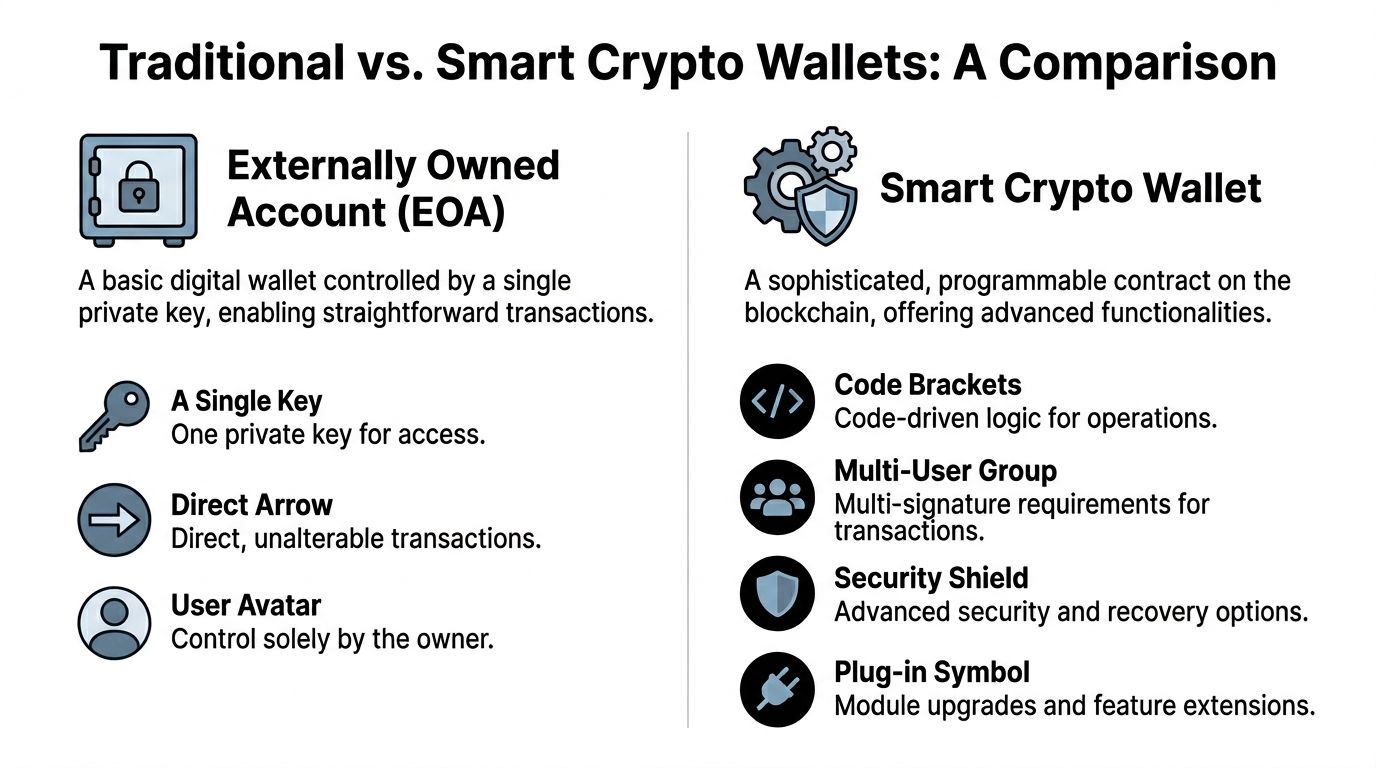
A smart crypto wallet solves that by turning the wallet from a basic key holder into programmable account infrastructure. You still control the assets. The difference is that the account can apply rules, permissions, and execution logic before a transaction goes through.
The simple definition
An EOA is an account controlled directly by one private key.
A smart wallet is an account run through smart contract logic or similar programmable authorization architecture. In practice, that gives the account features a plain EOA cannot handle on its own, such as:
- Multi-signature controls: more than one approval can be required.
- Spending limits: transfers can be capped by amount, token, or destination.
- Recovery methods: access can be restored through pre-set recovery rules.
- Automation hooks: recurring or conditional actions can be authorized in advance.
- Gas flexibility: some transactions can be paid through sponsored flows or alternative gas handling.
For traders learning the mechanics of crypto copy trading, that difference matters fast. The wallet stops being a passive signing tool and starts acting like execution policy.
Why account abstraction matters
Most modern smart wallet design comes back to account abstraction, especially ERC-4337.
At a practical level, account abstraction separates ownership from transaction logic. A normal account mostly answers one question: did the private key sign this? A smart wallet can answer more useful questions first: is this within the spending limit, is the destination approved, can these three actions be executed together, should a bot have temporary permission for this session only?
That is a significant shift.
For a copy trader, account abstraction works like replacing a manual gearbox with a transmission that can follow rules you set ahead of time. You still choose the route. The wallet just handles execution with more control and less friction.
Common results include:
- Atomic batching: approval, swap, and deposit can be grouped into one flow.
- Custom validation: the account can reject actions outside your rules.
- Delegated access: session keys can let a bot or device trade within narrow limits.
- Cleaner gas handling: the wallet can support flows that do not depend on holding the native gas token in the usual way.
What that changes for active traders
For active DeFi use, the benefit is not theory. It is fewer failure points during live execution.
A smart wallet can be set up so a copy trading system has permission to mirror trades up to a fixed size, only on approved protocols, only for a defined time window. That is a major improvement over exposing a hot wallet with broad permissions and hoping nothing goes wrong. The trader gets speed without giving up all control.
Batching matters too. If the source wallet rotates capital from one token into another and then deposits into a vault, a smart wallet can handle that as one planned sequence instead of several disconnected transactions. The result is tighter execution and fewer moments where price can move against you.
Wallet type comparison
| Feature | Externally Owned Account (EOA) | Hardware Wallet | Smart Wallet |
|---|---|---|---|
| Control model | Single private key | Single private key stored offline | Programmable rules, often with multiple authorization options |
| Best use case | Basic transfers and broad dApp compatibility | Long-term cold storage | Active DeFi, automation, copy trading, team controls |
| Transaction logic | Direct signing only | Direct signing only | Custom validation and execution logic |
| Recovery options | Usually seed phrase only | Usually seed phrase backup | Can support social recovery or other built-in recovery paths |
| Approvals | One signer | One signer | Can require multiple signers or conditional approval |
| Batch transactions | Limited in standard flow | Limited in standard flow | Designed to support batched actions |
| Gas flexibility | User pays gas directly | User pays gas directly | Can support gas abstraction or sponsored flows |
| Automation | Minimal | Minimal | Strong fit for recurring or rule-based actions |
| Security posture | Simple but fragile if key is lost | Strong for storage, slower for active trading | Strong if well designed, but depends on contract quality |
| Ideal trader profile | Casual user | Long-term holder | Active trader who wants execution and policy controls |
Start tracking smart money today
Join thousands of traders using WalletFinder.ai to find profitable wallets and copy their trades.
Start Free Trial →

