
Master Your DeFi with a Smart Contract Wallet
Master DeFi with a smart contract wallet. Learn how it works, account abstraction, social recovery, & smarter copy trading. Unlock advanced crypto features.
Losing a seed phrase is the kind of mistake that keeps crypto traders awake at night. So does clicking through a string of approvals just to complete one routine DeFi move. If you've ever approved a token, signed a swap, then signed another action for staking or bridging, you've already felt the limits of the old wallet model.
A traditional wallet works like a single metal key. Hold the key, control the funds. Lose it, and you're stuck. A smart contract wallet changes that model. Instead of relying only on one secret, it lets you set rules around how the account behaves onchain.
That difference matters more than most beginner guides admit. You're not just upgrading security. You're changing what a wallet is. It stops being a passive container and becomes an active account that can enforce approvals, limits, recovery methods, and multi-step actions.
For traders, that shift is practical. It changes how transactions appear, how strategies execute, and how you should interpret wallet behavior when studying smart money. Some of the cleanest onchain activity now comes from wallets that don't act like simple retail addresses at all.
Introduction Beyond the Private Key
The old wallet model is brutally simple. One private key controls everything. That's easy to understand, but it's also fragile. A single compromised device, a lost seed phrase, or one bad signing session can turn a manageable mistake into a permanent loss.
A smart contract wallet solves that by replacing single-key control with programmable rules. You still control your funds, but the control can be shared, delayed, limited, or recovered depending on how the wallet is configured.

Why traders started paying attention
Institutions moved early because the benefits look familiar to treasury teams. According to SQ Magazine's 2025 wallet adoption data, 52% of institutional wallets interact with smart contracts monthly to use enhanced security features. That matters because it shows this isn't a niche wallet preference. It's part of how serious capital is operating onchain.
For a newer trader, the easiest way to think about it is this:
- EOA wallets are keys
- Smart contract wallets are rule-based accounts
That one change provides better control over approvals, spending, team access, and recovery. It also creates richer behavior onchain. A wallet can require multiple signers. It can reject transfers above a threshold. It can bundle several actions together as one operation.
If you want a baseline on how standard crypto wallets differ before going deeper, this guide to the crypto DeFi wallet is a useful primer.
A better mental model
Think of a normal wallet like a house key taped to the front door. Whoever has the key gets in. A smart contract wallet is closer to a building with staff, access logs, approval rules, and backup contacts.
That sounds more complex, and it is. But the complexity is there to remove the all-or-nothing risk that comes with single-key wallets.
Practical rule: If your strategy depends on large balances, shared capital, or frequent DeFi actions, a wallet that follows rules is usually safer than a wallet that trusts one signer forever.
This is also why smart contract wallets matter to analysts. Their transactions often reflect deliberate setup rather than impulse. When you study these wallets, you're not just looking at trades. You're looking at decision systems.
How Smart Contract Wallets Fundamentally Work
The engine behind the modern smart contract wallet is usually account abstraction. That phrase sounds technical, but the idea is simple. It separates the account from the old assumption that one private key must directly authorize every transaction.
With account abstraction, your wallet can be a smart contract. That contract defines what counts as valid authorization. The rule might be one signature, multiple signatures, a passkey, a sponsored gas flow, or some other approved method.
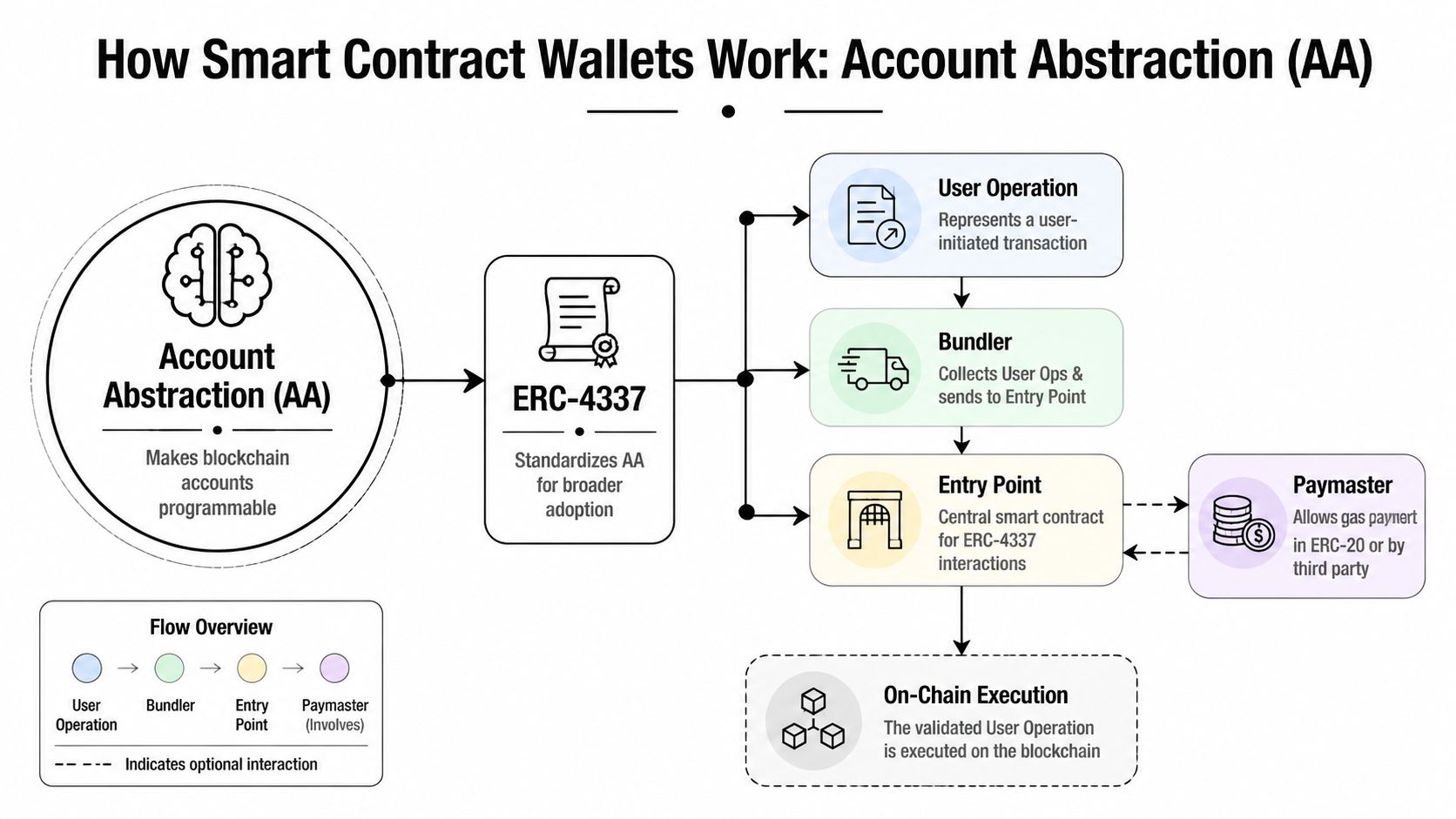
Think of it like a programmable assistant
A good analogy is a personal trading assistant with written instructions.
You tell the assistant what you're trying to do. Not every instruction gets executed automatically. The assistant checks the rules first. Does this action need another approval? Is the amount within a spending limit? Can gas be paid another way? If the conditions are met, the action goes through.
That assistant is the wallet contract.
Under ERC-4337, the process is standardized. As explained in Ledger's ERC-4337 overview, the architecture has five core components: UserOperations, Bundlers, EntryPoint, Paymasters, and Smart Accounts. Ledger also notes ERC-4337 was formally announced for production on March 1, 2023, and can work on any EVM-compatible blockchain.
The five pieces in plain English
This outlines each part's function.
| Component | Plain-language role | Why it matters to traders |
|---|---|---|
| UserOperation | Your instruction | It describes what you want the wallet to do |
| Bundler | A courier | It collects user instructions and sends them onward |
| EntryPoint | The gateway contract | It verifies and executes the operation |
| Paymaster | A fee sponsor | It can let someone else cover gas, or support alternate fee flows |
| Smart Account | Your programmable wallet | It enforces the wallet's custom rules |
Start tracking smart money today
Join thousands of traders using WalletFinder.ai to find profitable wallets and copy their trades.
Start Free Trial →

