
Sharpe Ratio Calculator: Master Portfolio Performance
Master the Sharpe Ratio Calculator. Learn its formula, calculate in Excel/Python, interpret crypto results, and find top wallets with Wallet Finder.ai for 2026.
You've probably done this already. You spot two wallets with the same headline return, both look elite at first glance, and the temptation is to mirror the one with the louder PnL screenshot.
That's usually where mistakes start.
Raw return hides the path. In crypto, the path matters as much as the endpoint because the path tells you whether the trader survived through controlled risk, got lucky on one burst move, or sat through a drawdown you'd never tolerate in your own capital. A Sharpe ratio calculator helps with that, but only if you use it with the right inputs and read the output with some skepticism.
Most guides stop at the formula. That's not enough for DeFi traders. The practical questions are harder: which return series should you feed the calculator, what do you use as the risk-free rate in crypto, and when is Sharpe the wrong metric entirely? Those are the questions that decide whether the number is useful or cosmetic.
Beyond Raw Returns Why Risk Adjustment Matters
Two wallets can finish in the same place and still be completely different bets.
One compounds through relatively smooth swings, cuts losers early, and rarely needs a miracle rebound. The other survives an ugly collapse, then catches one explosive recovery trade that drags the account back into the green. If you only rank them by return, they look equal. If you care about repeatability, they're not close.
That's why professionals don't stop at PnL. They ask how much uncertainty, instability, and pain came with that return. Risk-adjusted analysis doesn't eliminate judgment, but it filters out a lot of false positives.
What raw return misses
Raw performance tells you the destination. It doesn't tell you:
- How violent the ride was: A wallet that snaps between euphoric gains and deep losses can be hard to copy in real time.
- Whether the gains were concentrated: One outsized winner can mask a weak process.
- How exposed the strategy is to ruin: If the path includes severe drawdowns, many followers would have exited long before the recovery.
- Whether the result is benchmark-worthy: A trader may look impressive while surfing a strong market regime.
A good benchmarking habit is to compare return and risk together, not in isolation. This is the practical logic behind benchmarking portfolio performance.
Practical rule: If two strategies show similar returns, prefer the one that got there with less turbulence unless you have a very clear reason not to.
Why Sharpe became the default
The Sharpe ratio tries to answer a simple question: how much excess return did the strategy generate for the volatility it took?
That's why it became a standard first pass. It compresses return and variability into one number. For screening wallets, funds, or systems, that's useful. It lets you move beyond “who made the most” to “who got paid best for the risk they accepted.”
Still, in crypto, Sharpe is best treated as a starting filter, not a final verdict. It helps you reject noisy performers. It doesn't tell you everything about tail risk, liquidity stress, or non-linear payoff structures.
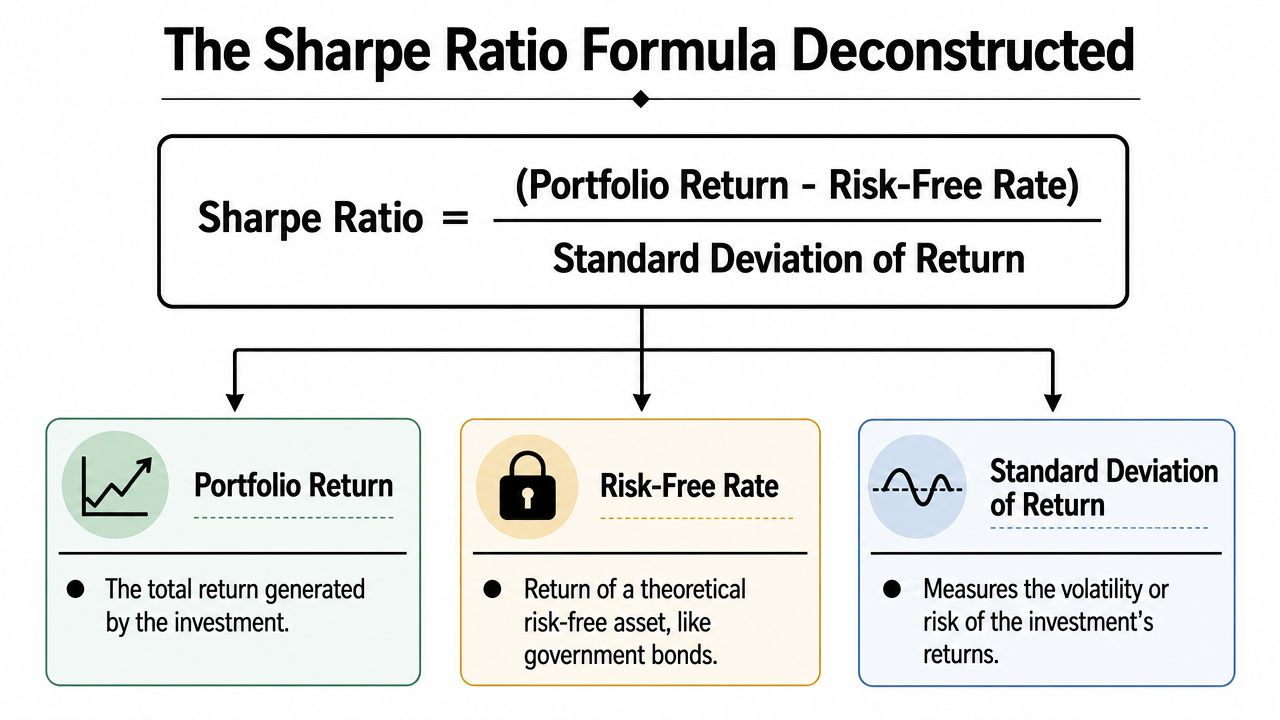
The Sharpe Ratio Formula Deconstructed
A wallet can post the same total return as another and still be far less attractive once you examine the path of returns. Sharpe is the shortcut traders use to separate return quality from return size.
Sharpe Ratio = (Portfolio Return - Risk-Free Rate) / Standard Deviation of Return
Read it in plain English. The numerator is excess return, what the strategy earned above a baseline cash alternative. The denominator is the volatility of the return series you chose. Higher excess return helps. Higher volatility hurts.
Start tracking smart money today
Join thousands of traders using WalletFinder.ai to find profitable wallets and copy their trades.
Start Free Trial →

