
Push Notification Alerts: Your DeFi Trading Edge
Learn how to use push notification alerts to master DeFi. This guide covers setup, best practices for traders, and how to get real-time copy trading signals.
You spot the move too late. A wallet you've been watching rotated into a low-float token, size was obvious, exits were clean, and the chart had already moved by the time you opened X, Telegram, and your dashboard. In DeFi, the edge often isn't finding information. It's getting the right signal quickly enough to act on it.
That's why push notification alerts matter more for traders than for most other users. Marketers use them to bring people back into an app. Traders use them to compress the time between an on-chain event and a decision.
The Best Crypto Alert Tools in 2026 — What Each One Does and When to Use It
Your article covers push notification mechanics and best practices thoroughly. What it does not answer is the practical question most readers arrive with: which specific tool should I use? The competitive landscape for crypto alerts in 2026 has fragmented into several distinct categories, and the right answer depends entirely on what you are trying to monitor.
TradingView remains the most versatile option for price and indicator-based alerts across a broad asset universe. It supports 12 different alert conditions including RSI crosses, MACD signals, volume spikes, and custom drawing tool triggers — not just price level thresholds. Delivery runs across push, email, webhooks, and in-app pop-ups. The free plan covers most alert functionality with a slower data flow and a cap on simultaneous active alerts. For traders who already use TradingView for chart analysis, keeping alerts inside the same tool avoids fragmenting attention across multiple platforms.
Coindera fills the gap for traders who want multi-exchange price monitoring in a dedicated alert app rather than inside a charting platform. Its free plan supports up to five active alerts via push, email, SMS, and Telegram across more than 11,000 assets on 30+ exchanges. The paid tier removes limits entirely. It is a clean companion tool for monitoring price thresholds on tokens that are not in your wallet tracking stack.
Binance's native alert system is worth mentioning specifically because it operates directly inside the exchange where most orders get placed. Binance supports threshold-based notifications for over 500 assets, percentage change alerts, and 24-hour high/low breach alerts, with typical delivery under 15 seconds during normal conditions. For traders who concentrate execution on one exchange, the embedded alerts eliminate a context switch between notification and order placement.
Where wallet-level on-chain alerts sit in this stack
The tools above are primarily price and indicator alert systems. They fire when a number crosses a threshold. They do not fire when a specific wallet enters a position, rotates to a new chain, or exits into strength. That behavioral layer is where WalletFinder.ai operates — and it answers a different question than any price alert system can. A price alert tells you something has already moved. A wallet activity alert tells you a wallet you have pre-identified as credible is taking action right now, before the price reaction has fully played out. The two categories are complementary rather than substitutes, and the traders who get the most from push notifications usually run both layers simultaneously — price alerts for market-structure awareness, wallet alerts for behavioral early warning. The guide on how to set push notifications on WalletFinder.ai covers the wallet alert setup specifically.
Why Instant Alerts Are a Trader's Superpower
A delayed signal is often the same as no signal.
For a DeFi trader, the job isn't just research. It's research paired with timing. You can identify profitable wallets, understand their sizing, and know which ecosystems they trade, but if your alert arrives after the crowd reacts, your setup has already degraded.
The average US smartphone user gets 46 push notifications per day, which means any trading signal has to compete in a crowded lock screen. Global opt-in rates average 61%, which makes relevance critical from the start. Those figures come from Business of Apps push notification statistics.
That matters because crypto alerts aren't lifestyle reminders. They're event-driven prompts tied to live market conditions. A tracked wallet buys. A wallet exits size into strength. A smart money address rotates from Ethereum to Solana. The alert needs to land when the action is still actionable.
Where speed changes the trade
A lot of traders still run an outdated stack:
- Telegram for everything
- Email for summaries
- Manual dashboard refreshes
- Social feeds for confirmation
That setup works for commentary. It doesn't work well for execution.
Push notification alerts shrink a simple but expensive delay. Instead of waiting to check a tab, the event comes to you. That changes behavior. You review the wallet, inspect the token, and decide whether to mirror, fade, or ignore. The alert becomes the trigger for a workflow, not a distraction.
Most missed trades don't come from a lack of data. They come from slow routing between data and attention.
What instant alerts actually do
Used correctly, push notification alerts give traders three advantages:
- Faster awareness: You see wallet activity as it happens, not when you remember to check.
- Better prioritization: A filtered alert stream forces focus on the wallets and events that matter.
- Cleaner execution: You stop reacting to chat noise and start responding to predefined signals.
That's the true edge. Not more notifications. Better timing on fewer, more meaningful ones.
How DeFi Trading Alerts Reach Your Phone
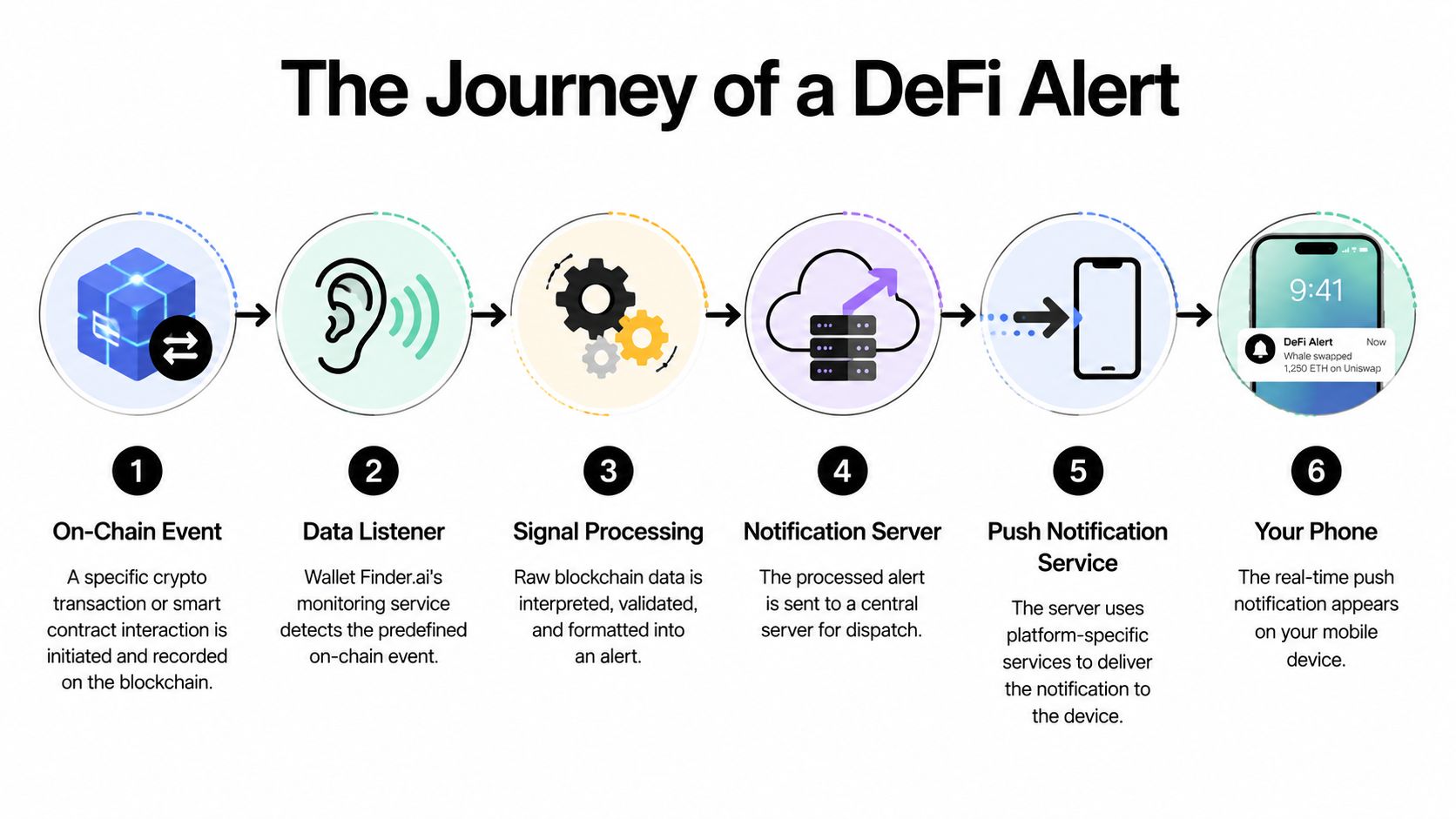
A trading alert feels simple on the surface. Your phone lights up, you tap, and you check the move. Underneath, there's a chain of systems working in sequence, and any weak point can slow or drop the alert.
The easiest way to think about it is as a courier route. The blockchain creates the event. A monitoring service recognizes it. A backend packages it. Apple or Google delivers it. Your device decides how prominently to surface it.
Start tracking smart money today
Join thousands of traders using WalletFinder.ai to find profitable wallets and copy their trades.
Start Free Trial →

