
Polygon to Fantom Bridge: A Trader's How-To Guide (2026)
Learn how to use a Polygon to Fantom bridge safely and quickly. This step-by-step guide covers choosing a bridge, fees, troubleshooting, and pro trading tips.
You spot a new farm, a fresh liquidity pocket, or a wallet cluster rotating into Fantom. Your capital is still sitting on Polygon. That gap between seeing the move and funding the move is where a lot of copy traders lose edge.
A good polygon to fantom bridge setup turns that delay into a routine operation. The mechanics matter, but the reason you bridge matters more. If you're following smart wallets, cross-chain movement is often the signal before the trade, not after it.
Why Bridge from Polygon to Fantom
A profitable move can die in the funding gap.
You catch a wallet cluster rotating out of Polygon stables and into Fantom-facing assets. The trade itself may still be early, but if your capital stays parked on Polygon, you are no longer copying conviction. You are copying the leftovers.

What bridging changes for a trader
Bridging from Polygon to Fantom is a positioning decision. It gives you access to liquidity, venues, and timing that do not sit on Polygon by default.
For copy traders, a key advantage is not the bridge transaction itself. The edge is getting capital onto the destination chain before the wallet you track finishes building the position. If a tracked wallet sends stables to Fantom, that transfer is often part of the thesis, not a housekeeping step. Fantom’s official documentation highlights its focus on fast finality and efficient execution, which is one reason active traders use it for quick rotation between DeFi positions, as described in the Fantom network documentation.
Three reasons the route makes sense in practice:
- You can act on cross-chain signals faster: Stablecoin inflows into Fantom often show intent before swaps, LP adds, or farm entries.
- You can access Fantom-native liquidity: Some pairs and yield setups only make sense on Fantom because the depth, incentives, or routing are different.
- You can reduce execution drift: Copy trading breaks down when the wallet you follow is already deploying while you are still funding the chain.
Wallet context helps here. A bridge transfer means more when you know what the wallet usually does after arrival. Tracking recurring behavior across Fantom wallets gives you a better read on whether the move is heading toward a DEX, a vault, or a fresh token launch. The patterns are easier to spot if you already study how smart money wallets behave on Fantom.
Bridging is often the first executable part of an alpha play. If the wallet moves capital first, waiting to bridge usually means accepting worse entries.
When bridging makes sense and when it doesn’t
Bridge with a destination in mind. Bridge with a first trade in mind too.
The best setups are simple. You know which asset should arrive on Fantom, which protocol gets the first allocation, how much FTM you need for gas, and whether the bridged token will be held or swapped on arrival. That keeps costs contained and cuts out extra transactions.
Bad bridge decisions usually come from vague intent, not bad infrastructure. Sending USDC to Fantom without checking the target pair, the dominant quote asset, or the liquidity depth often leads to an avoidable second swap, wider slippage, and more fee drag. For a copy trader, that friction is enough to turn a clean follow into a mediocre fill.
Choosing Your Bridge and Prepping Your Wallets
Bridge selection is a trading decision, not just a setup step. If the wallet you follow is rotating into Fantom for a reason, your bridge should match that plan with the least friction, the fewest extra swaps, and the lowest chance of arriving with the wrong asset.
For Polygon to Fantom, I usually start by checking Synapse Protocol and Celer cBridge. Both are widely used routes for standard assets. The practical difference is less about branding and more about route availability, supported tokens, expected output, and whether the destination asset lines up with the trade you want to copy.
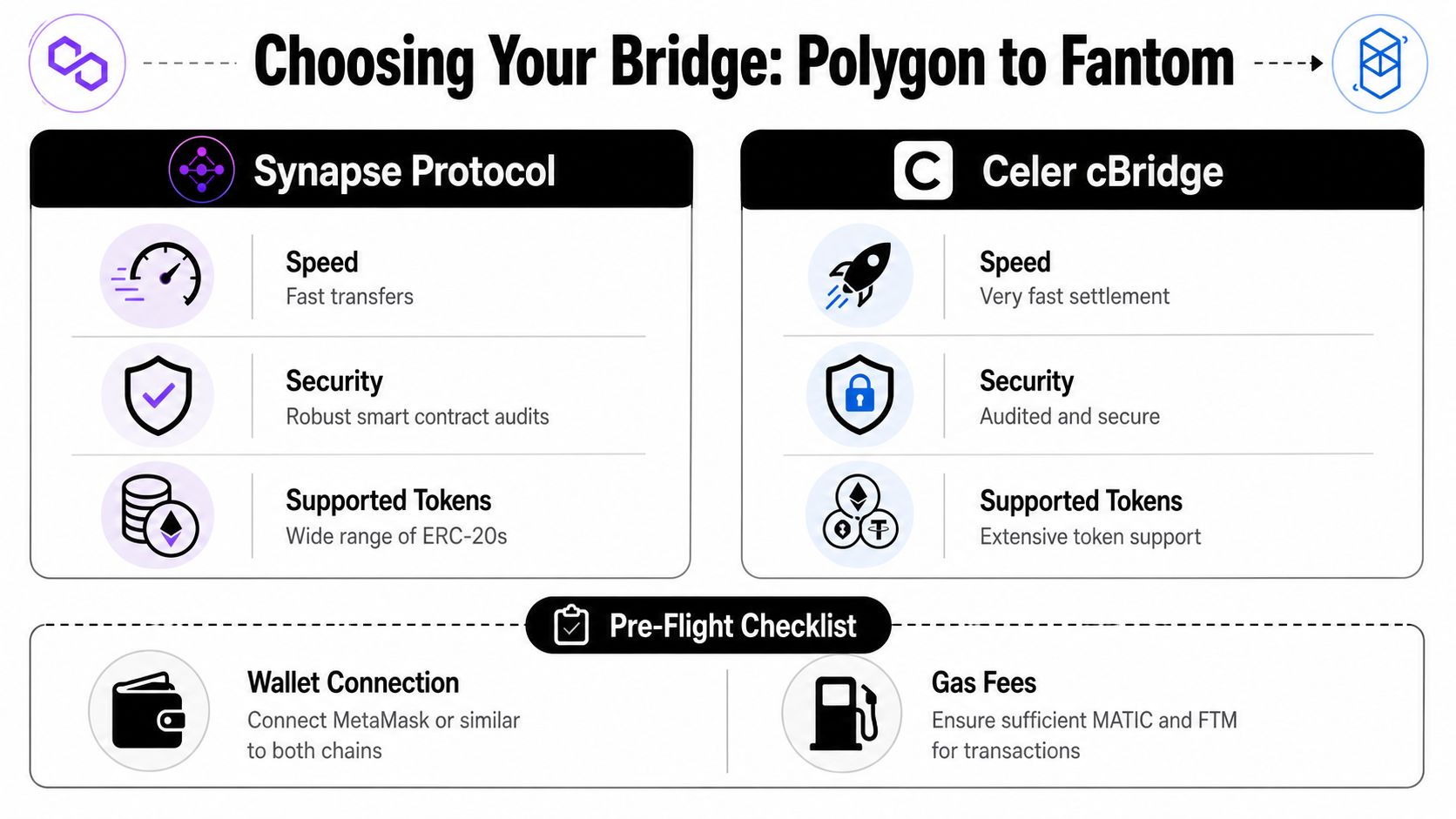
Polygon to Fantom bridge comparison
| Bridge | Speed Profile | Typical Cost Profile | Primary Tokens |
|---|---|---|---|
| Synapse Protocol | Fast for common routes, with supported route details available in the official Synapse documentation | Usually competitive for standard stablecoin transfers | USDC, DAI, USDT, SYN |
| Celer cBridge | Fast in practice, but route behavior depends on pool depth and asset support | Gas plus bridge fee, usually modest for supported pairs | USDC, USDT and other supported assets |
Start tracking smart money today
Join thousands of traders using WalletFinder.ai to find profitable wallets and copy their trades.
Start Free Trial →

