
Master Out of Sample Validation for Robust Crypto Strategies
Stop flawed backtests. Learn out of sample validation to build robust crypto strategies. Our guide covers walk-forward methods and common pitfalls.
You're probably sitting on a backtest that looks clean enough to trade. The equity curve rises, the hit rate feels believable, and the logic sounds smart when you say it out loud. Then you deploy it on live markets, and the thing starts bleeding almost immediately.
That's normal in crypto. It's even more common in on-chain strategies, where traders build signals from wallet tags, swap timing, token launches, and social momentum proxies that looked obvious only after the move already happened.
The problem usually isn't bad luck. The problem is that the strategy learned your dataset, not the market. Out of sample validation is the filter that tells you whether you found a tradable edge or just a polished illusion.
Why Your 'Perfect' Backtest Will Probably Fail
A new DeFi analyst usually makes the same mistake first. They find a cluster of wallets that bought early, filter for profitable trades, copy the behavior into a ruleset, and run a historical simulation. The result looks great because the rules were shaped by the same history they're being judged on.
That's not validation. That's rehearsal.
In trading research, this gap between what looked good in development and what survives on unseen data is large enough to kill a strategy. Quantpedia's review of trading-strategy research found that Sharpe ratios for out-of-sample results were, on average, 33% worse and 44% worse at the median than in-sample results in its summary of the literature on in-sample vs out-of-sample analysis of trading strategies.
Why crypto backtests fail faster
On-chain research makes the trap worse because the data feels richer than it really is. You can see wallet histories, token flows, position timing, and PnL trails. That creates the illusion that more visibility means more certainty.
It doesn't.
When you mirror wallets, you're often selecting survivors. You're also looking at behavior after the fact, with full knowledge of which wallets ended up looking smart. That introduces hidden hindsight into the entire research process.
Practical rule: If you discovered the strategy by staring at the winners, assume your first test is biased until proven otherwise.
What overfitting looks like in practice
Overfitting in DeFi rarely announces itself. It usually shows up as one of these:
- Too many filters: You only copy trades above a certain size, inside a narrow time window, for a specific token profile, after excluding “bad” examples that hurt the curve.
- Narrative tuning: Each rule sounds justified, but the full set was assembled because it improved historical results.
- Fragile performance: Change the date range, remove a wallet cohort, or shift execution timing slightly, and the backtest degrades fast.
A strategy that only works on the exact sample that created it isn't a strategy. It's a memory of past noise dressed up as process.
What Is Out of Sample Validation Exactly
Think of in-sample data as an open-book practice exam. You've seen the material, adjusted your notes, and learned where the easy points are. Out-of-sample data is the actual exam. You don't get to rewrite your answers after seeing the questions.
That's the whole idea.
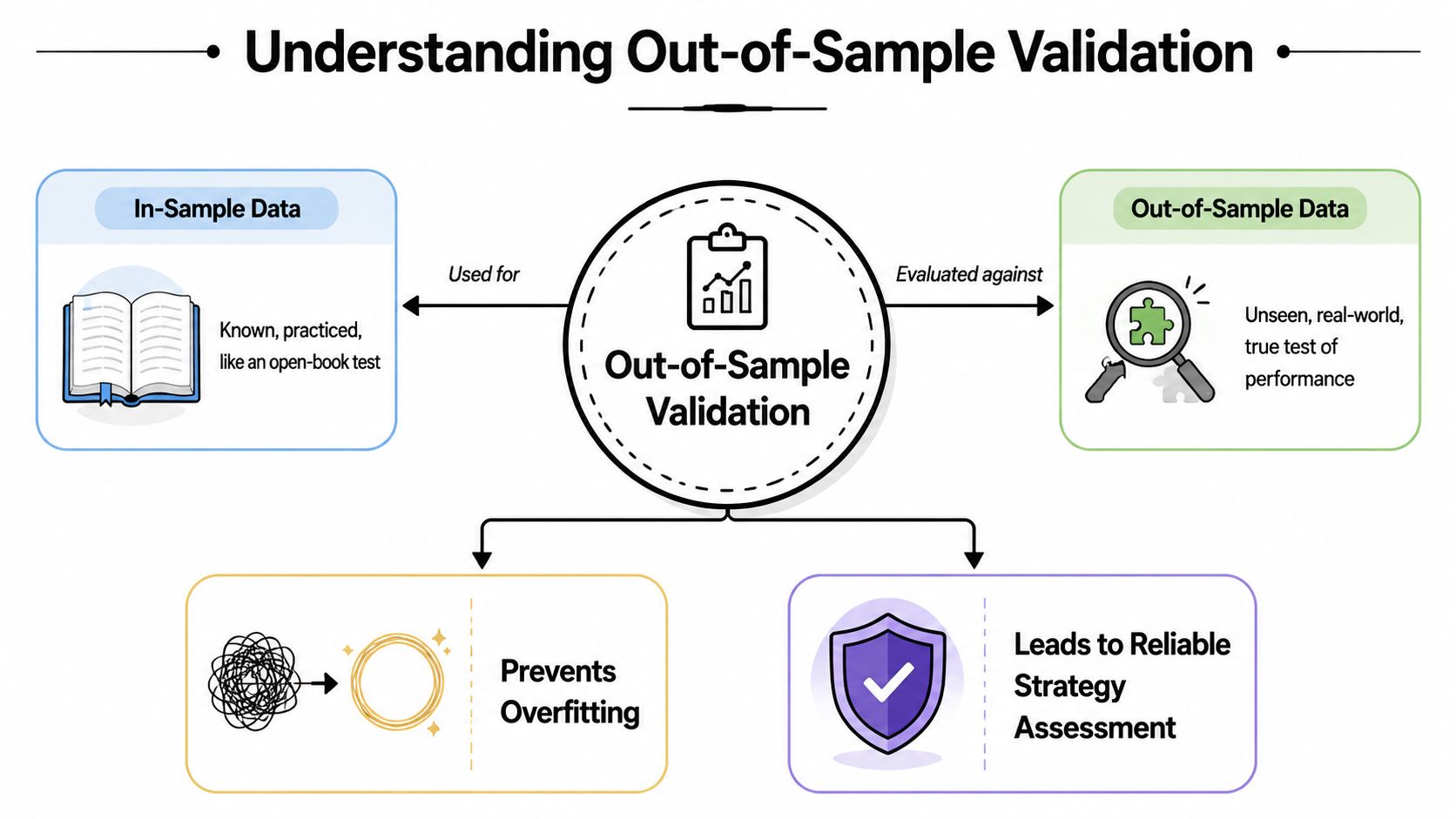
A model or rule set is built on one portion of the data. Then it's evaluated on a separate portion it never saw during development. That second portion is the only place where performance starts to mean something.
Research on validation methodology makes the point clearly: out-of-sample validation is technically stronger because performance must be measured on data the model never saw during training, and that independent evaluation gives a more realistic estimate of generalization before deployment, as described in this review of model evaluation methods.
The two datasets that matter
You only need two core ideas:
- In-sample data: The part used to fit, refine, or select the strategy.
- Out-of-sample data: The held-out part used to test whether the strategy still works when it can't cheat.
For a wallet-mirroring model, in-sample data might include earlier trades from tracked wallets. You use that period to decide what counts as a copyable signal. The out-of-sample segment is the later market period where those rules are frozen and tested without edits.
What it does and what it doesn't do
Out of sample validation doesn't guarantee future profits. It does something more important first. It tells you whether your process can survive first contact with unseen data.
That's why a mediocre-looking out-of-sample result can be more valuable than a gorgeous in-sample backtest. The mediocre result may be honest. The gorgeous one may be fiction.
A strategy that passes on unseen data still isn't proven. A strategy that fails on unseen data is already disqualified.
Why this matters for DeFi specifically
On-chain analysts often confuse transparency with predictability. Blockchain data is public, but public data still contains noise, lag, execution frictions, and shifting behavior. A profitable wallet can change tactics. A token meta can disappear. A copy-trading rule can stop working once too many people notice it.
Out of sample validation forces discipline. It prevents you from declaring victory just because your rules explain yesterday's winners.
Key Validation Methods for Trading Systems
Time-series validation lives or dies on one rule. You must preserve time order. For forecasting and trading systems, the model should be trained on earlier observations and tested on later ones, because random splitting can leak future information into training and artificially inflate accuracy, as explained in this overview of in-sample and out-of-sample forecasting for time-series data.
If you shuffle rows in a crypto dataset, you often hand your model pieces of the future. That's how people end up “predicting” moves that were only visible because the backtest contained a hidden cheat.
Train and test split
This is the simplest method. You divide the series into an earlier training block and a later test block. Build on the first part. Judge on the second.
It's useful when you want a fast first pass on a strategy idea, especially if you're testing a basic ruleset like “mirror wallets only after repeated accumulation in the same token.”
What it gets right is clarity. What it misses is reliability. One split can be misleading if that test period happened to be unusually easy or unusually hostile.
Walk-forward validation
This is the practical workhorse for trading.
You train on an initial period, test on the next period, roll the window forward, retrain, and test again. That mimics how a live research desk operates. You only know the past, you build from it, and then the next block of market data arrives.
Walk-forward validation is especially useful for on-chain systems because wallet behavior evolves. A wallet that was early on Solana memes might later migrate to a different ecosystem or shift from swing trades to launch sniping.
Desk habit: Freeze the rules before each walk-forward segment. If you tweak them after seeing the result, you've turned testing back into training.
Rolling-window validation
Rolling-window validation is similar, but instead of letting the training history keep expanding, you use a moving slice of recent history. That helps when old data may no longer describe the current market.
This can be useful in crypto because older regimes often become irrelevant. A token-launch environment driven by one liquidity structure can behave very differently from a later one. A rolling window lets you emphasize recency.
The drawback is that you may throw away useful longer-term context. Some behaviors repeat across cycles, and a window that's too short can make the strategy unstable.
Which one should you use
For most DeFi research, the choice comes down to the question you're asking:
- Quick sanity check: Use a simple train/test split.
- Deployment realism: Use walk-forward validation.
- High regime sensitivity: Use a rolling window when older data is likely stale.
| Method | How It Works | Best For | Main Drawback |
|---|---|---|---|
| Train/Test Split | Train on an earlier block of data and test on a later block once | Fast initial screening of strategy ideas | One test window can give a distorted view |
| Walk-Forward Validation | Repeatedly train on past data, test on the next unseen segment, then roll forward | Strategies that will be updated and monitored over time | More operationally demanding and easier to misconfigure |
| Rolling-Window Validation | Train on a moving recent window and test on the next future segment | Markets where older behavior may no longer be relevant | Can discard useful historical context |
Start tracking smart money today
Join thousands of traders using WalletFinder.ai to find profitable wallets and copy their trades.
Start Free Trial →

