
Buy the Dip Crypto: Master Smart Entry Strategies
Buy the dip crypto - Master buy the dip crypto without getting burned. Learn step-by-step signals, optimal entry timing, risk management, & how to mirror smart
Investors often lose money with buy the dip crypto because they follow a slogan, not a process.
A red candle hits. They buy because the chart looks “cheap.” Then price drops again, support breaks, panic takes over, and they either average down blindly or sell the bottom. The mistake isn't buying weakness. The mistake is buying weakness with no framework for trend, confirmation, sizing, or risk.
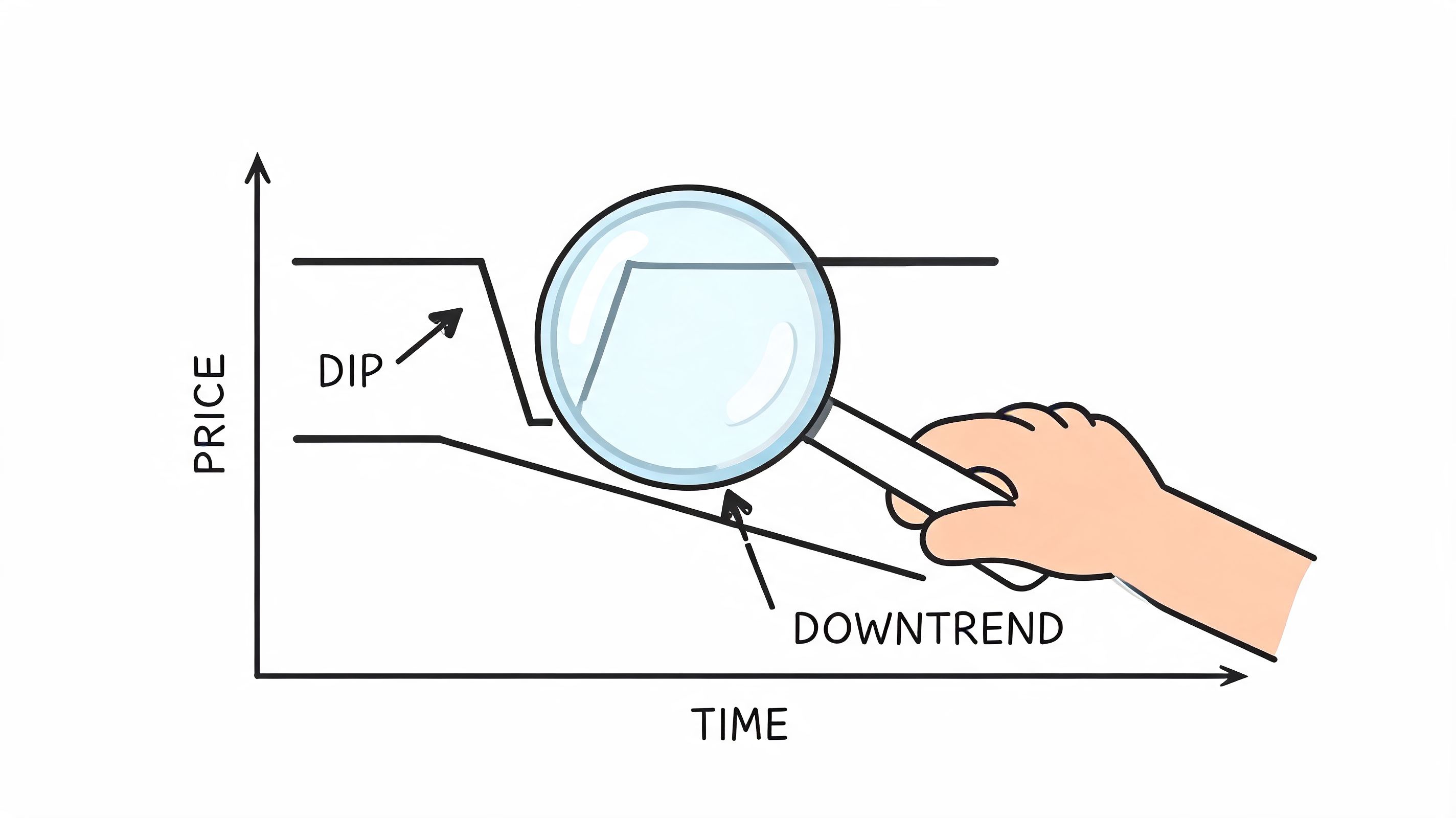
A real dip is a pullback inside a broader uptrend. A bad trade is a collapsing market dressed up as a bargain. The difference usually shows up in the same places: trend structure, momentum, support, and whether serious buyers are stepping in.
How the 2026 Market Changed the Buy-the-Dip Equation
The mechanics of buying a dip in crypto have not changed. The market environment in which you apply those mechanics has — and understanding what changed in 2026 helps you calibrate how aggressively to buy support levels that would have been far more ambiguous in prior cycles.
The most significant structural change is the presence of US spot Bitcoin ETFs as a persistent institutional demand layer. Before ETF approval, Bitcoin's dip behavior was driven almost entirely by retail sentiment, futures positioning, and whale accumulation — all of which could reverse quickly and produce the deep 70-80% drawdowns that characterized the 2018 and 2022 bear markets. The ETF structure changed that dynamic because institutional buyers who access Bitcoin through a regulated wrapper typically have much longer rebalancing horizons than retail traders. When Bitcoin fell from its October 2025 all-time high above $125,000 to around $63,000 in early February 2026, ETF inflows did not reverse. They remained net positive through the drawdown, which was the observable signal that this correction had a different character than the 2022 bear market — institutional demand was absorbing selling pressure rather than amplifying it.
The practical implication for dip buyers is that the 200-day moving average in 2026 functions as a more reliably supported level than it did in prior cycles, precisely because ETF-driven institutional capital tends to treat that level as a rebalancing trigger rather than a panic exit. The February 2026 dip to approximately $63,000 reached the 200-day MA vicinity and was followed by one of the strongest single-day recoveries in recent memory, with Bitcoin reclaiming $76,000 and eventually pushing higher. Traders who understood the ETF support structure — and who had pre-planned limit orders at the 200-day MA zone — entered one of the cleanest dip setups the current cycle produced.
What this does not change
The ETF demand floor makes certain levels more reliable supports, but it does not eliminate downside risk or guarantee that dips at the 200-day MA will always recover quickly. Markets can trade through institutional support levels during periods of acute macro stress. The ETF structure also does not apply to altcoins, which remain driven by sentiment and retail flow with the same volatility profiles as prior cycles. The structural change is Bitcoin-specific, and applying it to altcoin dip-buying logic is a category error that leads to oversized positions in assets without the same institutional bid. For the broader cycle context that frames which dip levels are most credible in the current environment, the crypto bull run prediction guide covers the macro and on-chain signals that define whether the broader trend still supports dip buying at all.
Why Most Traders Lose Money Buying Dips
The phrase sounds smart because it's simple. In practice, simple is what gets retail traders trapped.
Most losses come from three habits. First, traders assume every sharp drop is temporary. Second, they go too big too early. Third, they confuse hope with confirmation. When price keeps falling, they stop trading and start praying.
The falling knife problem
A market can be oversold and still go much lower. That's the part newer traders miss.
A dip worth buying usually shows some form of stabilization. A bad setup keeps slicing through support, closes weak, and never attracts committed buyers. Backtests on BTC and ETH from 2021 to 2026 found that laddered entry strategies outperformed lump-sum dip buys, while “falling knife” entries without stabilization failed 62% of the time. That's why pressing the buy button on the first hard flush is usually the wrong move.
Practical rule: Don't buy because price is down. Buy because the market has shown where buyers are defending.
Emotion ruins timing
Dip buying punishes ego. Traders want to call the exact bottom because it feels like skill. But bottom-picking usually leads to oversized entries, poor average cost, and ugly exits.
The common emotional traps look like this:
- FOMO after a fast drop means buying the first bounce instead of waiting for structure.
- Revenge sizing means adding more after the first entry goes red, even though the setup got worse.
- Narrative bias means holding because “it has to come back,” even when trend conditions have clearly changed.
- Social proof means copying loud accounts on X instead of reading price and flow for yourself.
What actually works
The traders who survive dip buying treat it like a checklist, not a vibe.
They want confluence. Trend still intact. RSI washed out. Support nearby. Buyers showing up. Risk defined before entry. Profit plan mapped before the rebound starts.
That sounds less exciting than calling bottoms on social media. It also keeps you in the game.
If you want a repeatable edge, stop asking whether price is lower than yesterday. Ask whether the market is offering a controlled entry inside a trend that still deserves your capital.
Is It a Dip or a Downtrend? Key Signals to Watch
Start with one assumption: price being lower doesn't mean value is better. It only means sellers had control.
Start tracking smart money today
Join thousands of traders using WalletFinder.ai to find profitable wallets and copy their trades.
Start Free Trial →

