
Crypto Liquidity Pools: The DeFi Guide
Learn how liquidity pool crypto works, how to participate safely, and how to maximize yields with this practical guide.
Ever wonder how you can instantly swap one crypto token for another on a decentralized exchange (DEX) without waiting for a buyer or seller on the other side? The magic behind that seamless experience is the crypto liquidity pool.
In simple terms, a liquidity pool is a big, crowdsourced pot of digital money locked away in a smart contract. These pools are the engine of decentralized trading, making it possible to trade tokens instantly.
The Foundation of Decentralized Trading
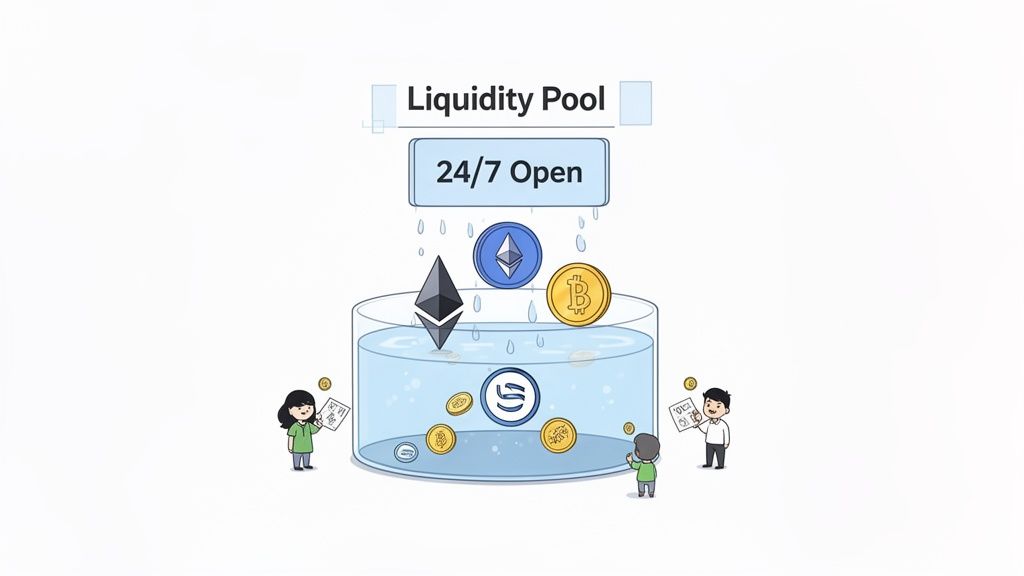
Picture a 24/7 currency exchange booth that operates without an owner. Anyone can walk up, contribute to its cash reserves, and in return, earn a small cut of every transaction that happens there. That's a liquidity pool in a nutshell. They're the core technology powering most of the decentralized finance (DeFi) world, enabling billions of dollars in trades every single day.
Traditional exchanges like Coinbase or Binance rely on an order book—a constantly updated list of buy and sell orders. This works, but it requires matching a buyer with a seller. Liquidity pools solve a huge problem for DEXs: how do you make sure there's always enough of a token available for someone to trade, especially for newer or less popular assets?
Who Powers These Pools?
The people who supply the crypto to these pools are known as Liquidity Providers (LPs). They are regular users who deposit their own crypto assets into a pool to help make trades possible for everyone else. By doing this, they provide the "liquidity" that keeps the exchange running smoothly.
So, why would anyone lock up their valuable assets? For a simple financial incentive: to earn a share of the trading fees generated every time someone swaps tokens. It’s a powerful way to put your idle crypto to work and generate passive income.
This setup creates a win-win-win situation:
- Traders get to swap a huge variety of tokens instantly, anytime they want.
- Liquidity Providers get rewarded for supplying the assets that make those trades happen.
- The DeFi Ecosystem gets a powerful, automated way to create markets for any asset without needing permission from a central authority.
A liquidity pool flips the script on trading. Instead of a peer-to-peer model (matching buyers and sellers), it becomes a peer-to-contract model where you trade directly with the pool's smart contract.
The Core Components Explained
At its heart, a liquidity pool is usually made up of two different tokens locked in a smart contract. A common example is an ETH and USDC pair. To become a liquidity provider for this pool, you’d need to deposit an equal value of both tokens. So, if 1 ETH is worth $3,000, you would deposit 1 ETH and 3,000 USDC.
This 50/50 value split is crucial because it establishes the initial price and keeps the pool balanced. The whole system runs on an underlying algorithm that automatically manages token prices and executes trades. It’s an elegant design that completely removes the need for middlemen, making trading faster, cheaper, and more open for everyone. We'll dive into that algorithm next.
How Automated Market Makers Power Trading
If a liquidity pool is the engine of decentralized trading, then the Automated Market Maker (AMM) is the computer running the whole show. This is the "magic" that lets you swap tokens instantly without ever waiting for another person to take the other side of your trade.
Don't think of an AMM as a person or a company. Think of it as a robotic banker that’s programmed to follow one simple, unbreakable mathematical rule. It doesn't negotiate, it doesn't haggle—it just follows its code, which is baked into a smart contract on the blockchain. The AMM’s only job is to manage the assets in the pool, set token prices, and process trades automatically.
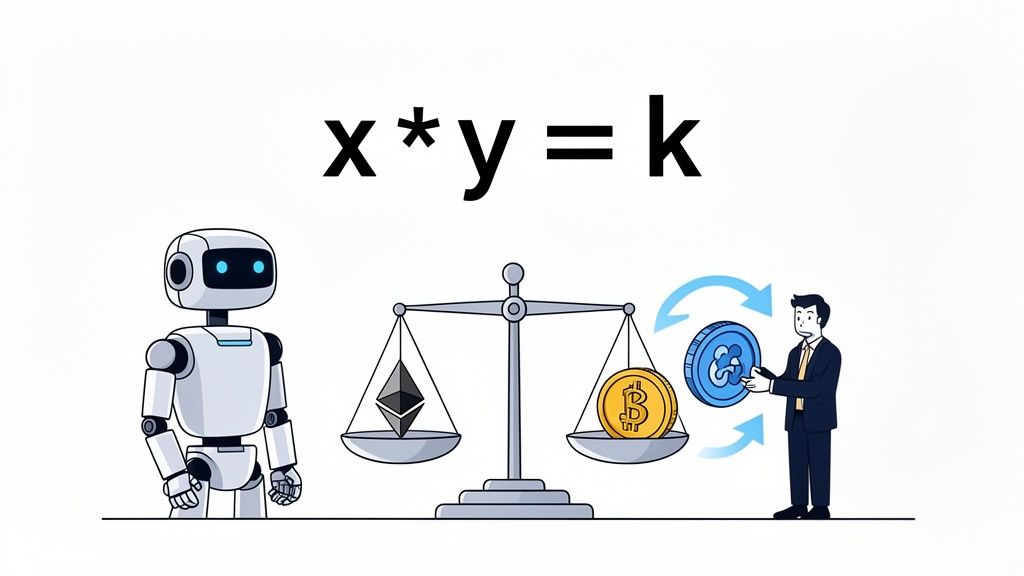
The whole thing is transparent and permissionless, forming the core of how decentralized exchanges work. To get the bigger picture, our guide on what a DEX does gives you more context on the ecosystem where these AMMs live. This autonomous design is what makes the entire system so incredibly efficient.
The Constant Product Formula
So what's the unbreakable rule? Most AMMs are built around the constant product formula, famously written as x * y = k. This elegant little equation is the secret sauce that keeps the liquidity pool balanced and functioning.
Here’s a quick breakdown:
xis the amount of Token A in the pool.yis the amount of Token B in the pool.kis the constant, a fixed number representing the pool's total liquidity.
The AMM’s prime directive is to make sure k always stays the same (ignoring fees for a moment). This means when a trader pulls some of Token A (x) out of the pool, they have to put enough of Token B (y) back in to keep the product of the two constant. This forced rebalancing is how prices are set algorithmically.
A Practical ETH and USDC Example
Let's see this in action. Imagine a popular ETH/USDC liquidity pool with:
- 10 ETH (Token A)
- 30,000 USDC (Token B)
First, we calculate our constant, k:10 (x) * 30,000 (y) = 300,000 (k)
The AMM will now do everything in its power to keep that k value at 300,000. Now, say a trader shows up wanting to buy 1 ETH.
When they take out 1 ETH, the pool's balance drops to 9 ETH. To keep the x * y = k rule intact, the amount of USDC must go up. The AMM calculates exactly how much USDC the trader needs to add to maintain that 300,000 constant.
9 (new x) * ? (new y) = 300,000 (k)? (new y) = 300,000 / 9? (new y) = 33,333.33
So, the trader has to deposit 3,333.33 USDC to get their 1 ETH. The trade is complete, and the pool now holds 9 ETH and 33,333.33 USDC. The constant k is still the same.
Did you catch what happened to the price? Before the trade, ETH was implicitly priced at $3,000 (30,000 / 10). After, the price is higher. The pool's new implied price is 33,333.33 / 9 = $3,703.70 per ETH. This automatic price adjustment, called slippage, is a fundamental feature of how AMMs operate.
The AMM is a price-setting machine. It doesn't look up prices on CoinGecko; it creates the price based purely on the ratio of assets within its own crypto liquidity pool.
AMMs vs. Traditional Order Books
This is a complete departure from the old-school order book model used by centralized exchanges like Binance or Coinbase. The differences really highlight why AMMs are such a game-changer for traders.
Start tracking smart money today
Join thousands of traders using WalletFinder.ai to find profitable wallets and copy their trades.
Start Free Trial →

