
Your Guide to Crypto Liquidity Pools
Explore our definitive guide to crypto liquidity pools. Learn how they work, the risks involved, and how to find profitable DeFi opportunities.
A crypto liquidity pool is a collective stash of digital currency locked in a smart contract. It's the core engine for decentralized exchanges (DEXs), enabling users to trade crypto without needing a direct buyer or seller. This system is the backbone of decentralized finance (DeFi), making everything from instant token swaps to advanced yield farming strategies a reality.
What Are Crypto Liquidity Pools and Why Do They Matter
Imagine a currency exchange booth at an airport needing to swap US dollars for Euros. It must keep a supply of both. A crypto liquidity pool follows the same principle but is automated and community-run.
Instead of a single entity, users called Liquidity Providers (LPs) contribute their assets. For example, an LP might deposit an equal value of Ethereum (ETH) and a stablecoin like USDC into a shared pool. In return for supplying these funds, they earn a portion of the trading fees each time someone uses that pool. This innovative model allows DEXs to operate 24/7, bypassing the traditional order books of centralized exchanges.
The Two Key Players
Every liquidity pool relies on two essential groups, each with distinct motivations:
- Liquidity Providers (LPs): Individuals who deposit their crypto to "make a market." Their primary goal is to generate passive income from the fees produced by trades.
- Traders: Users who come to the pool to swap one token for another. They pay a small fee for the convenience of an instant, automated trade, which is distributed to the LPs.
This creates a symbiotic relationship. Without LPs, there would be no assets for traders. Without traders, LPs would have no incentive to provide liquidity, as no fees would be generated.
At its core, a crypto liquidity pool replaces the traditional financial middleman with code. It’s a move away from a centralized order book managed by a single company to a decentralized, autonomous market powered by its own users.
The Foundation of Decentralized Trading
Before liquidity pools, early DEXs were inefficient. They mimicked the traditional order-book model, which was slow and struggled with low liquidity, leading to poor pricing and frequent failed trades.
The crypto liquidity pool solved this problem by creating a ready-to-go stockpile of assets, ensuring liquidity is always available for smooth and reliable token swaps. This innovation unlocked DeFi's potential, paving the way for the multi-billion dollar ecosystem of automated financial services we see today. Understanding this concept is the first step to mastering DeFi.
How Automated Market Makers Drive Pool Mechanics
A crypto liquidity pool operates on an engine called the Automated Market Maker (AMM). This smart contract replaces the old-school order book with a mathematical formula, allowing you to trade directly with the pool itself.
This core innovation enables the instant, permissionless trading that defines DeFi. The AMM's algorithm automatically adjusts token prices based on the balance of assets in the pool after each swap, ensuring a market is always available.
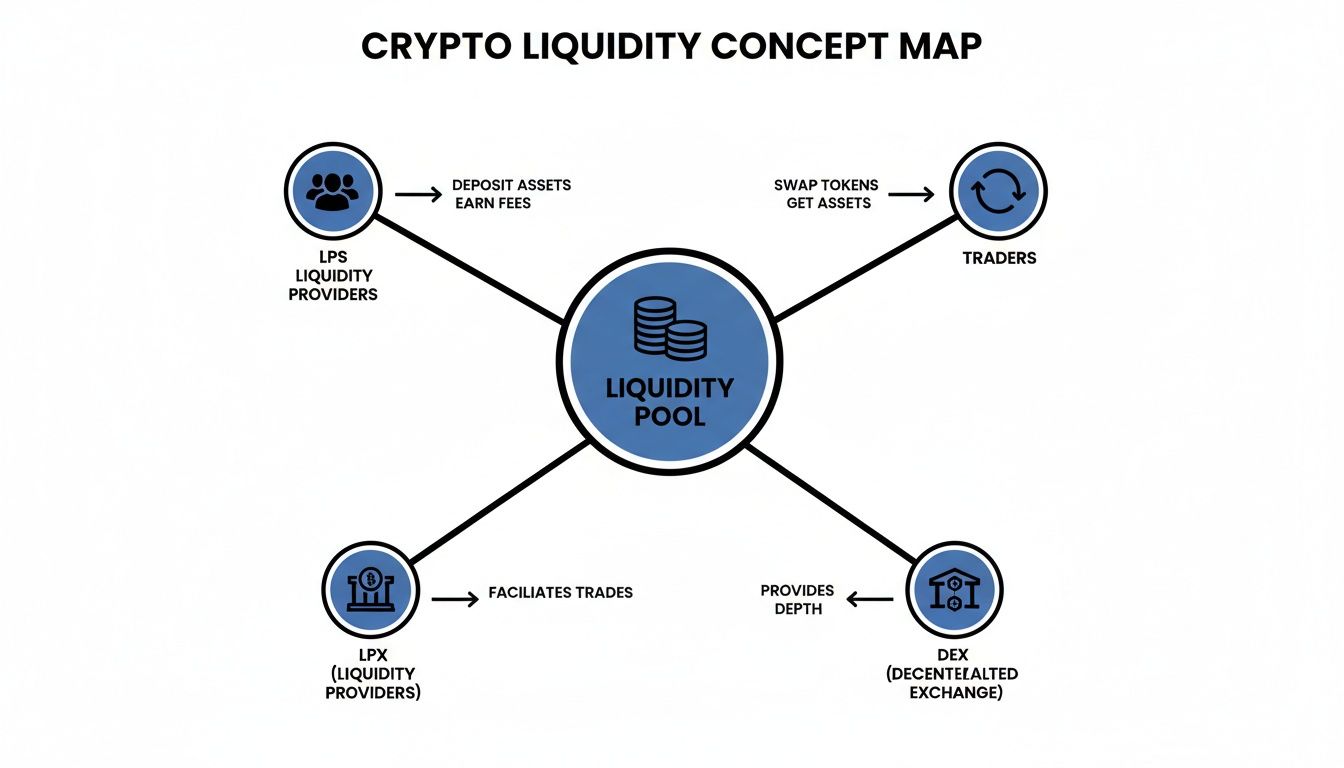
The diagram below illustrates how the pool serves as the central hub connecting all participants.
Start tracking smart money today
Join thousands of traders using WalletFinder.ai to find profitable wallets and copy their trades.
Start Free Trial →

