
Gas Fee Estimator: Time Your Crypto Trades Perfectly
Master the gas fee estimator to time DeFi trades. Learn to interpret estimates on Ethereum, Solana & Base for optimal profits and to avoid overpaying.
You're watching a wallet you trust ape into a move. You copy the trade, hit confirm, and then nothing happens. Your transaction sits pending while price runs away. By the time it lands, your entry is worse, your slippage is uglier, and the wallet you followed is already in profit.
That's not a research problem. It's an execution problem.
A gas fee estimator fixes more than cost. Used properly, it helps you decide whether to chase, wait, speed up, or skip the trade entirely. For copy traders, that's edge. On-chain, the trader who gets included at the right moment often beats the trader who had the better thesis.
Why Gas Estimation Is a Core Trading Skill
Most traders learn gas fees as a nuisance. They think about them right before clicking confirm, usually after seeing a bigger number than expected. That mindset leaves money on the table because gas isn't just overhead. It's part of trade timing.
If you're copy trading profitable wallets, gas is the spread between seeing the move and participating in it. A wallet can buy a breakout, and you can still lose on the same idea if your transaction lands late. In memecoins, launch trades, and thin liquidity setups, a slow inclusion can matter more than a slightly better token thesis.
Execution beats intention
A lot of newer traders focus on charts, alerts, and wallet tracking, then leave transaction settings on autopilot. That works until the market gets crowded. When a feed catches attention and many traders pile into the same contract, the winning move often goes to the trader who reads fee conditions correctly and reacts first.
Blocknative describes how modern estimators use pending mempool data and statistical modeling across Ethereum and major EVM networks. It also notes a broader shift after scaling upgrades, with one 2026 industry summary reporting average Ethereum transaction fees of about $0.30 to $0.34 by late 2025, down roughly 95% from earlier peaks, and average gas prices dropping from about 72 gwei in early 2024 to around 2.7 gwei by March 2025. Those figures matter because lower average fees don't remove competition. They make timing even more tradable because more users are willing to transact when costs feel manageable (Blocknative gas extension documentation).
Practical rule: Don't treat a gas estimate as a receipt. Treat it as a live quote for market access.
Where traders actually gain edge
A good gas read helps in three places:
- Entry timing: You can decide whether to hit now, wait for a calmer block market, or split size.
- Copy trading speed: You can choose a more aggressive fee when matching a fast wallet matters more than shaving cost.
- Exit discipline: During a rush for liquidity, getting out reliably often matters more than minimizing the fee.
The strongest traders don't ask only, “What will this transaction cost?” They ask, “What does this estimate say about whether this trade is still worth taking?”
That shift turns a gas fee estimator from a calculator into a trading tool.
How Blockchain Gas Fees Actually Work
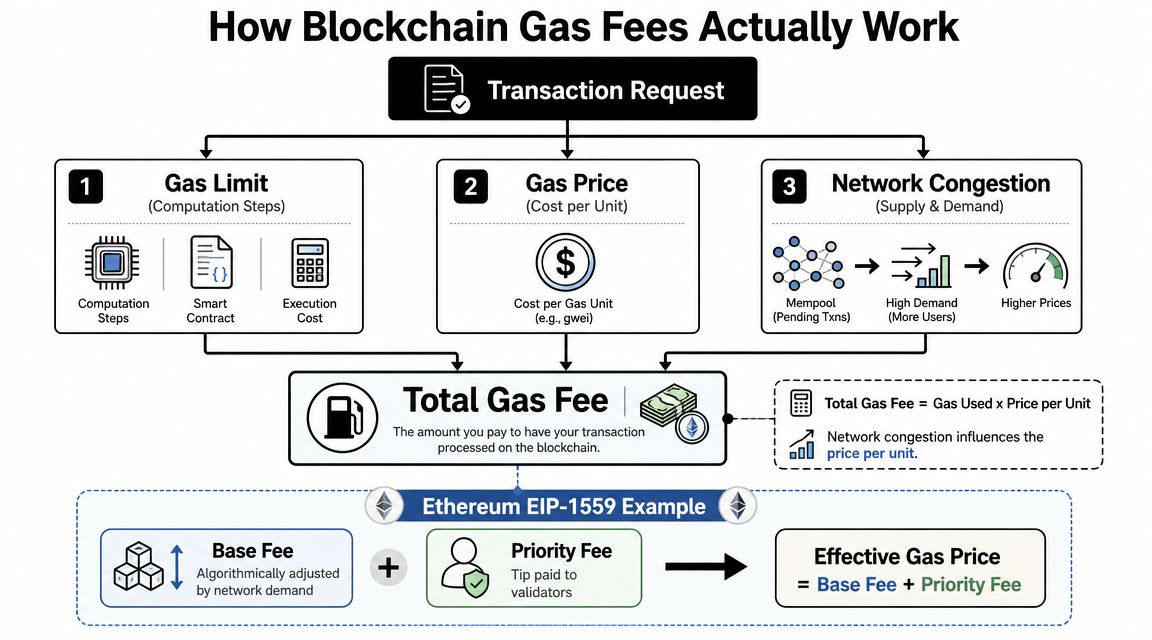
Gas is the cost of computation on-chain. The easiest way to think about it is a toll road with two moving parts. First, how long your trip is. Second, how crowded the road is when you enter.
On Ethereum, the gas limit is the amount of computational work your transaction is allowed to consume. The fee rate is shaped by the network's pricing model. A post-London estimator uses the formula gas limit × (base fee + optional tip). For a standard Ethereum transfer, the default gas limit is 21,000 units, gas prices are commonly quoted in gwei, and 1 gwei equals 0.000000001 ETH. If the base fee is 30 gwei and the gas limit is 21,000, the cost is 630,000 gwei, or 0.00063 ETH. The fee is paid in ETH from the sender's balance, not from the token being transferred (World gas fee explainer).
Start tracking smart money today
Join thousands of traders using WalletFinder.ai to find profitable wallets and copy their trades.
Start Free Trial →

