
Crypto Profit Simulator: Test Your Trades
Explore how a crypto profit simulator can enhance your strategy, backtest, mirror top wallets, and forecast gains with practical steps.
Ever heard the phrase "hindsight is 20/20"? In crypto trading, that clarity usually comes after a painful loss. What if you could test-drive your trading ideas before putting real money on the line? That's exactly what a crypto profit simulator does.
Think of it as your personal financial time machine. It lets you take a trading strategy, wind back the clock, and see how it would have performed in the wild markets of the past.
What Is a Crypto Profit Simulator

The best analogy for a profit simulator is a flight simulator for pilots. Pilots spend countless hours in a hyper-realistic simulator practicing for turbulence, engine failures, and chaos in a completely safe setting before flying a real jet.
A crypto profit simulator provides that same critical advantage for navigating the extreme volatility of digital assets. It's a significant leap beyond a basic crypto profit calculator, which usually just shows a simple "buy low, sell high" scenario. A simulator is different because it layers in the messy, real-world variables that impact your returns.
More Than Just a Price Chart
A powerful simulator doesn't just look at a price change from point A to point B. It digs into the critical details that determine if a strategy is profitable.
Here are key factors a good simulator must account for:
- Trading Fees: It incorporates both exchange and network (gas) fees to show the true cost of executing your strategy.
- Slippage: It models the potential difference between the expected trade price and the actual execution price.
- Position Sizing: It allows you to experiment with how different investment amounts would have altered your final profit and loss.
It's easy to look at a chart and think, "If only I'd bought there and sold there." Simulators bridge the gap between fantasy and reality by stress-testing your ideas against historical data, uncovering hidden flaws before they cost you real money.
For example, imagine you believed the March 2020 COVID crash was a generational buying opportunity. Using a simulator, you could model a $10,000 investment into Bitcoin around $7,200. You could then set a hypothetical sell order at its peak of $69,000 in November 2021. The simulation would calculate the staggering potential return after factoring in realistic fees, showing how a high-conviction trade could have performed under actual market conditions. A great resource from Breet.io explores more on calculating crypto profits in detail.
How Accurate Profit Simulations Actually Work
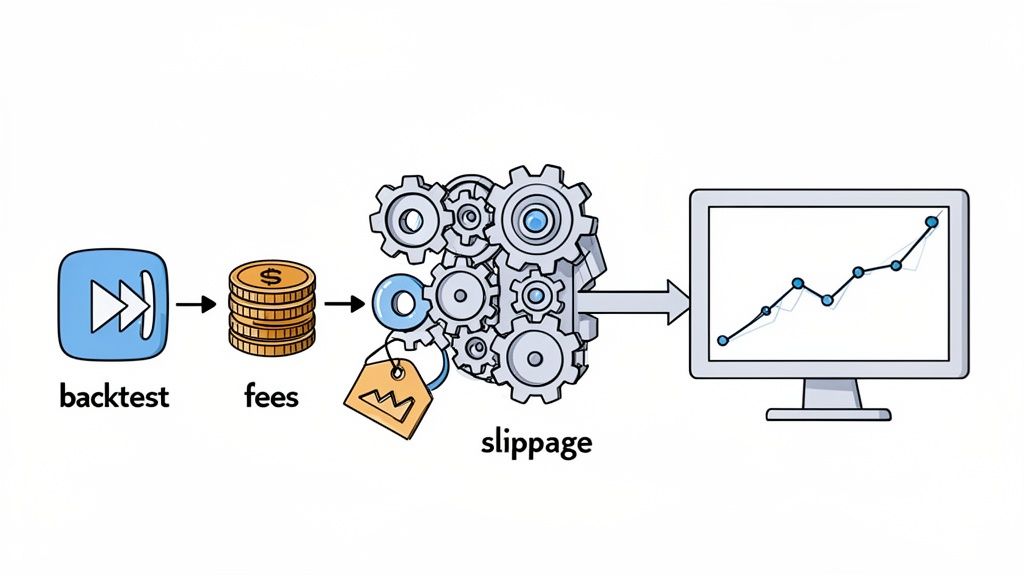
A good crypto profit simulator isn't a crystal ball; it's a hyper-realistic historical reenactment. Its strength lies in perfectly recreating past market conditions to see how a trading idea would have performed, warts and all. The engine powering this process is called backtesting.
Backtesting is simply applying a set of trading rules to historical data. It’s like having a time machine for your strategy. You can rewind the market, press play, and watch your specific buy and sell rules unfold trade by trade. It's the only way to replace wishful thinking with hard, data-driven evidence.
Beyond Simple Price Calculations
A top-tier simulator does much more than just analyze old prices. Its accuracy comes from layering in the crucial "frictions" of real-world trading that can erode profits.
Here’s a breakdown of the key variables a sophisticated simulator must handle:
Start tracking smart money today
Join thousands of traders using WalletFinder.ai to find profitable wallets and copy their trades.
Start Free Trial →

