
Efficient Frontier Analysis for Your Crypto Portfolio
A hands-on guide to efficient frontier analysis for crypto. Learn to optimize your DeFi portfolio's risk and return using on-chain data and practical steps.
Your crypto portfolio probably didn't start as a portfolio. It started as a series of trades.
A little ETH for conviction. A layer-2 token because the ecosystem looked early. A governance token from a protocol you personally use. A memecoin position that was supposed to be tactical and is now somehow one of your biggest exposures. Then those positions spread across wallets, chains, and exchanges until the whole thing became hard to judge as one system.
That's where efficient frontier analysis becomes useful. It gives you a structured way to turn a pile of token bets into a portfolio you can evaluate, compare, and improve. In traditional finance, the framework became foundational after Harry Markowitz introduced modern portfolio theory in 1952, showing that investors can evaluate portfolios with mean return, standard deviation, and correlation. The efficient frontier itself is the set of portfolios with the highest expected return for a given level of risk or the lowest risk for a given return, with risk measured as standard deviation of returns, as outlined in this efficient frontier overview.
From Crypto Chaos to a Coherent Strategy
In DeFi, the hard part isn't getting exposure. The hard part is understanding what exposure you already have.
A trader might think they're diversified because they hold BTC, ETH, a few perpetual DEX tokens, some restaked assets, and a basket of smaller names on Solana and Base. Then they map the return series and realize most of those positions still lean on the same risk regime. When market liquidity dries up, correlations tighten, and the portfolio behaves like one oversized beta trade.
What the model helps you answer
Efficient frontier analysis is useful because it forces specific questions:
- Which assets diversify each other: Not by story, but by how their returns move together.
- How much risk comes from concentration: A token can be a small line item by count and still dominate portfolio volatility.
- What trade-off you're accepting: Every portfolio sits somewhere on a risk and return map, whether you measure it or not.
- Which holdings are inefficient: Some combinations give less expected return for more risk than available alternatives.
That last point matters. In practice, plenty of crypto portfolios are inefficient because they were built incrementally, not designed.
Practical rule: If a portfolio was assembled one trade at a time, assume it needs to be rebuilt as a portfolio at least once.
What works in crypto and what doesn't
The classic model works well when you use it as a decision framework, not as a prophecy engine.
It works for comparing candidate allocations, spotting hidden concentration, and testing whether adding a token improves the total mix. It does not work well when traders treat historical averages as truth, ignore liquidity, or assume a token with a short trading history deserves the same confidence as an established asset.
For DeFi, the practical workflow is simple:
- Pull holdings from wallets and exchanges
- Collect clean historical price series
- Convert prices into return series
- Build the covariance matrix
- Generate candidate portfolios
- Plot the frontier and inspect the portfolios that survive
- Overlay real-world constraints before trading anything
That last step is where most toy models fail. A mathematically elegant allocation can still be unusable if the token is thin, structurally reflexive, or exposed to smart contract and bridge risk.
Efficient Frontier Analysis in a Nutshell
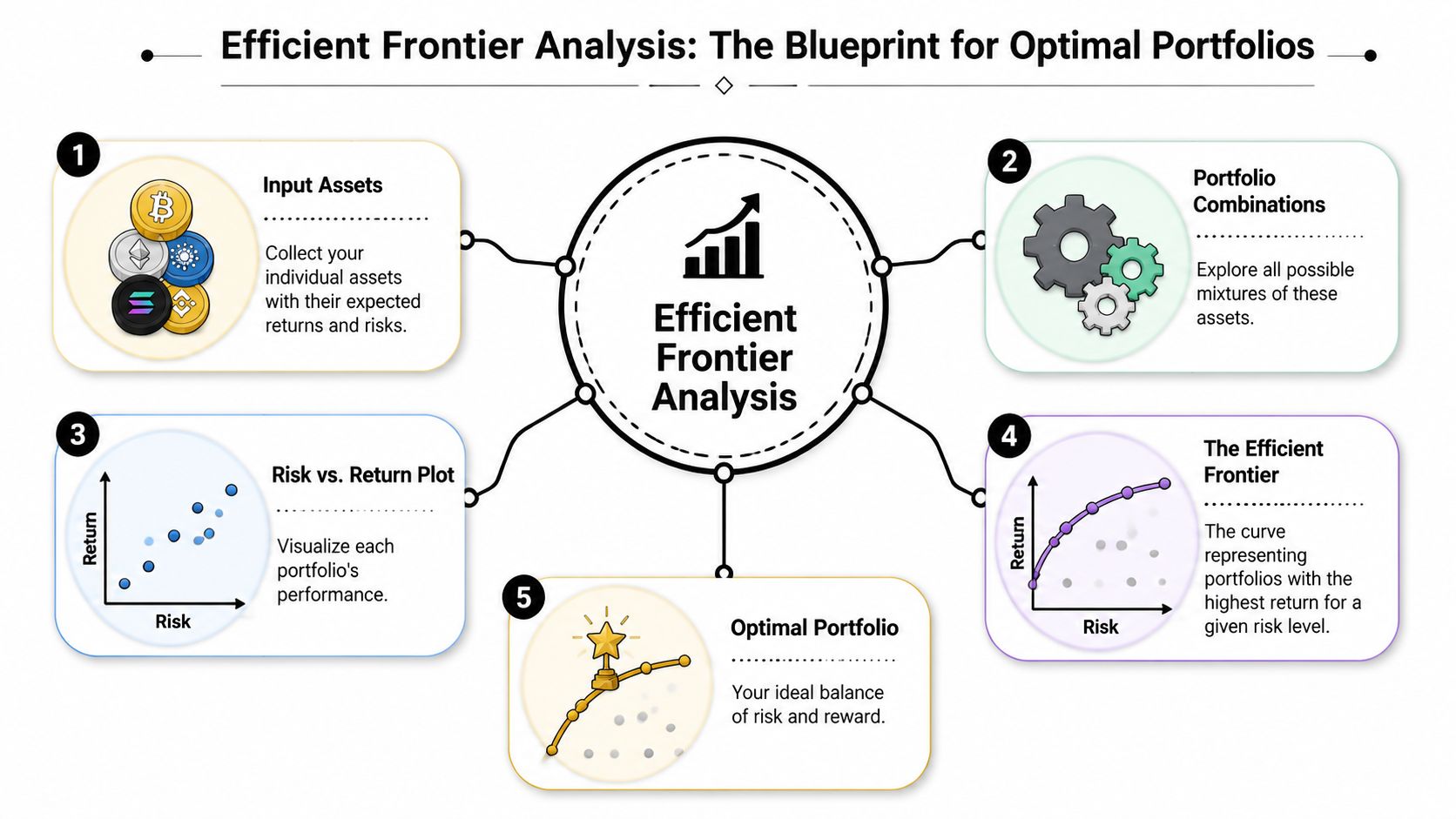
At its core, efficient frontier analysis is a ranking system for portfolios.
You start with a set of assets. For each possible combination of weights, you estimate expected return and risk. The frontier is the curve containing the portfolios that are non-dominated. For any target risk, it gives the highest-return portfolio in that class. For any target return, it gives the lowest-risk portfolio in that class, as described in Yale's introduction to the geography of the efficient frontier.
The three inputs that matter
The framework rests on three technical inputs:
| Input | What it means in practice | Why it matters in crypto |
|---|---|---|
| Mean return | Your estimate of average asset return over the chosen period | Crypto trends are regime-dependent, so this estimate is fragile |
| Standard deviation | The volatility of the asset's returns | This is the basic risk measure in the model |
| Correlation | How one asset's returns move relative to another's | This determines whether diversification is real or cosmetic |
Start tracking smart money today
Join thousands of traders using WalletFinder.ai to find profitable wallets and copy their trades.
Start Free Trial →

