
Crypto Profitability Calculator: A Guide
Use our crypto profitability calculator guide to master your P&L. Learn to factor in fees, slippage, and staking APY for truly accurate crypto gains.
It's a classic rookie mistake: subtracting your buy price from your sell price and calling it a day. The hard truth? That simple math gives you a dangerously incomplete picture of your crypto profitability. Real gains are almost always smaller than they appear, thanks to a host of hidden costs that can chip away at—or completely wipe out—what looked like a solid win.
Why Your Crypto Profit Calculations Are Incomplete
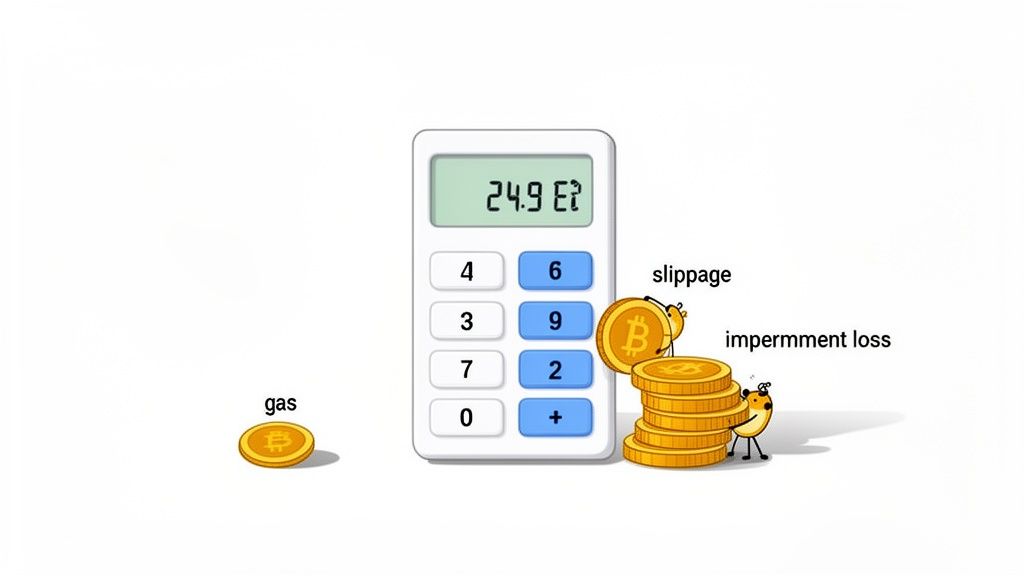
Many traders find out too late that the profit numbers they've been tracking are flat-out wrong. When you rely on surface-level math, you're ignoring the silent killers of your returns. This oversight doesn't just hurt your ego; it leads to bad trading decisions based on flawed data.
Getting a grip on your true profitability means you have to look beyond the basics. The nature of crypto—its volatility and decentralization—introduces costs that don't exist in traditional finance. Acknowledging and tracking these factors is the only way to get an honest assessment of your performance. For a deeper dive on another key metric, check out our guide on how a crypto average calculator works.
The Hidden Costs That Erode Profits
So, what are these profit-eating gremlins? They are everyday realities for anyone active in the crypto space, especially in DeFi. Ignoring them means you’re flying blind.
Here is an actionable checklist of costs to track for every trade:
- ✅ Network (Gas) Fees: Every on-chain action costs something. Whether sending tokens, swapping on a DEX, or interacting with a smart contract, you're paying a fee. On busy networks like Ethereum, these fees can be brutal, sometimes costing more than the trade itself.
- ✅ Exchange & Slippage Fees: Centralized exchanges have trading fees, which are usually straightforward. But on decentralized exchanges (DEXs), you also have to deal with slippage—the difference between the price you expected and the price you actually got. Both directly subtract from your bottom line.
- ✅ Impermanent Loss: This is a uniquely DeFi headache. If you're providing liquidity to a pool, the value of your deposited assets can drop compared to if you had just held them in your wallet. The fees you earn as a liquidity provider can easily be wiped out by impermanent loss.
Here’s where it gets real: Confusing revenue with profit is the fastest way to lose money. A $100 gain on paper can easily flip to a $20 loss once you factor in $50 in gas fees and another $70 lost to slippage on a volatile, low-liquidity token.
Simple Math vs. Realistic Accounting
The gap between a quick, back-of-the-napkin calculation and a proper, comprehensive one is huge. One gives you a feel-good (but false) number, while the other gives you the truth about your financial standing. Here’s a breakdown of what often gets missed.
Profit Factors Often Missed in Calculations
| Factor | Simple Method (Often Misleading) | Comprehensive Method (Your Goal) |
|---|---|---|
| Transaction Fees | Ignored | Includes all exchange and network fees. |
| Price Execution | Assumes expected trade price. | Accounts for slippage on DEXs. |
| DeFi Risks | Not considered. | Factors in impermanent loss for liquidity pools. |
| Overall Result | Inflated, overly optimistic profit. | Accurate, realistic Net Profit or Loss. |
Start tracking smart money today
Join thousands of traders using WalletFinder.ai to find profitable wallets and copy their trades.
Start Free Trial →

