
Crypto Price Alert Guide for Pro Traders
Master the crypto price alert. Learn to set advanced triggers, track smart money wallets, and integrate alerts into a winning trade strategy.
A modern crypto price alert is a powerful trigger for your trading strategy, not just a simple reminder to check prices. Think of it as an intelligent signal that automates your market watch, letting you act on critical movements the moment they happen—not hours later.
Go Beyond Price with Smarter Crypto Alerts
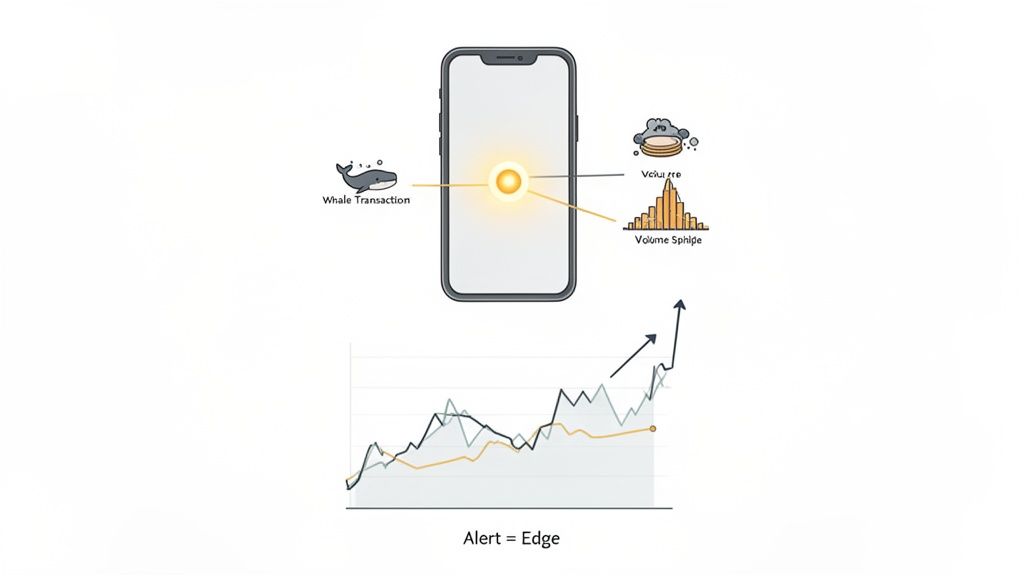
In crypto, timing isn't just important—it's everything. The market's wild volatility means fortunes can be made or lost in minutes. Trying to manually track every chart, asset, and wallet is not just hard; it’s flat-out impossible. This is where a modern crypto price alert system becomes your most valuable ally.
The days of setting a simple alert for when Bitcoin hits a certain dollar value are long gone. Today’s tools are so much more sophisticated, transforming passive pings into proactive trading signals.
The Shift from Simple Pings to Strategic Triggers
A basic alert might tell you that Solana (SOL) just crossed $200. It's useful, sure, but it’s missing all the context. Why did it move? Was it a broad market rally, a massive whale purchase, or a sudden surge in trading volume? Answering these questions is the difference between making a smart trade and a purely reactive one.
The real edge comes from alerts that signal why a price is moving. A notification about a sudden 300% volume spike on a low-cap token provides a much stronger trading thesis than a simple 10% price jump.
Advanced alert systems are built to give you this deeper context. They let you monitor not just the price but the underlying market dynamics driving it. To see how different platforms stack up, it's worth exploring a top-tier crypto price alert app.
Here’s how this evolution completely changes the game for traders:
- From Reactive to Proactive: Instead of reacting to price changes after the fact, you get notified about the events that cause them, like a huge exchange inflow or a prominent trader's first buy.
- From Noise to Signal: You can finally filter out minor market fluctuations. Focus only on the events that match your strategic criteria, like a token being added to a new decentralized exchange (DEX).
- From Manual Labor to Automation: A good alert system works for you 24/7, scanning the blockchain for opportunities so you don't have to be glued to your screen.
Real-World Scenarios Uncover Opportunities
Let's say you’re tracking a new memecoin. Setting a price alert for a 20% increase is standard practice. But what if you could set an alert that triggers only when a wallet known for smart memecoin trades makes a purchase of over $50,000? That one notification is infinitely more valuable.
This is the new paradigm of crypto alerts. It’s about creating intelligent tripwires that give you a crucial head start. A single, well-timed notification—whether it's about a whale's transaction, a smart money wallet's new position, or a sudden change in on-chain metrics—can mean the difference between catching a breakout and becoming someone else's exit liquidity.
Building Your First Intelligent Alert System
Alright, let's move from theory to practice. This is where a crypto price alert system really starts to shine. Setting up your first intelligent alert doesn't have to be a headache. Using a platform like Wallet Finder.ai, you can start with the basics and quickly level up to more powerful, strategic triggers that cut through the noise.
The first move is always to pick your assets and define some simple price levels. For example, if you're watching Ethereum, you might set an alert for when it breaks a key resistance level, say $4,500, or dips to a support level at $3,800. This is the bread and butter of any alert strategy.
But honestly, static price points are just the beginning. The real edge comes from creating alerts based on how the market is actually moving.
From Static Prices to Dynamic Triggers
To really get ahead, your alerts need to track the speed and momentum of price changes. A sudden, sharp move is almost always more telling than a slow, gradual one. You can set up your alerts to catch this velocity.
Here are some actionable, advanced trigger types you can set up today:
- Percentage Change Alerts: Instead of a fixed price, get a notification if an asset like Solana (SOL) pumps 10% in under 30 minutes. That’s a signal of intense, immediate buying pressure you won't want to miss.
- Volume Surge Alerts: A price move on low volume can easily be a fakeout. A better approach is to set an alert for when a token’s trading volume spikes 200% above its 24-hour average. This confirms that real money is driving the move.
- Technical Indicator Alerts: If you're comfortable with technical analysis, this is where it gets fun. For instance, you could create an alert for when a coin’s 50-day moving average crosses above its 200-day moving average—a classic "golden cross" bullish signal.
These dynamic triggers help you filter out the routine market chatter and focus only on the events that actually demand your attention.
An alert isn't just a notification; it's a pre-defined filter for opportunity. By setting triggers for volatility and volume, you’re telling your system, "Only bother me when something truly important happens."
This is the kind of setup that helps you navigate extreme market swings. Picture this: it’s January 15, 2026, and Bitcoin smashes through its all-time high, soaring past $97,000 for the first time before quickly pulling back into the high $80,000s. With forecast models for 2026 showing a wild range between $75,000 and $150,000, having smart alerts at key levels isn't just helpful—it's a necessity. You can explore the detailed 2026 Bitcoin price predictions to get a sense of the volatility we're all bracing for.
Choosing the Right Delivery Channel
How you get an alert is just as important as what triggers it. The best systems give you multiple delivery channels, and each one is suited for different situations.
| Delivery Channel | Speed | Detail Level | Best For |
|---|---|---|---|
| Telegram Messages | Instant | Low | Time-sensitive trades, like a whale purchase or a sudden price pump where every second counts. |
| Push Notifications | Fast | Medium | General market updates and watchlist movements that are important but not critically urgent. |
| Email Summaries | Slow | High | End-of-day reviews, giving you a detailed breakdown of all triggered alerts for deeper analysis later on. |
Start tracking smart money today
Join thousands of traders using WalletFinder.ai to find profitable wallets and copy their trades.
Start Free Trial →

