
Cross Chain Wallet: A Guide for DeFi Traders
Discover how a cross chain wallet unlocks seamless multi-chain DeFi. This guide covers trading, asset management, and security strategies.
Think of a cross-chain wallet as a universal passport for your crypto. It’s a single hub where you can manage, swap, and send assets across different blockchains like Ethereum, Solana, and Base without juggling a dozen different apps. It’s all about making your DeFi life simpler and more profitable.
Why Single-Chain Wallets Are Holding You Back
In today’s fast-moving DeFi world, sticking to just one blockchain is like trying to navigate New York City with a map of only Manhattan. A single-chain wallet works perfectly in its own neighborhood, but it builds digital walls that cut you off from the rest of the market.
Imagine a trader who needs a separate bank account, in a different currency, for every single country they do business in. It’s a recipe for chaos—scattered funds, confusing statements, and painful delays when you need to move money fast. That’s exactly the headache traders deal with when using separate wallets for each blockchain.
The Problem of Digital Isolation
When your funds are trapped on individual chains, you run into some serious roadblocks that can eat into your profits and waste your time:
- Missed Opportunities: The hottest trades often pop up on newer, faster chains like Solana or Base. By the time you’ve created a new wallet, sent funds to an exchange, and bridged them over, the alpha is long gone.
- Fragmented Capital: Your money is spread thin across multiple wallets. This makes it nearly impossible to get a clear picture of your total portfolio or quickly put your capital to work where it’s needed most.
- Complex Management: Juggling a collection of seed phrases, addresses, and interfaces isn’t just annoying—it’s a massive security risk. One mistake, and you could be in serious trouble.
This fragmentation is a huge obstacle for anyone serious about DeFi. The market no longer operates in silos, and traders need tools that can keep up.
A cross-chain wallet is no longer just a nice-to-have gadget; it's the 'universal passport' every modern DeFi trader needs. It lets you move capital seamlessly, chase opportunities anywhere, and manage everything from one secure command center.
The Shift to a Multi-Chain Mindset
The push for interoperability isn't just a passing trend—it's a fundamental change in how we interact with crypto. Traders want to follow smart money wherever it goes, and cross-chain wallets are what make that possible.
The numbers back this up. The global crypto wallet market is expected to have around 820 million active users by 2025, with hot wallets—many of which are now cross-chain—making up a massive 78% of the total. This growth shows just how much users want multi-chain capabilities.
Looking ahead, the market is projected to hit $14.84 billion by 2026 and explode to $98.57 billion by 2034, driven largely by this need to break down blockchain barriers. You can explore more cryptocurrency hot wallet statistics to see just how big this shift is.
How Cross Chain Wallets Bridge Blockchains
A cross chain wallet isn’t some kind of crypto magic. Under the hood, it's a sophisticated piece of software that uses clever technology to let you move your assets between totally separate blockchain ecosystems. Once you understand the basic mechanics, you can appreciate how these wallets create a smooth experience out of what is actually a very complex process.
Let's skip the dense technical jargon and use some simple analogies to see how it all works.
The whole point of a cross-chain wallet is to solve the headache of managing assets scattered across different blockchains. For any serious trader, especially DeFi copy traders on platforms like Wallet Finder.ai, this is a game-changer. Instead of juggling wallets for Ethereum, Solana, Polygon, and others, you get one unified interface to store, send, and swap your tokens.
This problem of "wallet fragmentation" is a real drag on performance. It leads to missed opportunities, makes your portfolio a nightmare to manage, and leaves your funds scattered and inefficient.
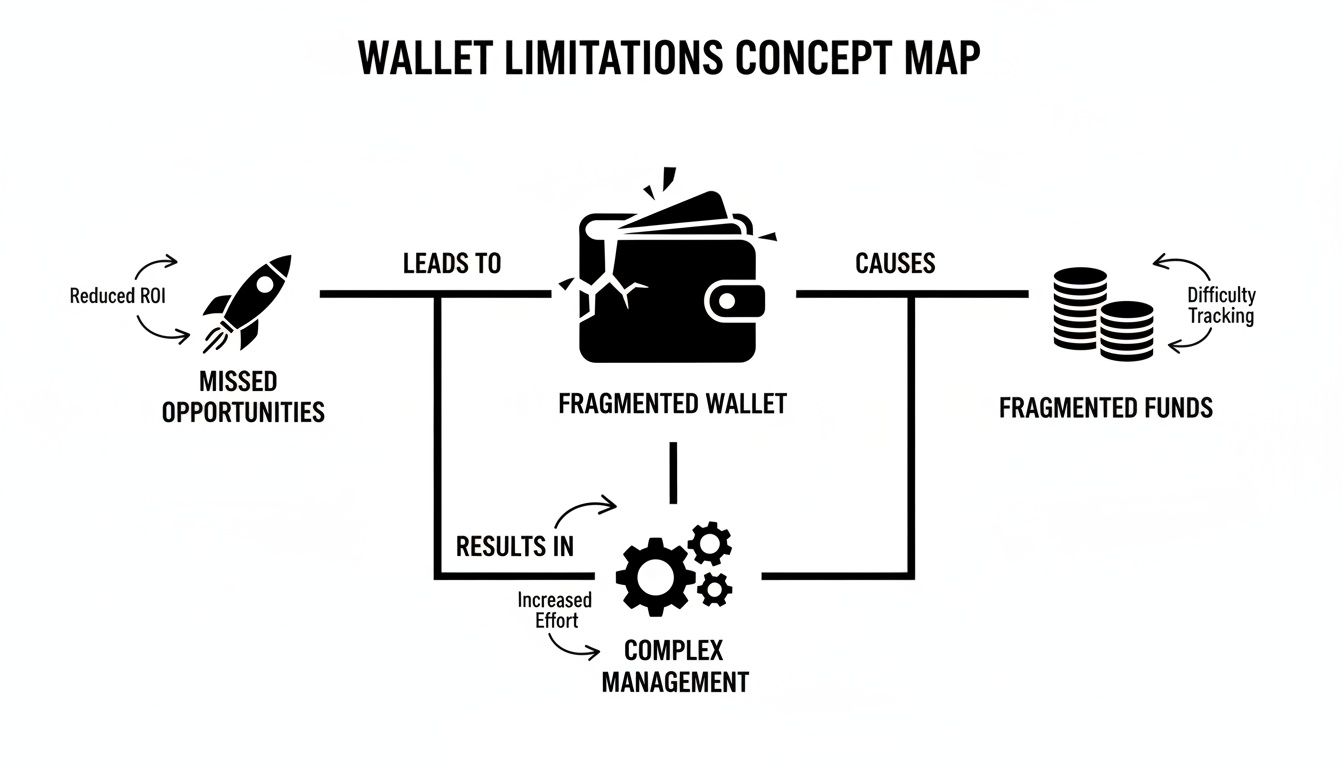
As you can see, these pain points make it tough to act fast and keep a clear picture of your total holdings. A single, unified wallet is the only logical solution.
The Role of Blockchain Bridges
The most common way wallets move assets between chains is through blockchain bridges. Think of a bridge as a secure currency exchange counter at an international airport. You show up with your US Dollars (your tokens on Ethereum) but need Euros (tokens on Polygon) for your trip.
Here's the process step-by-step:
- Lock: You deposit your original asset (e.g., USDC on Ethereum) into the bridge's smart contract. This asset is now locked and held in custody.
- Mint: The bridge verifies the deposit and then mints a new, "wrapped" version of that asset (e.g., USDC.e on Polygon) on the destination chain.
- Transfer: This newly minted, pegged token is sent to your wallet address on the new chain, ready for you to use.
When you want to bridge back, the process reverses: the wrapped token is "burned" (destroyed), and your original asset is unlocked and returned to you.
Bridges are the workhorses of the cross-chain world, enabling value to flow between otherwise isolated networks. But remember, their security hinges entirely on the integrity of the smart contracts that lock and mint those assets.
Atomic Swaps: The Trustless Trade
Another powerful method is the atomic swap. Imagine you want to trade your rare comic book for a friend's vintage action figure, but you don't fully trust each other to mail the items at the same time. An atomic swap is like using a special, automated escrow box with two separate locks.
You both place your items inside. The box is programmed to only unlock and give you the other person's item if, and only if, both items are present. If one of you backs out or fails to put their item in, the box automatically returns everything to its original owner. This all-or-nothing process guarantees a fair trade happens simultaneously, completely removing the need for a trusted middleman. If you want to go deeper, check out our guide on how chain swap crypto works.
Smart Contract Wallets: The Personal Assistant
Finally, there are smart contract wallets. These are much more than just a place to hold your private keys; they are programmable accounts that live directly on the blockchain. The best way to think of a smart contract wallet is as a personal financial assistant who has authorized access to accounts at several different banks on your behalf.
You can give this assistant a single, high-level command, like, "Move $1,000 from Bank A to Bank B and use it to buy some specific stocks." The assistant handles all the underlying paperwork, transfers, and brokerage orders automatically. In the same way, a smart contract wallet can execute complex, multi-step actions across different chains from a single instruction, making it incredibly powerful for sophisticated DeFi strategies.
Comparing Cross Chain Technologies
Each of these technologies comes with its own set of trade-offs when it comes to speed, security, and what it’s best used for. This quick comparison table breaks down the key differences to help you understand what's likely powering your cross-chain wallet.
Start tracking smart money today
Join thousands of traders using WalletFinder.ai to find profitable wallets and copy their trades.
Start Free Trial →

