
Crypto Cost Basis Tracking a Definitive Guide
Master crypto cost basis tracking with our guide. Learn FIFO, LIFO, handle on-chain complexity, and streamline tax reporting with powerful tools.
You open your wallet history to prepare taxes and instantly hit a wall. One wallet traded on Ethereum, another on Solana, a third only touched Base, and somewhere in that mess you bridged assets, farmed yields, claimed rewards, and swapped tokens that no exchange report fully understands.
That's why cost basis tracking feels so brutal in crypto. It isn't just arithmetic. For active DeFi traders, it's closer to reconstruction work. You're rebuilding what happened, when it happened, what each asset originally cost, and which lot got disposed of when you sold, swapped, staked, or removed liquidity.
If you've been leaning on exchange exports and hoping they tell the full story, they probably don't. A cleaner approach starts with understanding the mechanics, then building a workflow that can survive real on-chain activity.
Why Crypto Cost Basis Is a Tax Nightmare
For a simple stock trade, most investors think in one line: buy, hold, sell. Crypto rarely behaves that way. A DeFi trader might buy ETH on a centralized exchange, move it to a wallet, bridge it to another chain, swap part of it for a token, pair that token in a liquidity pool, receive LP tokens, unstake later, and then sell the proceeds in pieces across multiple wallets.
Every one of those actions can affect cost basis tracking.
At the simplest level, cost basis is the amount tied to an asset for tax purposes. When you dispose of that asset, your gain or loss depends on the difference between what you received and what your basis was. The hard part in crypto isn't understanding that sentence. The hard part is proving the right basis after months of fragmented wallet activity.
Why DeFi traders get stuck
Traditional finance has spent years standardizing broker reporting. In U.S. securities, broker cost-basis reporting rules were phased in by asset type starting with equities acquired on or after January 1, 2011, then mutual funds, ETFs, and dividend-reinvestment plans acquired on or after January 1, 2012, and most fixed-income securities and options acquired on or after January 1, 2014, according to Schwab's explanation of broker cost-basis rules. Crypto, especially self-custodied crypto, doesn't give you that same safety net.
That difference matters. In DeFi, the burden usually stays with you.
Crypto taxes usually break down at the point where wallet history and tax-lot history stop matching.
If you're trying to calculate gains manually, a good primer on realized gains can help frame the job. This guide on how to calculate capital gains for crypto transactions is useful for understanding the tax result you're ultimately trying to produce.
The real problem isn't one trade
Most traders don't fail because they forgot one purchase price. They fail because history becomes fragmented.
- Wallet sprawl: Assets move across multiple addresses.
- Chain sprawl: The same position may touch several networks.
- Protocol complexity: LP deposits, reward claims, and token wrappers muddy the audit trail.
- Missing context: Transfers can look like sales if your records don't tie them together.
That's why crypto cost basis tracking is a tax nightmare. You're not just logging trades. You're rebuilding the story of each token lot from first acquisition to final disposition.
The Building Blocks of Cost Basis Calculation
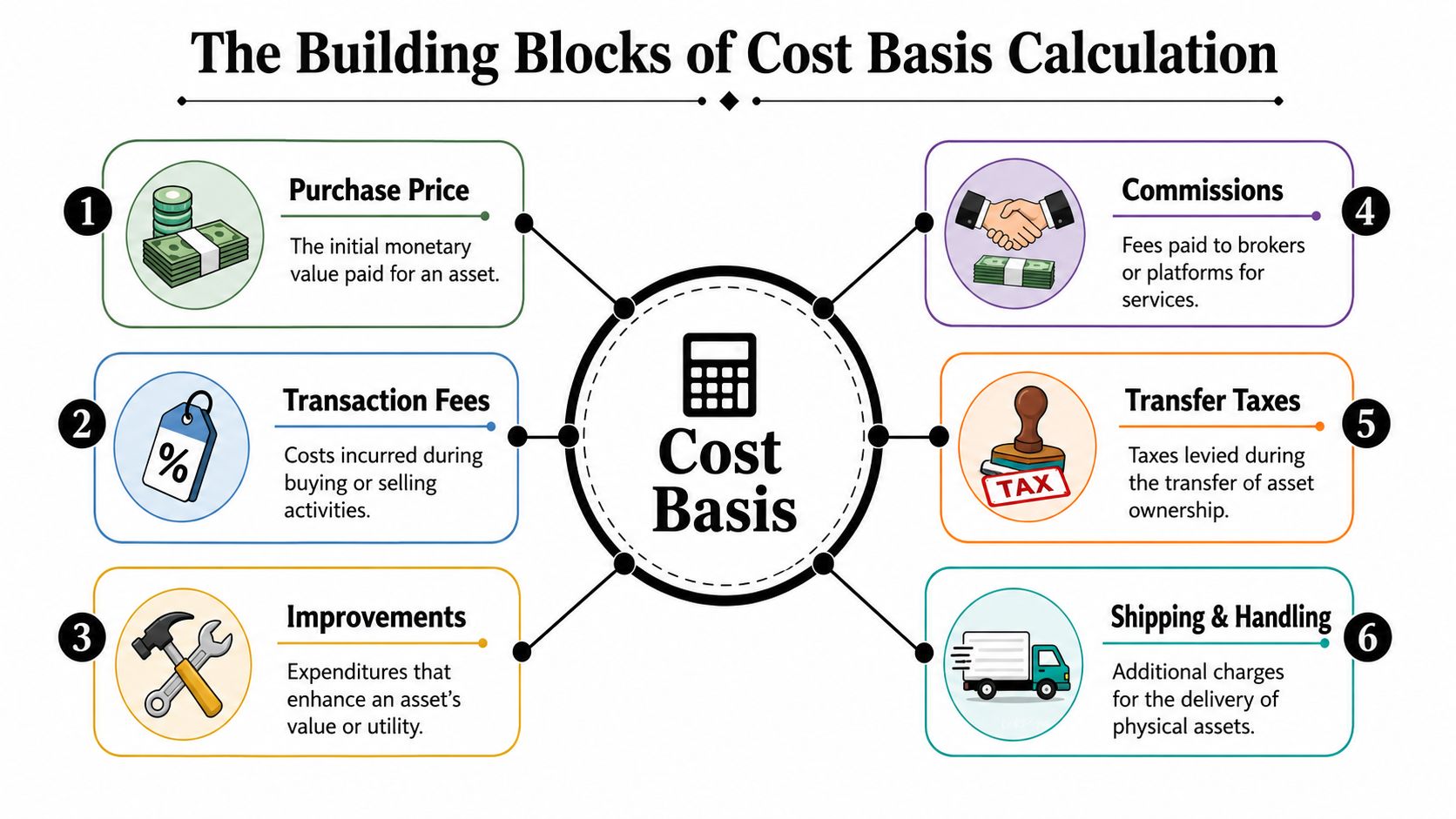
Start with the core rule. Cost basis is not just what you paid to buy the token. For securities, Fidelity notes that basis also includes transaction costs such as brokerage commissions, reinvested dividends or capital-gains distributions, and other IRS-recognized adjustments. In crypto, that same principle extends to gas fees and other on-chain transaction costs, as explained in Fidelity's guide to capital gains and cost basis.
That one point clears up a lot of confusion. If you bought a token for one amount but paid meaningful gas to acquire it, the tax record may need to reflect more than the sticker price.
Think of basis like total landing cost
A simple analogy helps. Suppose you buy a rare collectible online. The item price is only part of your actual cost. You might also pay shipping, insurance, marketplace fees, and payment processing charges. If you later resell it, your true economic investment wasn't just the headline price.
Crypto works the same way.
For many traders, basis includes items like:
- Purchase value: What you gave up to acquire the asset.
- Gas and network fees: Costs paid on-chain to complete the transaction.
- Trading fees: Exchange or protocol fees tied to the acquisition.
- Adjustments from later events: In some cases, later activity changes the tax story tied to the lot.
What counts as a disposal
A lot of confusion comes from thinking only fiat sales matter. In crypto, a taxable disposal often happens when you part with one asset, even if no cash hits your bank account.
Common examples include:
- Selling crypto for fiat
- Swapping one token for another
- Using crypto to buy goods or services
- In some cases, converting or unwinding positions that effectively dispose of one asset and replace it with another
If you swap ETH for USDC on a DEX, that's usually not just a “trade” in casual language. For tax lot purposes, it often means you disposed of ETH and acquired USDC.
Practical rule: If an asset leaves your wallet in exchange for something else of value, stop and ask whether you just created a taxable disposition.
Calculators can help with the mechanics. If you want a quick sense of average acquisition cost before you tackle lot-level detail, try this crypto average calculator for position tracking.
The data you need every time
For reliable cost basis tracking, capture these details for every transaction:
| Record item | Why it matters |
|---|---|
| Date and time | Helps order lots correctly |
| Wallet and chain | Ties the movement to the right ledger |
| Asset sent and received | Defines the disposal and acquisition |
| Quantity | Determines lot matching |
| Fees paid | May affect basis or proceeds |
| Transaction hash | Gives you audit support |
Start tracking smart money today
Join thousands of traders using WalletFinder.ai to find profitable wallets and copy their trades.
Start Free Trial →

.avif&w=3840&q=75)