
How to Calculate Crypto Profit (A Real Guide)
Learn how to calculate profit cryptocurrency with clear steps, practical tools, and strategies to maximize returns in any market.
Figuring out your crypto profit seems simple: just subtract what you paid from what you sold for. But the actual cost of a trade goes far beyond the initial price. Hidden expenses like trading fees, network gas, and slippage can take a serious bite out of your gains, turning a "win" into a loss if you're not careful. This guide provides the formulas and actionable steps you need to see your real gains.
Look Beyond the Price Tag: The Real Cost of a Crypto Trade
Before you can calculate profit on any trade, you must understand all the costs that quietly eat away at your returns. It's a classic rookie mistake to just look at the buy and sell price. That simple math completely ignores the hidden expenses that determine what you actually take home.
Trust me, ignoring these costs can quickly turn what looks like a winning trade into a surprising loss. These aren't optional fees; they're part of transacting on any blockchain or exchange. Getting this right is the first step toward accurate profit and loss (PnL) tracking and making smarter trades.
The Trio of Transaction Costs
Every trade comes with key expenses you must factor in. While some are small percentages, they add up fast, especially if you're an active trader.
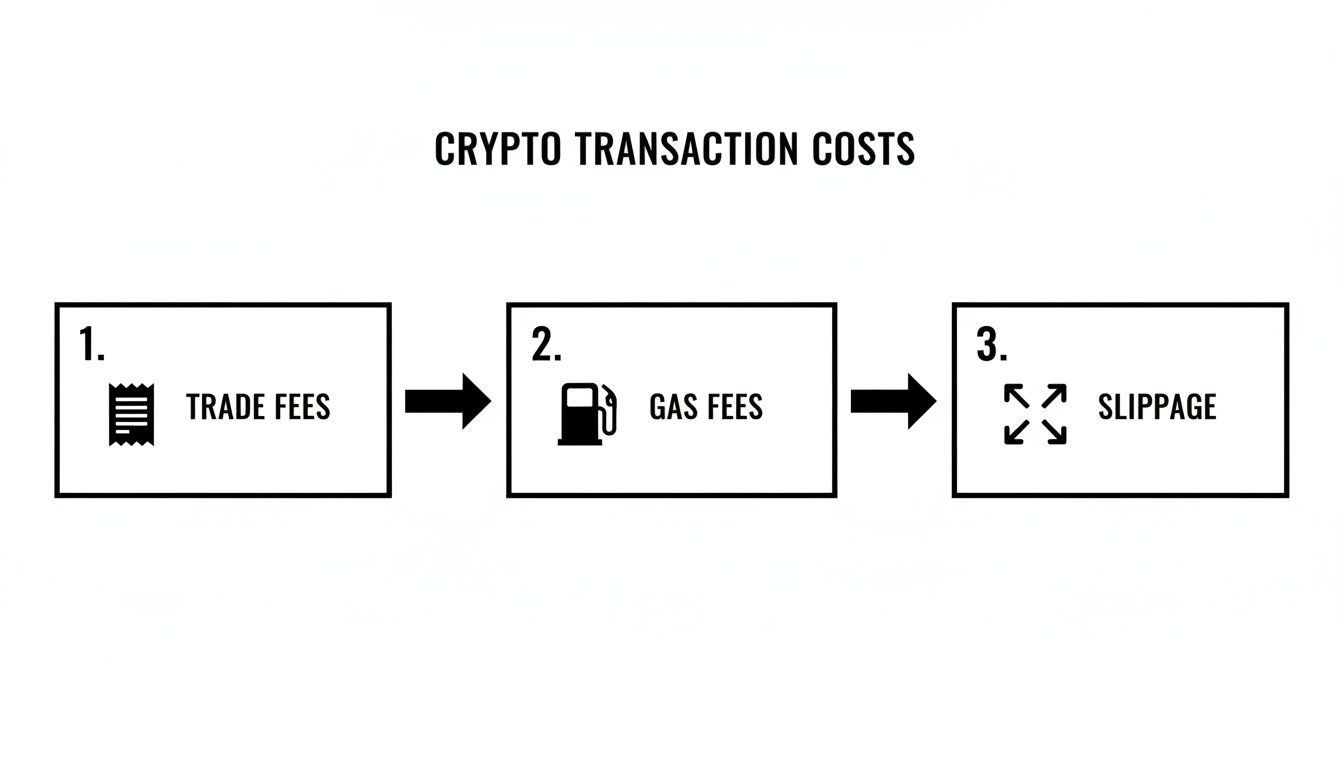
Here are the main costs you can't afford to overlook:
- Exchange Trading Fees: Centralized exchanges like Coinbase or Binance charge a fee to execute your trade. It’s usually a small percentage (e.g., 0.1%) of the trade's value and can vary depending on whether you're a "maker" (adding liquidity) or a "taker" (removing it).
- Network Gas Fees: When using a decentralized exchange (DEX) like Uniswap, you pay a network fee, or "gas." This fee compensates network validators for processing your transaction. On networks like Ethereum, these fees can swing wildly, sometimes hitting hundreds of dollars during peak times.
- Slippage: This occurs in fast-moving markets when an asset's price changes between the moment you confirm a trade and when it actually executes on-chain. If you're swapping $1,000 of ETH for a new token, slippage might mean you only get $995 worth back, creating an instant small loss.
A huge mistake I see all the time is traders only subtracting the trading fee they see on the exchange. Forgetting to account for a $45 gas fee on an Ethereum swap or 2% slippage on a low-liquidity token can completely throw off your profit calculation.
Let's walk through a real-world example. Say you decide to swap 1 ETH (worth $3,500) for a hot new token on Uniswap. The platform gives you an estimated return, but by the time your trade actually goes through, you've paid $50 in gas and lost another $30 to slippage.
Suddenly, your real cost isn't $3,500—it's actually $3,580. To make any profit, that new token must now climb high enough to cover that more expensive entry point. It's that easy for a trade that looked great on paper to start in the red.
Mastering the Essential Crypto Profit Formulas
Now that you’re wise to the hidden costs, it’s time for the core math. This isn't just theory—it's the toolkit every serious trader uses to distinguish between paper gains and actual, bankable returns. Mastering these simple formulas is what separates guessing from knowing your real performance.
The first concept you must nail is Realized PnL (Profit and Loss). This is the profit or loss from a trade you’ve already closed. It’s the money you’ve either made or lost, plain and simple.
Your Realized PnL is the ultimate source of truth. It cuts through market noise and tells you exactly what a specific trade returned after all the dust settled and the fees were paid.
Calculating Realized PnL
The formula itself is straightforward. For any single trade, you can figure out your profit with this simple equation:
(Sell Price - Buy Price) - Total Fees = Realized Profit
Let's run through a quick, real-world example. Imagine you bought 1 ETH for $3,000. A few weeks later, you sell it for $3,500. Along the way, you racked up $50 in various fees (exchange commissions, gas, etc.).
Here’s how the math breaks down:
($3,500 - $3,000) - $50 = $450
Your realized profit is $450. Even though the price jumped by $500, your actual take-home gain was chipped away by fees. It's a crucial detail that trips up many new traders.
This flowchart breaks down the main costs—trade fees, gas, and slippage—that you have to subtract to find your true profit.
Start tracking smart money today
Join thousands of traders using WalletFinder.ai to find profitable wallets and copy their trades.
Start Free Trial →

