
Guide to Block Chain Analytics for DeFi Traders
Unlock profitable crypto trades with this guide to block chain analytics. Learn on-chain analysis, track smart money, and find high-potential wallets.
Block chain analytics is the process of digging through public blockchain data to find actionable intelligence. For a DeFi trader, this isn't just data—it's the secret sauce that reveals the "why" behind market moves, turning guesswork into sharp, data-driven decisions.
What Is Blockchain Analytics and Why It Matters
Picture the blockchain as a giant, transparent public library. Every transaction is recorded in a permanent, unchangeable book. Anyone can read these books, but the sheer volume of information is staggering. It's information overload.
Block chain analytics is the skill of knowing which books to read and how to interpret them for a real edge.
Instead of just reacting to price charts and news, you start seeing the hidden forces that drive those prices. This deeper insight is what separates successful traders from the rest. You stop reacting and start anticipating.
From Raw Data to Trading Signals
On-chain data provides a crystal-clear view of market behavior that traditional financial analysis can't offer. It helps you answer critical questions that lead to smarter, more profitable strategies.
Here’s what it unlocks:
- Tracking "Smart Money": Pinpoint wallets of highly profitable traders and see where they move capital before the market catches on.
- Discovering New Trends: Spot which tokens are being quietly accumulated by influential wallets—often a clear signal of an upcoming price surge.
- Learning from Winners: Analyze the entire trading history of successful wallets. See their wins, losses, and exact strategies to sharpen your own.
- Validating Narratives: Cut through the noise. Instantly verify if market hype is backed by real money or if it's just a baseless rumor.
By mastering block chain analytics, you transition from being a market spectator to a market detective. You learn to piece together clues from wallet movements and transaction patterns to build a solid picture of what’s really happening.
The Trader's Unfair Advantage
Ultimately, the goal is simple: make better, more profitable decisions. It’s like a business analyzing sales data to understand customer behavior, but you're applying that same logic to the entire crypto market.
Tools like blockchain explorers are your starting point. To understand them better, check out our guide on what is a blockchain explorer and how it works. Mastering this fundamental knowledge is the first step to unlocking the powerful insights block chain analytics has to offer.
Decoding the Language of On-Chain Data
To profit from on-chain data, you must learn its language. The blockchain communicates through transactions, wallet addresses, and token flows. The real skill is turning that raw information into a clear trading signal. Mastering a few core block chain analytics techniques is what separates the noise from the alpha.
Think of each technique as a different tool in a detective's kit. You wouldn't solve a case with just one piece of evidence. By combining these on-chain methods, you can build a complete picture of what the smartest traders are doing and, more importantly, why.
This concept map shows how everything starts with the public ledger. From there, block chain analytics branches out to help us track smart money and spot market-moving trends before they happen.
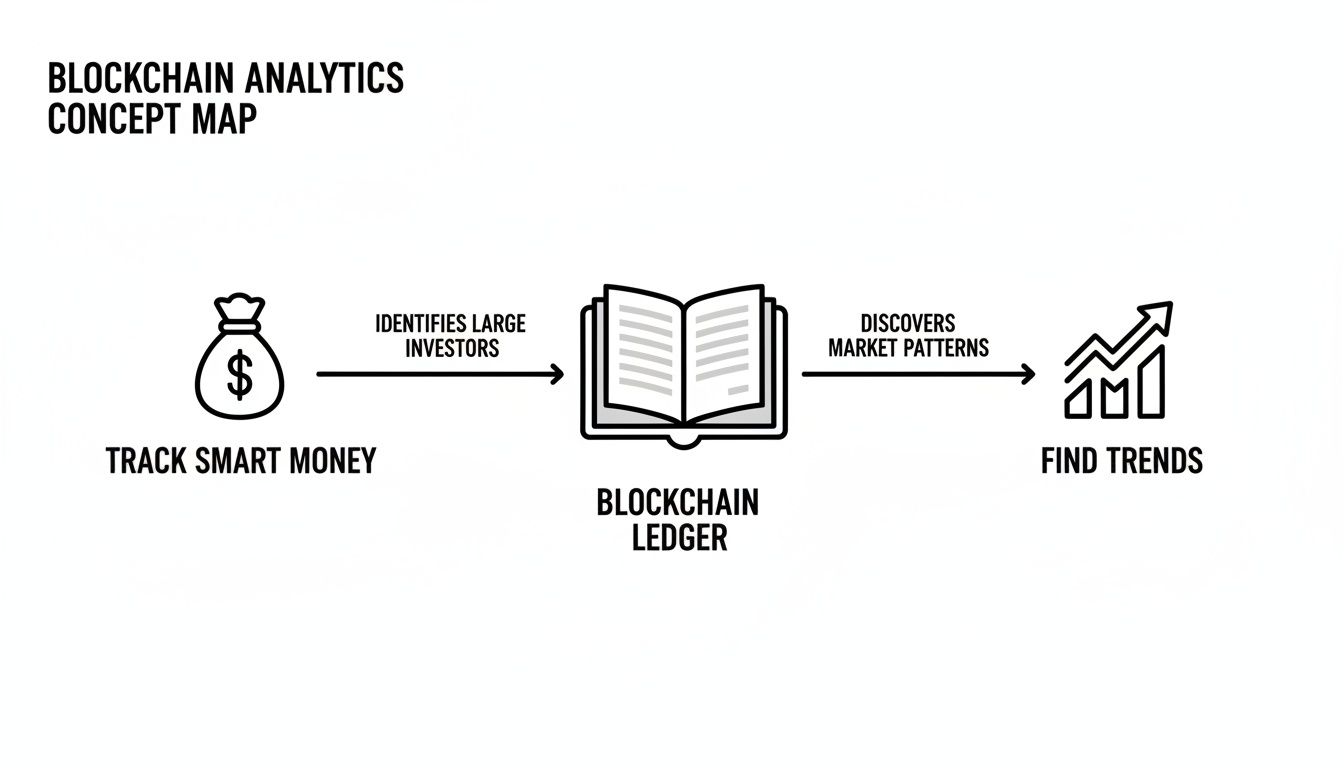
The entire point is to use the ledger's transparency to find an edge. Let’s break down the essential techniques you'll need.
Follow the Money with Transaction Tracing
Transaction tracing is financial detective work for the crypto age. It’s about following funds as they move between wallets to reveal their source, path, and destination. This is how you understand the story behind market movements.
For example, a large sum of stablecoins moving from a dormant wallet to a major exchange often precedes a big buy. Conversely, a whale shifting a massive token position from DeFi to a centralized exchange wallet could be a major red flag that they’re about to sell.
Transaction tracing isn't just watching numbers; it's about understanding the intent behind the movement. It’s the closest you can get to reading the minds of major players based on their actions.
This technique helps you answer critical questions:
- Where did this top trader get their starting capital?
- Are they quietly sending funds to a new, undiscovered DeFi protocol?
- Is a project’s treasury wallet making suspicious moves?
Unmasking Traders with Wallet Clustering
Blockchain anonymity is largely a myth. While wallet addresses seem random, wallet clustering groups multiple addresses likely controlled by the same entity. It’s like discovering that a trader’s five different brokerage accounts all belong to the same person.
Top traders often spread capital across dozens of wallets to hide their size and strategy. Clustering algorithms analyze transaction patterns—like simultaneous funding from a single source or coordinated trades—to link them together. This provides a true picture of a trader's net worth, portfolio, and strategic footprint. Without it, you’re only seeing a small piece of the puzzle.
Grading Performance with PnL Analysis
Profit and Loss (PnL) analysis is the ultimate report card for any wallet. It calculates realized and unrealized gains for every asset a wallet has ever touched, giving you an unfiltered look at its performance. This is one of the most powerful tools in block chain analytics.
PnL cuts through social media hype. A trader might brag about one huge win, but a PnL check could reveal a history of losses.
A solid PnL analysis reveals:
- A wallet's all-time net profit.
- Its win rate (percentage of profitable trades).
- The biggest winning and losing trades.
- Average holding periods and risk habits.
This is non-negotiable for determining if a "smart money" wallet is genuinely skilled or just got lucky once.
Tracking the Tides with Liquidity Flow Analysis
Liquidity flow analysis is like tracking capital tides in the DeFi ocean. It shows where money is flowing in aggregate—which tokens, protocols, or ecosystems are attracting capital and which are bleeding assets.
When you see billions in liquidity rushing into a specific DeFi protocol, it signals massive market conviction. When that capital flees, it signals risk or fading interest. This macro view helps you identify broad market trends and position yourself ahead of the herd.
Core On-Chain Analysis Techniques at a Glance
This table breaks down these core on-chain techniques with a simple analogy and the key question each one helps you answer.
| Technique | Simple Analogy | Key Question It Answers |
|---|---|---|
| Transaction Tracing | Following a money trail | "Where is this smart money moving their capital right now?" |
| Wallet Clustering | Grouping a trader's different accounts | "What is this trader's true net worth and overall strategy?" |
| PnL Analysis | Looking at a wallet's report card | "Is this trader consistently profitable over time?" |
| Liquidity Flow Analysis | Tracking capital tides | "Which DeFi sectors or tokens are gaining the most momentum?" |
Start tracking smart money today
Join thousands of traders using WalletFinder.ai to find profitable wallets and copy their trades.
Start Free Trial →

