
Best Cryptocurrency Portfolio Tracker Guide
Discover the best cryptocurrency portfolio tracker. Compare top tools by DeFi support, on-chain analytics, and copy trading features to elevate your strategy.
The best cryptocurrency portfolio tracker isn't just about adding up your balances. It’s a tool that gives you deep on-chain analytics, accurate DeFi PnL, and real-time alerts on what the smart money is doing. The old guard of tracking tools just can't keep up anymore—they were never built for the chaos of yield farming, NFT flipping, and multi-chain trading. You need actionable insights, not just a static list of numbers.
Why Traditional Portfolio Trackers No Longer Cut It
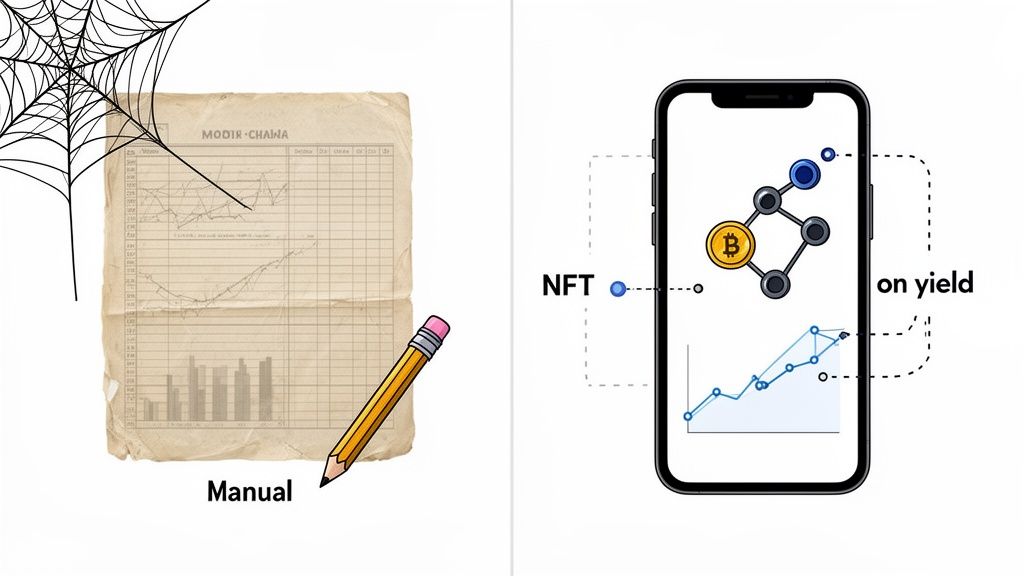
Remember when you could just hold some Bitcoin and Ether in one wallet and track it on a spreadsheet? Those days are long gone. The crypto world has exploded into a massive ecosystem of decentralized finance (DeFi), NFTs, and dozens of different blockchains. This evolution has left most traditional portfolio trackers in the dust.
Most of the older tools and manual methods just weren't built for this. They typically lean on basic exchange APIs, which means they're completely blind to what’s happening on-chain.
The Limits of Outdated Tracking
The cracks in these old systems start to show the minute you dive into modern crypto strategies. They just fall apart when trying to handle a few critical things:
- Inaccurate DeFi PnL: Trying to calculate your real profit and loss from yield farming, providing liquidity, or staking is a nightmare for basic trackers. They often see these complex transactions as simple transfers, which throws your performance data completely out of whack.
- No Multi-Chain Support: Assets are constantly moving between Ethereum, Solana, Base, and other networks. A tracker that can't follow that movement is more of a liability than a help. You need a single, unified view to manage positions across chains, which most older platforms just don't have. If you've felt this pain, you're not alone—we cover it in our guide on how to track DeFi portfolios across multiple wallets.
- No Real-Time On-Chain Data: The market moves at the speed of a block confirmation. If you're relying on delayed API data, you're always a step behind. A genuinely useful cryptocurrency portfolio tracker has to pull its insights directly from the chain, in real time.
The core problem is simple: traditional trackers show you what you hold, but they can't tell you why its value is changing or what the smart money is doing next. They give you a static snapshot in a market that never stops moving.
The Need for Actionable Intelligence
This hunger for deeper, real-time tracking is only getting more intense as the market matures. Take 2025, for example, when Bitcoin's market dominance shot past 60% and institutional ETF inflows topped $115 billion. Being able to see those market shifts as they happened was critical. Even with all that institutional money pouring in, major assets still saw huge corrections, proving how vital it is to have trackers that can monitor HODLer sentiment and dominance shifts on the fly. You can read more about these kinds of 2026 crypto market predictions on youhodler.com.
At the end of the day, a modern crypto investor needs more than a glorified balance sheet. You need a command center that turns raw blockchain data into clear trading signals, helping you spot opportunities and manage risk across the entire Web3 world.
What to Look For in a Modern Crypto Tracker
Picking the right crypto portfolio tracker isn't just about finding a pretty dashboard anymore. In today's on-chain world, you need a powerful set of features that can actually keep up with the chaos. A modern tracker has to be an analytical engine, not just a simple balance aggregator.
To make the right call, you need a solid framework for evaluation. The criteria below cut through the marketing fluff and get straight to the non-negotiable features you need to succeed in DeFi, memecoin trading, and multi-chain investing.
Multi-Chain and Protocol Support
The first, most basic test is a tracker's reach. The crypto world isn't just about Ethereum now; huge amounts of action are happening on networks like Solana, Base, Arbitrum, and others. Any top-tier tracker worth its salt has to offer comprehensive support across all the major and up-and-coming chains you're active on.
But just supporting the chain isn't enough. The platform also needs deep integrations with the specific DeFi protocols you're using. That means it has to correctly identify and track assets you have tied up in:
- Liquidity Pools: It must recognize your LP positions, calculating their underlying value and even impermanent loss.
- Staking and Restaking: It needs to accurately track your staked assets and the rewards you're earning from protocols like Lido or EigenLayer.
- Lending and Borrowing: It has to display your collateral and debt positions from platforms like Aave or Compound.
If a tracker only shows the native token of a protocol sitting in your wallet but misses all your complex positions within it, it’s giving you a dangerously incomplete picture of your portfolio.
Profit and Loss Accuracy
This is where most basic trackers fall flat on their face. Calculating your true PnL in DeFi is an incredibly messy business. A proper cryptocurrency portfolio tracker must be able to dig through complex transaction histories to give you a precise picture of how you're really doing.
The gold standard for any tracker is its ability to calculate your PnL on a per-wallet, per-token, and even per-trade basis. Without that level of detail, you're flying blind, unable to separate your winning strategies from the ones that are bleeding you dry.
Think about it: if you're providing liquidity for a new memecoin on Base, the tracker needs to account for the initial swap fee, the value of the LP tokens you got, any farming rewards you earned, and the final value when you pulled out—including slippage and gas fees. Anything less is just a wild guess.
On-Chain Analytics and Real-Time Alerts
Finally, the best tools do more than just report what happened; they turn raw data into signals you can act on. This is where robust on-chain analytics and customizable, real-time alerts come in. These are the features that separate a passive dashboard from an active trading weapon.
To help you compare your options, here’s a quick checklist of the capabilities that truly matter.
Essential Features Checklist for Modern Portfolio Trackers
When you're comparing different trackers, it's easy to get lost in a long list of features. This table cuts through the noise and highlights the absolute must-haves for any serious trader today.
| Feature Category | Essential Capability | Why It Matters for Traders |
|---|---|---|
| On-Chain Discovery | Tools to find and analyze top-performing wallets and trending tokens. | Helps you spot smart money movements and discover opportunities before they become mainstream. |
| Real-Time Alerts | Instant notifications (e.g., via Telegram or push) for wallet activity. | Allows for timely copy trading and quick reactions to market-moving transactions by influential traders. |
| Historical Analysis | The ability to review a wallet's complete trade history, including entries, exits, and PnL. | Provides deep insights into a successful trader's strategy, helping you learn and replicate their methods. |
Start tracking smart money today
Join thousands of traders using WalletFinder.ai to find profitable wallets and copy their trades.
Start Free Trial →

