
APR vs APY Calculator: Your Crypto Guide
Struggling to compare DeFi yields? Use our APR vs APY calculator guide to understand compounding and choose investments that truly maximize your crypto returns.
The real difference between APR and APY boils down to one crucial thing: compounding.
APR (Annual Percentage Rate) is the simple, flat interest rate you earn or pay over a year. Think of it as the sticker price. APY (Annual Percentage Yield), on the other hand, is the actual rate you get after factoring in the magic of compounding. For anyone serious about crypto, especially in DeFi, understanding this distinction is non-negotiable for calculating real returns.
APR vs APY: What Crypto Investors Need to Know
When you're navigating the world of decentralized finance (DeFi), you'll see APR and APY everywhere. Getting them mixed up is a rookie mistake that can lead to costly errors and missed gains. While they sound alike, one tells you the advertised rate, and the other reveals your true earning potential.
An APR vs APY calculator is the essential tool that bridges this gap. It translates a simple rate into the effective yield you can actually expect. This is especially vital in crypto, where compounding can happen daily or even multiple times a day, dramatically amplifying your returns.
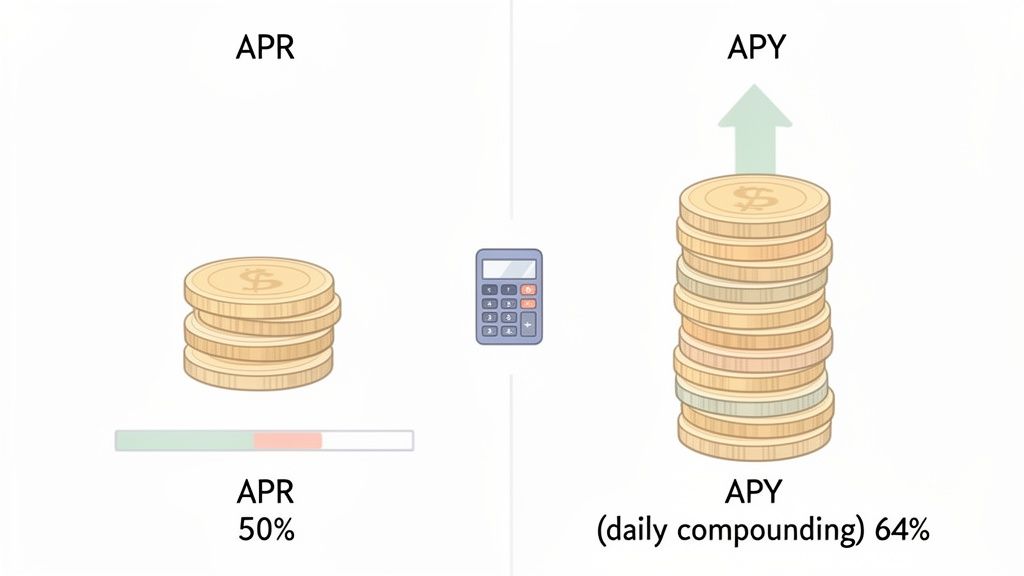
Unpacking APR and APY
Let's break these down into simple, actionable terms.
APR (Annual Percentage Rate) represents the yearly interest on your money without any frills. It's a straightforward number that ignores the effect of compounding within that year.
- Think of it as simple interest. If you stake $1,000 in a pool with a 50% APR, you'll earn $500 over one year—if you don't touch the rewards.
- Best for borrowing. When you take out a loan, a lower APR is always better. It reflects the pure cost of borrowing before any compounding kicks in.
APY (Annual Percentage Yield), however, shows you the total interest you'll earn in a year, including the effects of compounding. Compounding simply means you're earning interest not just on your initial principal, but also on the interest that has already piled up.
Key Takeaway: APY shows the true growth of your investment. Because it accounts for interest earning its own interest, APY will always be equal to or higher than the APR.
This is where the real gains are made. A 50% APR might not seem that different from a 60% APY at first, but the compounded growth over time can be massive. For a deeper dive, you can learn more about what APY in crypto means and how it’s calculated.
APR vs APY: A Quick Comparison
This table helps you understand the fundamental differences between Annual Percentage Rate and Annual Percentage Yield at a glance, so you know which metric to focus on.
| Metric | APR (Annual Percentage Rate) | APY (Annual Percentage Yield) |
|---|---|---|
| Calculation Basis | Simple interest; does not include compounding. | Compound interest; includes interest earned on interest. |
| Primary Use Case | Best for understanding the cost of borrowing money. | Best for understanding the return on investments and savings. |
| Complexity | Simple and straightforward to calculate. | More complex, as it depends on compounding frequency. |
| Investor Focus | Focus on APR when you owe money (loans, credit cards). | Focus on APY when you are earning money (staking, yield farming). |
Start tracking smart money today
Join thousands of traders using WalletFinder.ai to find profitable wallets and copy their trades.
Start Free Trial →

