
What Is UTXO: Master Crypto Transactions in 2026
What is UTXO? Explore this core crypto concept. Learn its impact on privacy, trading, and on-chain analysis to boost your insights in 2026. Get started now!
You're probably looking at a wallet transfer, an exchange withdrawal, or a cluster of small incoming deposits and thinking: why does this look so messy on Bitcoin-style chains?
That confusion usually comes from one thing. You're expecting a wallet to work like a bank account. On a UTXO chain, it doesn't.
If you want the practical answer to what is UTXO, think like an on-chain trader, not a textbook reader. UTXO changes how wallets build transactions, how analysts track entities, how privacy breaks down, and why one wallet can become expensive to move at exactly the wrong time. For copy traders and researchers, this matters because the structure of a transaction often tells you as much as the transfer itself.
The UTXO Model Explained with an Analogy
A trader pulls up a Bitcoin wallet and sees one payment split into several outputs, plus a second output that appears to send funds back to the sender. It looks messy until you view the wallet the right way.
A UTXO is an unspent transaction output. On a UTXO-based chain, a wallet does not hold one editable balance. It holds separate chunks of value created by earlier transactions. Your displayed balance is just the total of those chunks.
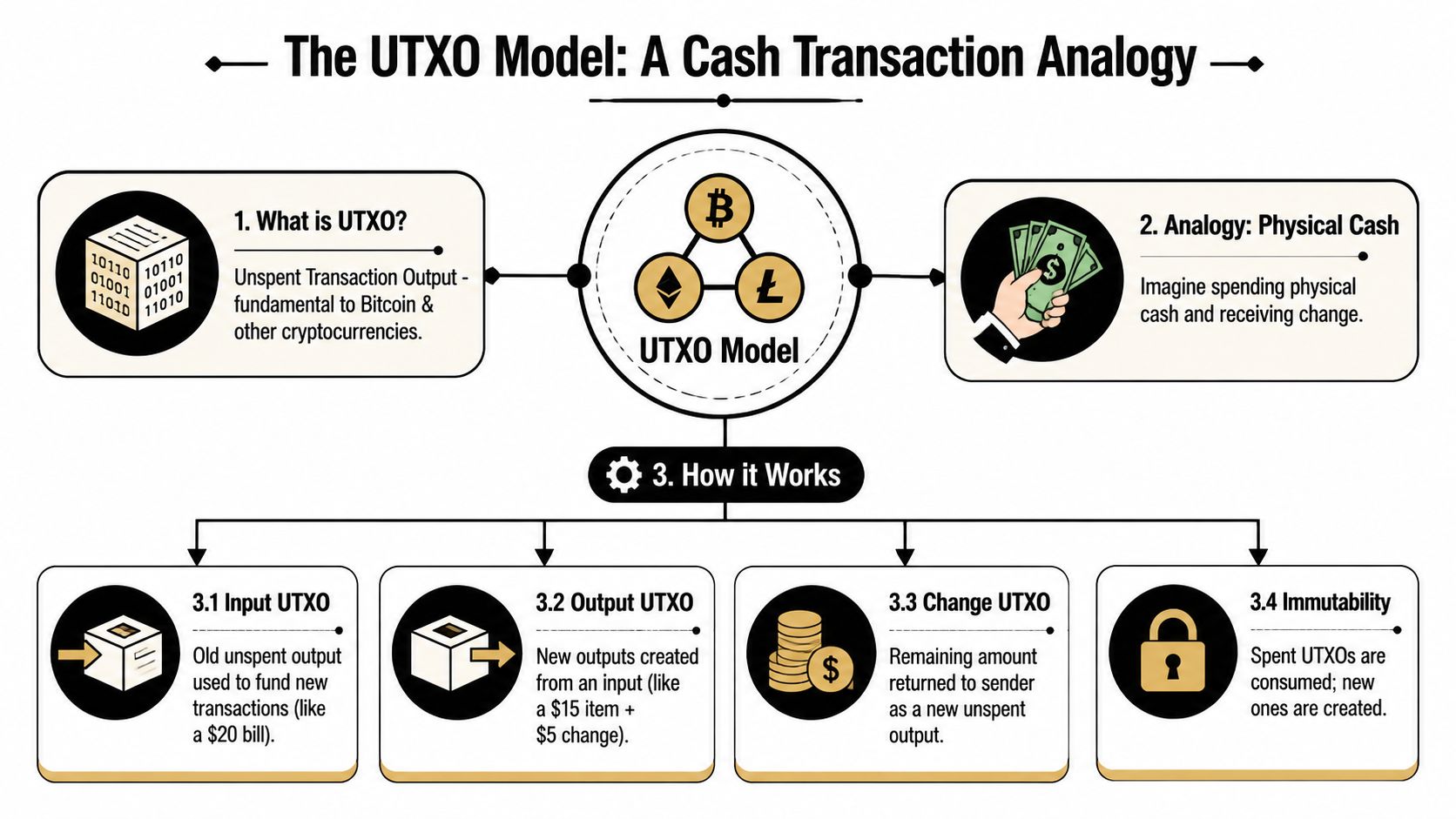
Discrete pieces of value
The cash analogy works because spending on a UTXO chain behaves like spending physical bills.
Say your wallet controls the digital equivalent of:
- a $20 bill
- a $10 bill
- a $5 bill
Your wallet shows $35. Under the hood, though, you do not have one $35 balance entry. You have three separate spendable outputs.
That detail matters. A UTXO is not an account balance that gets edited up or down after each transfer. It is a specific output from an earlier transaction. When you spend it, you consume that output in full. If the payment is smaller than the output you used, a new output is created for the recipient and another new output usually comes back to you as change, as explained in Learn Me A Bitcoin's overview of how Bitcoin UTXOs work.
Why traders and analysts should care
This structure changes how you read wallets on-chain.
A wallet with ten small UTXOs is different from a wallet with one large UTXO, even if both show the same total balance. The first wallet can be more expensive to move in a high-fee environment because the transaction may need to include many inputs. The second can be cleaner to spend, but it may reveal a clearer funding path when analysts trace where the coins came from.
That is why smart money tracking on UTXO chains goes beyond “wallet balance went up” or “wallet balance went down.” Analysts watch how outputs are grouped, how change is handled, and whether a wallet tends to merge coins, split them, or avoid combining them for privacy reasons.
Why the model exists
The design also makes validation simpler for the network. Nodes do not need to maintain a running bank-style ledger for each wallet. They check whether the specific outputs referenced in a transaction are still unspent.
Practical rule: On a UTXO chain, the wallet balance is a summary. The real objects that matter are the individual outputs.
If you've ever used a blockchain explorer guide for reading on-chain activity, this is the filter that makes Bitcoin-style transactions easier to read. What looks like clutter is usually useful information about coin selection, change handling, wallet behavior, and sometimes trader intent.
How UTXO Transactions Work Step by Step
A UTXO transaction is easier to read if you follow the coins as separate pieces, not as one wallet balance.
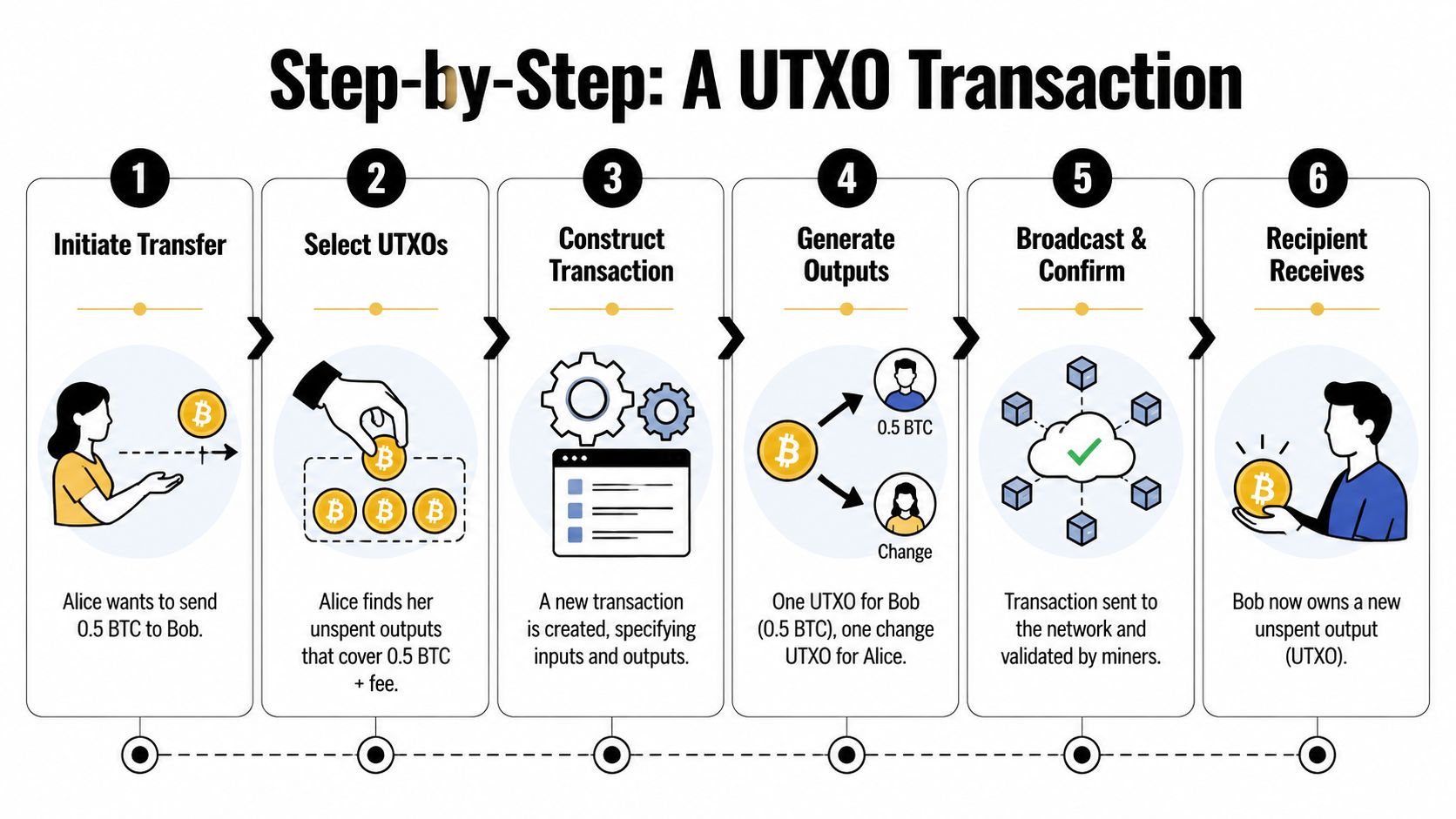
A simple payment flow
Start with a trader wallet that holds three UTXOs: 0.2 BTC, 0.3 BTC, and 0.8 BTC. The trader wants to send 0.5 BTC.
The wallet cannot shave a piece off one UTXO and leave the rest sitting in place. It has to choose one or more full outputs as inputs, spend them, and create new outputs from that spend.
A typical flow looks like this:
The wallet picks inputs
It selects the UTXOs needed to fund the payment. In this example, it might choose the 0.2 BTC and 0.3 BTC outputs together, or it might spend the 0.8 BTC output alone.Those selected inputs are fully consumed
Once an input is used in a transaction, that exact UTXO no longer exists as spendable value.New outputs are created
One output sends value to the recipient. If the inputs add up to more than the amount being sent, another output returns the remainder to the sender as change.The fee is left behind implicitly
On UTXO chains, the fee is usually the gap between total input value and total output value.The network checks the spend
Each input must point to a real, unspent output from an earlier transaction. If any referenced output was already spent, the transaction fails validation.
That structure explains why one payment can produce multiple outputs and why the "change" side of a transaction often matters more to analysts than the payment side.
Why change exists
Cash is the right analogy. If you buy something for $30 with a $50 bill, you do not split the bill into a $30 piece and keep the rest in your hand. You hand over the full bill and receive $20 back as change.
A UTXO works the same way.
If your wallet spends a 0.8 BTC UTXO to send 0.5 BTC, the transaction may create:
- 0.5 BTC to the recipient
- change back to your wallet
- a small remainder absorbed as the fee
That change is not the old coin with a lower balance. It is a new output with its own history, its own script, and its own role in future analysis.
Here's the compact version:
| Transaction part | What it means |
|---|---|
| Input | An older unspent output now being spent |
| Recipient output | A new output assigned to the payee |
| Change output | A new output returned to the sender |
| Fee | The difference between total input value and total output value |
Start tracking smart money today
Join thousands of traders using WalletFinder.ai to find profitable wallets and copy their trades.
Start Free Trial →

