
What Is TVL in DeFi? A Guide
Understand what is TVL (Total Value Locked) in DeFi. This guide explains how it works, why it matters, and how to use it for crypto analysis.
In decentralized finance (DeFi), if you want to quickly gauge a protocol's health and scale, there’s one number you look at first: Total Value Locked (TVL).
Think of it like checking a bank's total deposits. It’s a straightforward metric that tells you how much capital the community has collectively entrusted to a specific DeFi application. A higher TVL often signals greater user trust, deeper liquidity, and more activity.
Decoding TVL: A Core DeFi Metric
So, what exactly is TVL? At its heart, it’s the total dollar value of all the crypto assets currently locked within a DeFi protocol's smart contracts.
These assets aren't just sitting there gathering dust. They're being put to work—staked to secure a network, deposited into a lending protocol, or used to provide liquidity for a trading pool. When you see a protocol with a $1 billion TVL, it means users have parked that much capital on the platform, signaling they believe it's secure and offers a valuable service.
The Building Blocks of TVL
To really get what TVL means, you need to understand what counts toward that final number. It’s a mix of different assets, all valued in real-time.
The main ingredients include:
- Staked Assets: Tokens locked up by users to earn rewards or participate in network governance.
- Lent Assets: Funds deposited into lending protocols like Aave or Compound to earn interest from borrowers.
- Liquidity Pools: Pairs of tokens supplied to decentralized exchanges (DEXs) to enable smooth and efficient trading for other users.
Basically, if a crypto asset is committed to a protocol and can't be immediately withdrawn, it contributes to its TVL. This simple sum gives you a powerful snapshot of a platform’s financial footprint at any given moment.
Total Value Locked is more than just a number; it’s a measure of collective confidence. It reflects the willingness of thousands of users to commit their capital to a protocol, signaling its perceived utility and security in the market.
How TVL Is Calculated
The math behind TVL is actually pretty simple. You take the total amount of each token locked in a protocol, multiply it by its current market price, and then add it all together.
For example, imagine a lending platform holds 10,000 ETH (with ETH priced at $2,000) and $5 million in USDC stablecoins. The TVL would be (10,000 ETH * $2,000/ETH) + $5,000,000 USDC, which equals $25 million. You can learn more about how different assets contribute to TVL on CoinMarketCap.
To make it even clearer, here’s a quick breakdown of the core concepts.
TVL At a Glance
This table breaks down the essential components of Total Value Locked into simple terms.
ConceptSimple ExplanationExampleLocked AssetsAll crypto tokens (ETH, SOL, USDC) deposited by users.A user deposits 10 ETH into a lending protocol.Current Market PriceThe real-time USD value of each locked asset.The price of ETH is $3,500 at the time of deposit.Total ValueThe sum of the USD value of all locked assets.The protocol's total TVL is the sum of all deposits.
Understanding these three pieces is all you need to grasp how TVL works. It’s a dynamic figure that changes constantly with both new deposits and the fluctuating prices of the underlying assets.
How DeFi Protocols Calculate TVL
Okay, so you get the "what" of TVL. Now, let's pull back the curtain and see how this number actually gets calculated. At its heart, the math for a single DeFi protocol is pretty simple—think of it like tallying up the total value of a diverse stock portfolio.
First, you identify every single crypto asset locked up in the protocol's smart contracts. This could be anything from majors like ETH and SOL to stablecoins like USDC and DAI. You take the total amount of each asset and multiply it by its current market price.
Add all those individual dollar values together, and voilà—you get the protocol's Total Value Locked. It’s a real-time snapshot of all the capital users have trusted it with.
A Step-by-Step Calculation Example
Let's make this real. Imagine a decentralized lending protocol where users have deposited three different assets.
Here’s how the TVL math would break down:
- Count Up the Assets:
- 5,000 ETH is locked for lending.
- 10,000,000 USDC is sitting as collateral.
- 50,000 LINK has been supplied to a crypto liquidity pool.
- Grab the Current Prices:
- ETH is trading at $3,500.
- USDC holds its peg at $1.00.
- LINK is priced at $18.
- Do the Math and Sum It Up:
- ETH Value: 5,000 ETH * $3,500 = $17,500,000
- USDC Value: 10,000,000 USDC * $1.00 = $10,000,000
- LINK Value: 50,000 LINK * $18 = $900,000
- Total TVL = $28,400,000
- Growing User Trust: More people are depositing their hard-earned assets, which signals that they see the protocol as secure and dependable. This kind of organic growth is the healthiest you can get.
- Attractive Yields: The protocol might be offering juicy returns on staking, lending, or liquidity pools, pulling in capital from yield farmers hunting for the best profits.
- New Feature Launches: Dropping a popular new product, like an innovative liquidity pool or a unique borrowing mechanic, can trigger a fresh wave of deposits.
- Positive Market Sentiment: During a bull run, the price of crypto assets goes up. This naturally inflates the dollar value of the tokens locked in a protocol, boosting its TVL without a single new deposit.
- Security Concerns: Rumors or news of a hack, an exploit, or a potential vulnerability will cause a mass exodus as users rush to pull their funds to safety.
- Decreasing Yields: When juicy incentive programs end or returns start to shrink, yield farmers pack up their capital and move on to the next protocol offering better rewards.
- Wider Market Downturn: In a bear market, asset prices fall across the board. This lowers the overall TVL even if the number of users and deposited tokens stays the same.
- Competitor Success: A rival project—new or old—might launch a more compelling feature that siphons liquidity away from the established protocol.
- You deposit 10 ETH into a liquid staking protocol like Lido. This 10 ETH now counts toward Lido's TVL.
- You receive stETH (staked ETH) in return.
- You then deposit that stETH as collateral in a lending protocol like Aave.
- The value of that stETH just got counted again in Aave’s TVL.
- Token Creation: A new, unknown protocol launches its own token.
- Liquidity Provision: The developers use their own funds to create a liquidity pool for this token on a DEX, which sets an initial price.
- Inflation: They then lock up a massive supply of their own token within their protocol. Since TVL is calculated by multiplying the token count by its price, the number skyrockets.
- Profitability: A protocol can have billions in TVL but generate almost no real revenue for its treasury or token holders.
- Security: A high TVL just makes a protocol a juicier target for hackers. It's not a badge of honor guaranteeing audited, battle-tested smart contracts.
- User Activity: It can't tell the difference between a few whales depositing huge sums and a vibrant community of thousands of genuinely active users.
- Head to an Aggregator like DeFiLlama: Open up the main dashboard to get that 30,000-foot view of the entire DeFi space.
- Filter by Chain: Zero in on the ecosystem you’re interested in—whether that's Ethereum, Solana, Base, or something else entirely.
- Sort by TVL Change: Look for protocols showing solid TVL growth over the last 7-day and 30-day periods. This immediately filters out the short-term noise and helps you focus on projects with real momentum.
- Dig Into the Chart: Once a protocol catches your eye, click on it and study its historical TVL chart. Is the growth steady and consistent, or was it just one massive deposit? Smooth, steady inflows are the signal you’re looking for.
- A ratio below 1.0: This could be a flashing sign that the project is undervalued. Its market cap is smaller than the capital it secures, suggesting there might be serious room for growth if the market wakes up and reprices it.
- A ratio above 1.0: This might mean the project is overvalued, or that the market has incredibly high expectations for its future growth. The token's valuation is running ahead of the actual capital locked in its ecosystem.
- Pick Your Platform: Head over to a trusted site like DeFiLlama. It’s the go-to for tracking TVL across nearly every chain and protocol imaginable.
- Find the Project: Just type the protocol's name into the search bar.
- Dig into the Data: You’ll get a dashboard showing its current TVL, historical charts, and where it stacks up against others in its ecosystem.
That simple arithmetic is exactly how every protocol’s TVL gets figured out.
The Role of Price Oracles and Aggregators
This whole calculation hinges on one thing: accurate, live price data. DeFi protocols can't just guess the price of ETH; they rely on services called price oracles. Think of platforms like Chainlink or Pyth as the data feeds that pipe reliable market prices directly into smart contracts.
Without trustworthy price oracles, TVL calculations would be a mess—inaccurate and easy to manipulate. These services are the unsung heroes making sure the data we use to judge a protocol's health is actually correct.
Now, while each protocol can calculate its own TVL, most of us get our data from massive aggregators. Platforms like DeFiLlama are constantly running these calculations for thousands of protocols across dozens of blockchains, giving us a bird's-eye view of the entire ecosystem.
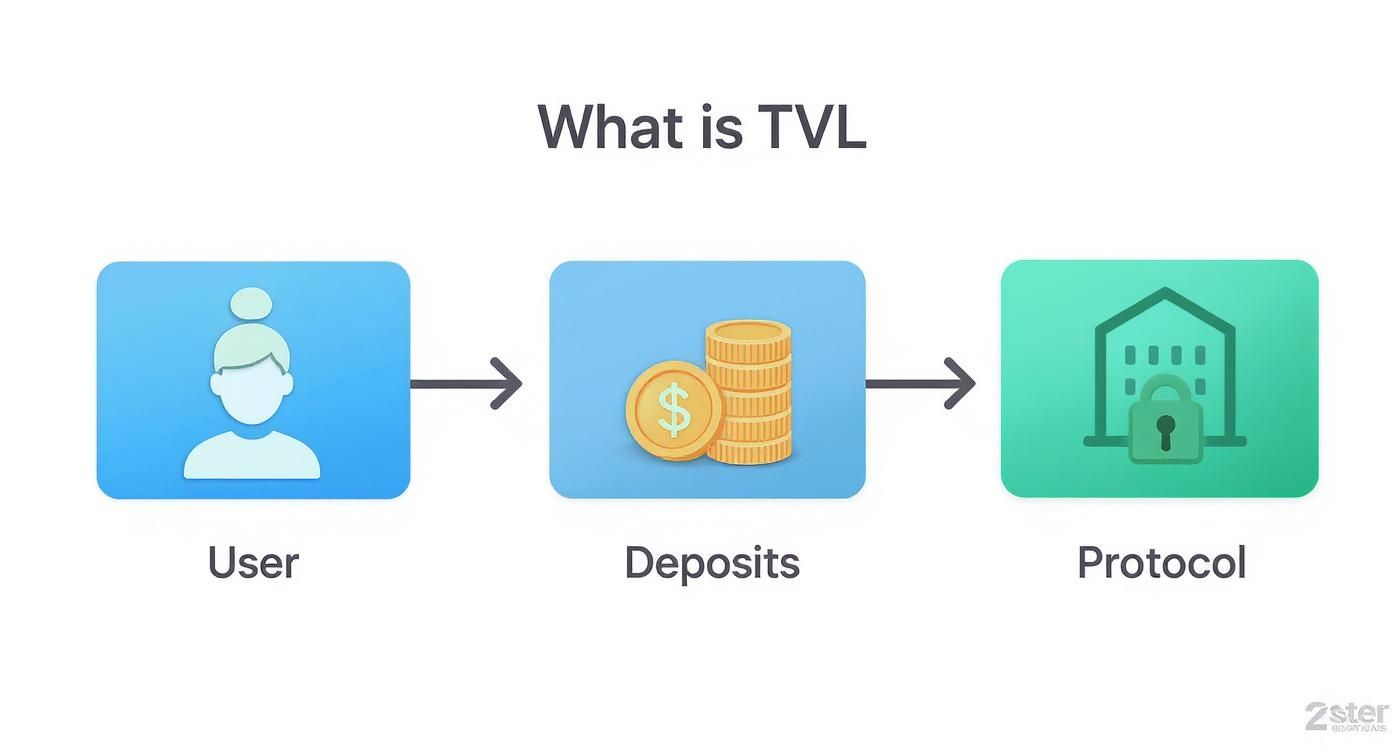
The flow is simple: users deposit assets, and those assets immediately contribute to the protocol's TVL.
Start tracking smart money today
Join thousands of traders using WalletFinder.ai to find profitable wallets and copy their trades.
Start Free Trial →

