
Discover Everything About What Is Initial Dex Offering
Learn what is initial dex offering, how IDOs work, & compare to ICOs in our 2026 guide covering risks, due diligence & finding top IDOs.
You're probably looking at a token launch calendar, a launchpad announcement, or a Discord thread and asking the fundamental question behind all the hype: is this an edge, or just another crowded sale where early buyers dump on each other?
That's the right question.
Most explainers answer “what is an initial DEX offering” at the glossary level and stop there. Traders need more than that. You need to know how the launch works, where the risk sits, what usually breaks after listing, and how to tell the difference between a clean setup and a bad one. In practice, an IDO is only interesting if the structure gives you a workable entry, enough liquidity to trade, and tokenomics that don't punish you the moment the pool opens.
What Is an Initial DEX Offering (IDO)
An Initial DEX Offering, or IDO, is a token launch where a blockchain project makes its first public debut on a decentralized exchange, using liquidity pools and smart contracts so buyers can trade as soon as the sale goes live. That's why IDOs are often framed as a more community-driven alternative to older fundraising models like ICOs and IEOs, as described in CoinMarketCap's Initial DEX Offering glossary.
If you're searching for early-stage crypto opportunities, this is one of the main routes you'll run into. A project doesn't wait for a centralized exchange listing. It launches directly into on-chain trading.
That changes the experience for both sides. The project gets a public sale and immediate market access. Buyers don't have to wait for some later listing event to see a tradable market. If you need a quick refresher on the venue itself, this breakdown of what a DEX does is useful context.
Why traders care about IDOs
An IDO matters because it compresses fundraising and market launch into the same event. You're not only buying a token. You're stepping into the first live market for that token.
That creates opportunity, but it also creates stress:
- Price discovery happens fast: The market starts forming almost immediately.
- Positioning gets exposed early: Team allocations, community demand, and seller pressure show up quickly.
- Execution matters more than narrative: A good story won't save a weak launch.
Practical rule: Don't evaluate an IDO like a private investment memo. Evaluate it like a fresh market with fragile liquidity and emotional order flow.
What makes an IDO different in practice
The term sounds technical, but the core idea is simple. A project launches on a DEX, users commit funds, smart contracts handle distribution, and trading opens once liquidity is added.
The important part isn't just the definition. It's the implication. An IDO is not “early access” in the abstract. It's a public token sale with a live market attached to it. That's why some IDOs become strong opportunities and others become traps within hours.
How IDO Mechanics Work Step by Step
An IDO is easiest to understand if you think of it as a self-running sale and listing process. The project sets the rules in code. Users bring funds. The contract handles distribution. The liquidity pool becomes the first market.
Ledger describes an IDO as a fundraising method where a crypto project sells newly issued tokens directly on a DEX, typically via smart contracts and liquidity pools rather than a centralized intermediary, with the sale and first listing happening on-chain and enabling immediate trading liquidity once the pool is live in its IDO glossary entry.
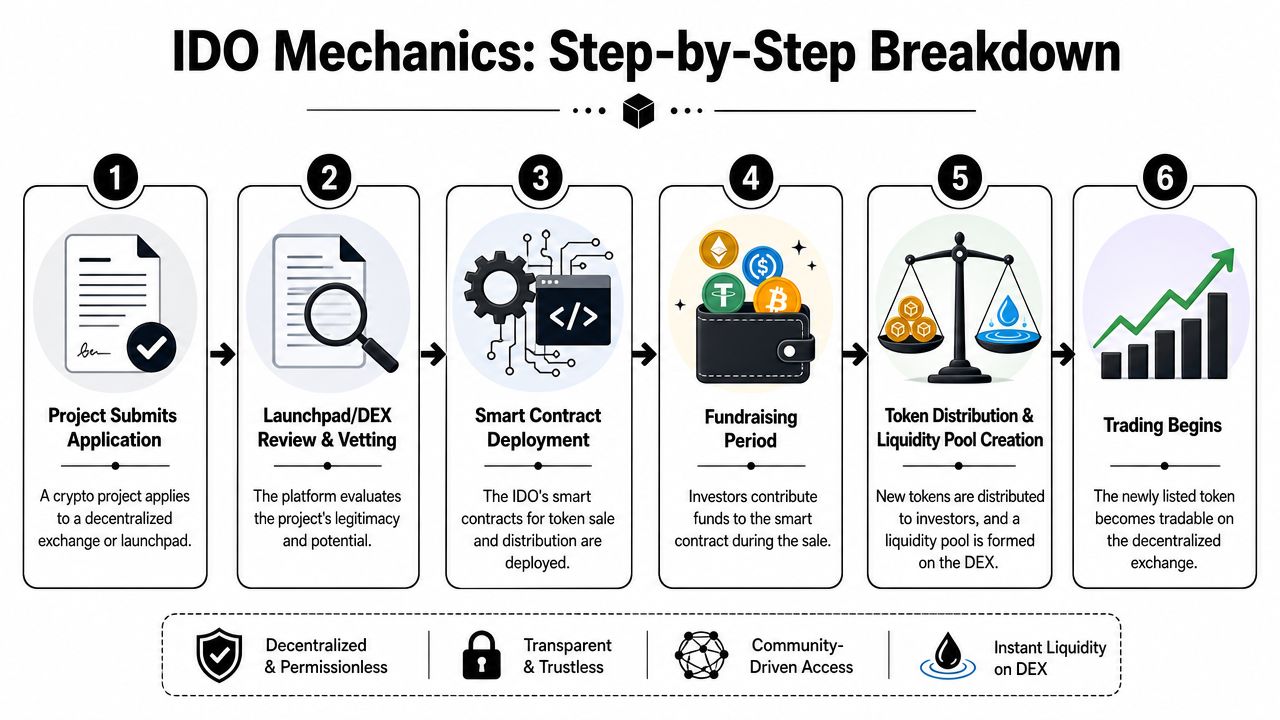
The flow from setup to trading
Here's the practical sequence most traders deal with:
A project chooses a launch venue
Sometimes that's a launchpad with an approval process. Sometimes it's a direct DEX listing path.Sale contracts get deployed
These contracts define who can participate, how funds are accepted, and how tokens are distributed.Participants commit funds
Buyers connect a wallet and send the accepted asset during the sale window.Tokens are allocated
The contract either distributes tokens automatically or makes them claimable.Liquidity gets added
The team pairs the new token with a base asset in a pool so trading can begin.The market opens
At that point, the token has a live venue for buying and selling.
Why token pairing matters
The opening market doesn't appear out of nowhere. It needs a pair. In practice, that means the project's token is matched with a base asset that traders already use. That pairing creates the first executable market.
It operates as an automated booth instead of an order-book listing. The contract doesn't need a centralized operator to match people manually. It handles the swap logic itself.
The part most beginners miss
What works cleanly on paper can still go badly in live trading. The sale might be orderly, but the first hour can still be chaotic if demand is one-sided or the pool is shallow.
That's why experienced traders don't stop at “how do I join?” They ask:
- How is allocation handled?
- When does claiming start?
- When exactly is liquidity added?
- Is the first market likely to be deep enough to trade without ugly slippage?
The smartest way to read an IDO isn't as a launch event. Read it as the creation of a brand-new market with almost no trading history.
IDO vs ICO vs IEO A Clear Comparison
IDOs didn't appear in a vacuum. They grew out of dissatisfaction with earlier fundraising models. CoinGecko notes in its guide to IDOs that IDOs emerged as the market shifted away from ICOs and IEOs.
That history matters because each format changes who controls access, who handles distribution, and how quickly a token reaches a tradable market.
IDO vs ICO vs IEO key differences
| Characteristic | Initial Coin Offering (ICO) | Initial Exchange Offering (IEO) | Initial DEX Offering (IDO) |
|---|---|---|---|
| Where the sale happens | Usually through the project itself | Through a centralized exchange | On a decentralized exchange or DEX-linked launchpad |
| Intermediary | Minimal or none beyond the project team | Centralized exchange acts as gatekeeper | Smart contracts and on-chain infrastructure handle the process |
| Access style | Depends on project rules | Depends on exchange account access and platform rules | Usually wallet-based participation |
| Token listing path | May come later and separately | Often tied to the exchange hosting the sale | Launch and first public market happen in the same on-chain flow |
| Custody model | Users often rely on project process | Users rely on exchange process | Users interact through their own wallets |
| Core trade-off | Open but often trust-heavy | More structured but more centralized | Faster, on-chain, but highly sensitive to launch quality |
Start tracking smart money today
Join thousands of traders using WalletFinder.ai to find profitable wallets and copy their trades.
Start Free Trial →

